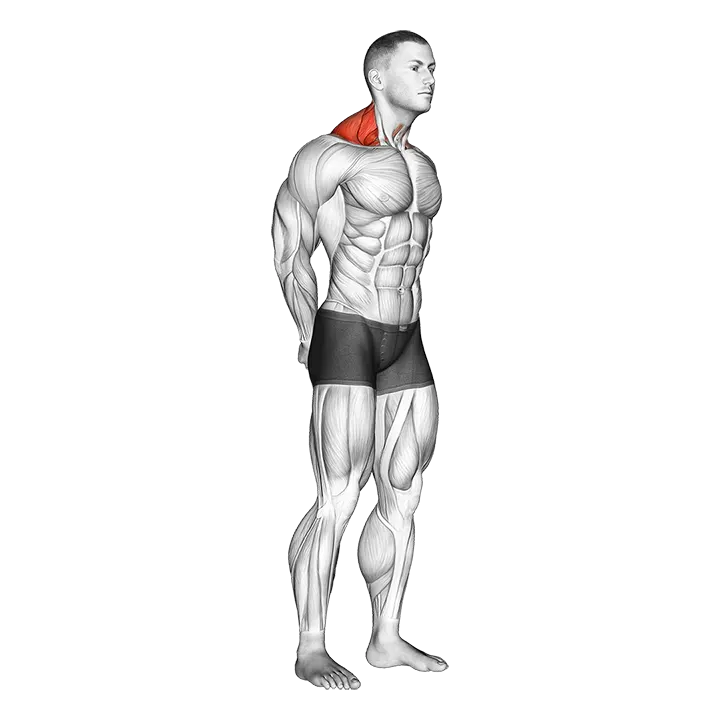
Neck Protraction Stretch
- Target muscle
- —
- Equipment
- Body weight
- Body part
- Neck
- Type
- Stretching
The neck protraction stretch is a mobility exercise that targets the suboccipital muscles and deep cervical extensors at the back of the neck — tissues that commonly tighten with prolonged forward-head posture. By deliberately protracting and then retracting the head, you increase awareness of neck alignment and relieve tension built up from sitting at a desk or looking down at a screen.
How to do the Neck Protraction Stretch
- 1Sit upright in a chair or stand with your feet hip-width apart, keeping your spine long and your shoulders relaxed.
- 2Look straight ahead so your ears are roughly stacked over your shoulders as your starting position.
- 3Slowly slide your head forward — as if pushing your chin toward an imaginary wall in front of you — without tilting your chin up or down. Your head should translate forward, not tilt.
- 4Hold the protracted position for 2–3 seconds and notice the gentle stretch along the back of your neck.
- 5Reverse the movement by drawing your head straight back and tucking your chin slightly until your ears are again stacked over your shoulders — you should feel the stretch shift up to the base of your skull. This is the retraction phase.
- 6Hold the retracted position for 2–3 seconds, then return to neutral.
- 7Repeat the forward-and-back cycle for the prescribed number of repetitions, moving slowly and deliberately throughout.
Form tips
- Keep your chin level throughout — the motion should be a horizontal glide, not a nod or a tilt.
- Breathe steadily; exhale as you protract and inhale as you retract.
- Move only as far as you can without pain. A gentle pull at the back of the neck is normal; sharp or radiating pain is not.
- Perform this stretch in front of a mirror at first so you can confirm your head is translating straight forward rather than drifting to one side.
Common mistakes
- Tilting the chin up while protracting, which compresses the back of the neck instead of stretching it.
- Moving too quickly through the range of motion, which reduces the stretch stimulus and can cause strain.
- Raising or rounding the shoulders during the movement, which shifts tension away from the neck and can cause unnecessary discomfort.
- Holding your breath, which increases muscle tension and reduces the effectiveness of the stretch.
- Protracting so far that you feel pinching or sharp pain at the base of the skull — stay within a comfortable, pain-free range.
Frequently asked questions
What muscles does the neck protraction stretch target?
It primarily stretches the suboccipital muscles and deep cervical extensors at the back of the neck — small muscles that run between the base of the skull and the upper cervical vertebrae and are among the first to tighten with forward-head posture.
How often should I do the neck protraction stretch?
For desk workers or anyone with persistent neck tension, performing 2–3 sets of 10 repetitions once or twice a day is a reasonable starting point. Listen to your body and reduce frequency if soreness develops.
Is neck protraction the same as a chin tuck?
They are related but not identical. A chin tuck focuses on retraction — pulling the head straight back. The neck protraction stretch adds a deliberate forward glide (protraction) before retracting, making the full range of motion part of the exercise.
Can this stretch help with forward-head posture?
It can help by improving awareness of neutral head position and mobilising tight tissues at the back of the neck. For lasting posture improvement, pair it with strengthening exercises for the deep neck flexors and upper back.
Should I feel discomfort during the neck protraction stretch?
A mild stretching sensation at the base of the skull or along the back of the neck is normal. Stop if you feel sharp, shooting, or radiating pain, and consult a healthcare professional before continuing.







