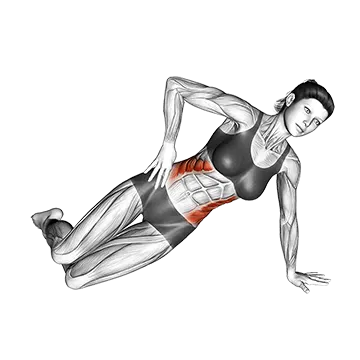
Oblique Crunches Floor
- Target muscle
- Obliques
- Synergist muscles
- Rectus Abdominis
- Equipment
- Body weight
- Body part
- Waist
- Type
- Strength
Oblique Crunches Floor is a bodyweight core exercise that targets the obliques, with the rectus abdominis acting as a synergist. Performed lying on the floor with the knees tilted to one side, it isolates the lateral muscles of the waist through a short, controlled crunch. It is a practical choice for building rotational and side-bending core strength without any equipment.
How to do the Oblique Crunches Floor
- 1Lie on your back on the floor with your knees bent and your feet flat on the ground, hip-width apart.
- 2Let both knees fall to one side — for example, to the left — keeping your upper back and shoulders flat against the floor.
- 3Place your fingertips lightly behind your head, elbows wide, without interlacing your fingers or gripping your neck.
- 4Brace your core, then exhale as you curl your upper body upward and diagonally toward your lowered knees, contracting the obliques on the working side.
- 5Pause briefly at the top of the movement and squeeze the obliques before beginning the descent.
- 6Inhale as you lower your upper body back to the floor with control, maintaining tension in the core.
- 7Complete all reps on that side, then reposition your knees to the other side and repeat for an equal number of reps.
Form tips
- Lead the movement with your shoulder rather than your elbow — this directs the effort into the obliques and keeps stress off your neck.
- Keep your hips and knees fixed in the tilted position for the whole set — the torso does all the moving, so the obliques stay under tension instead of the legs unwinding to help.
- Focus on a short, deliberate range of motion; lifting your shoulder blades a few inches with a strong muscular contraction is more effective than swinging high.
- Exhale forcefully on the way up to help brace the core and intensify the oblique contraction.
Common mistakes
- Pulling on the neck with the hands, which shifts strain to the cervical spine and reduces oblique activation.
- Using momentum to swing the torso up instead of contracting the obliques, which decreases muscle engagement and increases the risk of strain.
- Crunching straight up toward the ceiling rather than diagonally toward the knees, which trains the rectus abdominis instead of the target obliques.
- Allowing the hips or lower back to rotate off the floor, which reduces lateral isolation and can cause lumbar discomfort.
- Holding the breath, which increases intra-abdominal pressure unnecessarily and reduces stability — exhale on the effort.
Frequently asked questions
What muscles do oblique crunches floor work?
The primary target is the obliques (internal and external). The rectus abdominis assists as a synergist throughout the movement.
How is this different from a standard crunch?
In oblique crunches floor, your knees are tilted to one side and you curl your torso diagonally toward them, directing the effort to the lateral muscles of the waist rather than the front of the abdomen.
Should I feel any strain in my neck?
No. If you feel strain in your neck, rest your fingertips lightly behind your head without pulling and focus on initiating the movement from your shoulder, not your elbow or head.
How many reps should I perform per side?
Because no external load is added, most people work in the range of 12–20 reps per side. Complete all reps on one side before switching to keep the obliques under consistent tension.