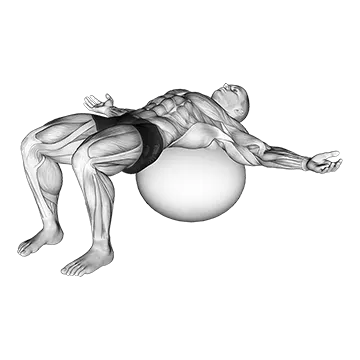
Plank Alternating Hit the Ball
- Target muscle
- —
- Equipment
- Stability ball
- Body part
- Waist
- Type
- Strength
The Plank Alternating Hit the Ball is a core stability exercise that challenges your waist, abs, and obliques by requiring you to maintain a plank position on a stability ball while alternately tapping each hand off the ball. The unstable surface demands constant anti-rotation control, making it effective for building core endurance and balance.
How to do the Plank Alternating Hit the Ball
- 1Place a stability ball on the floor and kneel behind it.
- 2Walk your hands onto the ball so your forearms or palms rest on top, and extend your legs behind you into a full plank position.
- 3Brace your core, squeeze your glutes, and align your body in a straight line from head to heels.
- 4Keeping your hips level, lift your right hand off the ball and tap the side of the ball firmly.
- 5Return your right hand to the top of the ball and immediately lift your left hand to tap the opposite side.
- 6Continue alternating sides in a controlled rhythm, resisting any rotation or sagging of the hips with each tap.
- 7Breathe steadily throughout — exhale as you tap, inhale as you return.
- 8Complete your target number of reps per side, then step your feet in and return to a kneeling position to finish.
Form tips
- Press the ball firmly into the floor with your supporting hand to minimize wobble before each tap.
- Keep your gaze down toward the ball — looking forward causes your neck to crane and disrupts your plank alignment.
- Think of your torso as a rigid plank; any twist or hip drop means your core has disengaged.
- Start with slow, deliberate taps before increasing your pace — speed should only come after you can hold a stable position.
- Position your feet slightly wider than hip-width apart to give yourself a more stable base while you learn the movement.
Common mistakes
- Letting the hips rotate side to side: rotating your hips reduces core demand and places stress on your lower back — keep them square to the floor throughout.
- Sagging the lower back: a collapsed lumbar spine compresses the discs and shifts work away from the abs — re-brace your core and tuck your pelvis slightly.
- Rushing the taps: moving too fast sacrifices stability and turns the exercise into momentum-driven movement rather than controlled core work.
- Placing hands too far apart on the ball: a wide hand position changes the leverage and makes it harder to control the ball — keep your hands close to the center.
- Holding your breath: breath-holding spikes intra-abdominal pressure unnecessarily — maintain a steady breathing rhythm to sustain endurance sets.
Frequently asked questions
What muscles does the Plank Alternating Hit the Ball work?
The exercise primarily works the muscles of the waist and core — the rectus abdominis, transverse abdominis, and obliques. Because the stability ball creates an unstable surface, your deep stabilizers and anti-rotation muscles have to work continuously to keep your body in a straight line.
Is this exercise suitable for beginners?
It is moderately challenging for beginners because it combines plank endurance with balance on an unstable surface. If you are new to planks, build comfort holding a standard forearm plank on the floor for 30–60 seconds before progressing to the stability ball version.
How many sets and reps should I do?
A good starting point is 2–3 sets of 8–12 taps per side (16–24 total taps per set), resting 45–60 seconds between sets. As your stability improves, increase the reps or slow down the tempo rather than adding weight.
Can I do this exercise if I don't have a stability ball?
Without a stability ball you can perform a standard plank with alternating hand taps on the floor, which removes the balance challenge but still trains the same core muscles. A BOSU ball or folded mat can also add mild instability as an intermediate option.
How does this exercise differ from a regular plank?
A regular plank is a static hold. The Plank Alternating Hit the Ball adds dynamic movement — lifting and tapping one hand at a time — on an unstable surface. This forces your obliques and deep core muscles to resist rotation and shifting, increasing the anti-stability demand beyond a standard plank.