Plank Arm Lifts
- Target muscle
- Rectus Abdominis
- Synergist muscles
- Latissimus Dorsi
- Equipment
- Body weight
- Body part
- Back
- Type
- Strength

Plank arm lifts are a bodyweight core exercise performed in a high plank position where you alternately raise one arm off the floor while keeping the torso rigid and level. The movement targets the rectus abdominis and challenges the lats to stabilize the shoulder of the supporting arm. It is well suited for building anti-rotation core strength and shoulder stability without any equipment.
How to do the Plank Arm Lifts
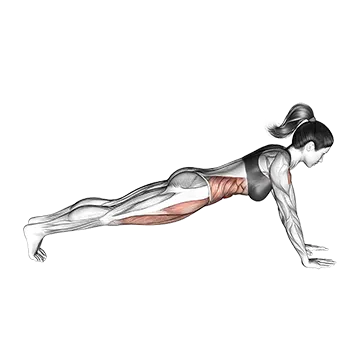
- 1Get into a high plank with your hands directly under your shoulders and your feet hip-width apart.
- 2Brace your core, squeeze your glutes, and make your body form a straight line from head to heels.
- 3Shift your weight slightly onto your right hand without letting your hips rotate or drop.
- 4Lift your left arm off the floor, extending it straight in front of you at shoulder height.
- 5Hold for one to two seconds while keeping your hips square to the floor and your spine neutral.
- 6Lower your left hand back to the starting position with control.
- 7Repeat the lift on the right arm, again resisting any rotation through the hips or shoulders.
- 8Continue alternating arms for your target number of reps per side.
Form tips
- Set your feet wider than hip-width when you first learn the movement — the wider base of support makes it easier to resist rotation while you build stability.
- Think about keeping both hip bones pointing straight down at the floor throughout every lift; the moment one rises, reduce your range or slow down.
- Exhale as you raise your arm and inhale as you return it — steady breathing prevents you from holding your breath and losing core tension.
- Keep the lifting arm in line with your torso rather than swinging it to the side, which places unnecessary stress on the shoulder.
- Move slowly — a controlled two-second raise and two-second lower is more effective than a fast tap that lets momentum do the work.
Common mistakes
- Rotating the hips to the side of the lifting arm, which defeats the anti-rotation purpose of the exercise and reduces the demand on the core.
- Sagging the hips toward the floor, which lets the abs lengthen and dumps the load into an extended lower back instead of training spinal stability.
- Piking the hips upward during the lift, which offloads the core and shifts the movement into the shoulders rather than keeping it a full-body plank drill.
- Placing the feet too close together, which makes the base of support so narrow that the body has to rock to compensate rather than staying level.
- Rushing through reps, which reduces time under tension for the abs and lats and increases the chance of losing neutral spine position.
Frequently asked questions
What muscles do plank arm lifts work?
Plank arm lifts primarily work the abs — especially the rectus abdominis — which must brace hard to prevent the spine from sagging or rotating. The lats of the supporting arm work to keep the shoulder stable and the torso level throughout each lift.
How are plank arm lifts different from plank shoulder taps?
The two names are often used interchangeably. In some variations the lifted arm reaches forward (more of a reach or arm lift), while shoulder taps involve touching the opposite shoulder with the raised hand. Both challenge the same core anti-rotation pattern.
How many reps should I do for plank arm lifts?
Six to twelve reps per side per set is a common starting range. Prioritize holding neutral alignment on every rep over hitting a high number — fewer clean reps are more effective than many sloppy ones.
Can beginners do plank arm lifts?
Yes. Start with a wider foot stance to increase stability, and pause briefly at the bottom between reps until you can control the movement. Once you can complete a set without your hips rotating, narrow the stance and increase reps gradually.
Should I do plank arm lifts on my wrists or on my fists?
Either works. If your wrists are uncomfortable in the flat-hand position, performing the exercise on your fists keeps the wrist in a neutral position and reduces the load on the joint while delivering the same core training stimulus.