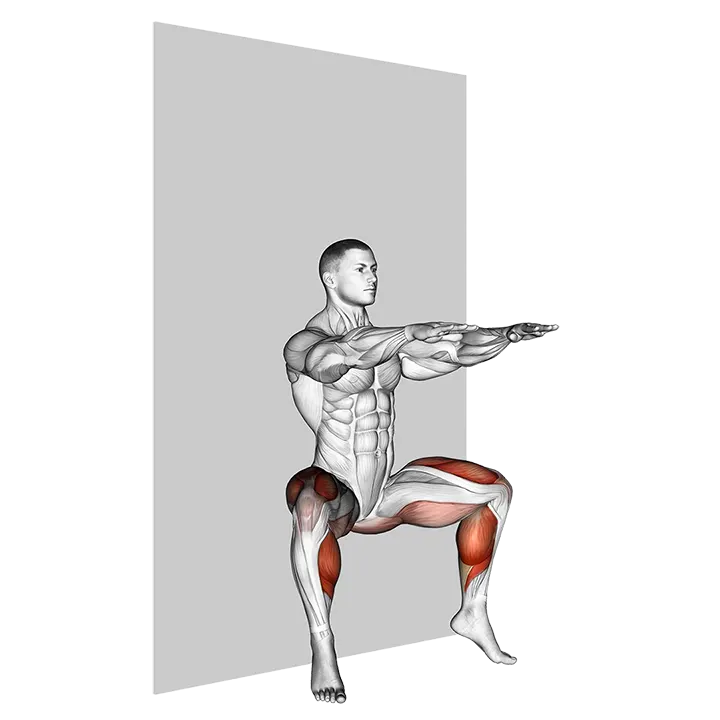
Plyo Sit Squat (wall)
- Target muscle
- Gastrocnemius, Quadriceps, Soleus
- Synergist muscles
- Adductor Magnus
- Equipment
- Body weight
- Body part
- Thighs
- Type
- Strength
The Plyo Sit Squat (wall) is an explosive bodyweight exercise that targets the quadriceps, gastrocnemius, and soleus, with the adductor magnus assisting as a synergist. Performed against a wall for support, it combines the isometric wall-sit position with an upward plyometric jump to build lower-body power and endurance. It is well suited for athletes seeking to develop leg strength and reactive force without any equipment.
How to do the Plyo Sit Squat (wall)
- 1Stand with your back flat against a wall and your feet shoulder-width apart, positioned about 60–70 cm from the wall.
- 2Slide your back down the wall until your hips and knees are both at roughly 90 degrees, entering a wall-sit position.
- 3Keep your chest up, core braced, and both feet fully planted on the floor.
- 4Hold the bottom position for 1–2 seconds to establish stability.
- 5Drive explosively through your heels and the balls of your feet, pushing off the ground to jump straight up.
- 6Extend your knees and ankles fully at the peak of the jump, letting your back slide up the wall rather than pushing your hips away from it.
- 7Land softly with slightly bent knees and immediately slide back down the wall into the squat position.
- 8Repeat for the prescribed number of repetitions without losing contact with the wall between reps.
Form tips
- Keep your back in full contact with the wall throughout the sit phase to ensure proper squat depth and spinal alignment.
- Drive through the entire foot — not just the toes — on each jump to maximize engagement of the quadriceps and gastrocnemius.
- Land forefoot-first and roll back onto the heels so the landing is spread across the whole foot before you reset into the wall-sit.
- Brace your core before each jump; a stable trunk transfers power more efficiently from your lower body.
- Control your descent back into the wall-sit rather than dropping into it to keep tension on the working muscles.
Common mistakes
- Letting the knees cave inward during the jump or landing — this places harmful stress on the knee joint and reduces power output; actively push the knees out in line with the toes.
- Allowing the heels to rise off the floor in the wall-sit — a forefoot-only base is unstable and leaves you no room to load the ankles, so the push-off loses both leverage and power.
- Rushing through the sit phase without achieving 90-degree knee flexion — a shallow squat limits quadriceps recruitment and defeats the purpose of the exercise.
- Landing stiff-legged — absorbing impact with locked knees transmits excessive force through the joints; always land with a slight bend.
- Pushing away from the wall mid-rep — the wall provides alignment cues; drifting forward changes the movement pattern and reduces the exercise's effectiveness.
Frequently asked questions
What muscles does the Plyo Sit Squat (wall) work?
The primary muscles worked are the quadriceps, gastrocnemius, and soleus. The adductor magnus acts as a synergist, helping to extend the hip during the explosive push-off phase.
How is the Plyo Sit Squat (wall) different from a regular wall sit?
A standard wall sit is a static isometric hold, while the Plyo Sit Squat (wall) adds an explosive jump at the top of each rep. This plyometric element trains reactive strength and power in addition to muscular endurance.
Is the Plyo Sit Squat (wall) suitable for beginners?
It is best suited for intermediate to advanced trainees who already have solid squat mechanics and basic leg strength. Beginners should first master the static wall sit and bodyweight squat before adding the plyometric component.
How many sets and reps should I do for the Plyo Sit Squat (wall)?
For power development, 3–4 sets of 6–10 explosive reps with full recovery between sets works well. For muscular endurance, you can increase reps to 12–15 with shorter rest periods.
Do I need any equipment for the Plyo Sit Squat (wall)?
No equipment is needed — only a flat, sturdy wall and enough clear floor space to jump and land safely. Wearing athletic shoes with good grip is recommended to prevent slipping on takeoff and landing.







