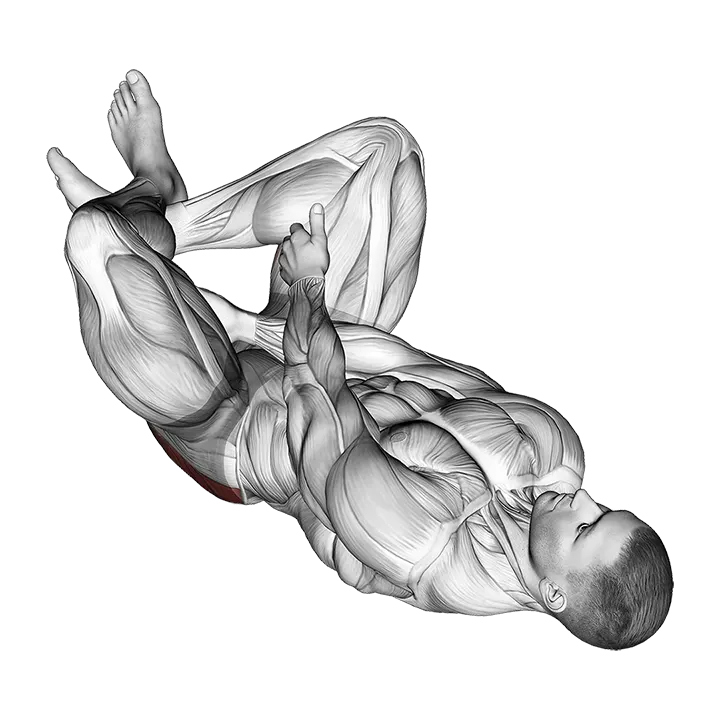
Reclining Lower Trunk Extensor Stretch
- Target muscle
- —
- Equipment
- Body weight
- Body part
- Hips
- Type
- Stretching
The Reclining Lower Trunk Extensor Stretch is a supine mobility exercise that targets the lower back extensors (erector spinae) and glutes. Performed lying on your back, it uses gravity and body weight to gently decompress the lumbar spine and release tension in the hips. It is well suited for post-workout recovery, morning mobility routines, or relieving stiffness from prolonged sitting.
How to do the Reclining Lower Trunk Extensor Stretch
- 1Lie flat on your back on a mat with your legs extended and arms resting at your sides.
- 2Draw both knees toward your chest by bending at the hips and knees.
- 3Wrap your hands around your shins, just below the knees, and interlace your fingers.
- 4Gently pull your knees closer to your chest until you feel a mild stretch across your lower back and hips.
- 5Keep your head and shoulders relaxed against the mat — do not lift them.
- 6Hold the position for 20–40 seconds while breathing slowly and deeply.
- 7On each exhale, allow your lower back to soften further into the mat.
- 8Release your legs back to the starting position in a controlled manner.
Form tips
- Keep your neck long and your shoulders pressed lightly into the mat throughout the hold.
- Breathe into your lower back — visualise expanding the space between vertebrae on each inhale.
- Adjust the intensity by pulling your knees closer for a deeper stretch or easing them away to reduce it.
- If one side feels tighter, hold each leg individually after the bilateral hold to address the asymmetry.
- Place a folded towel under your head if you feel any strain in the neck or upper back.
Common mistakes
- Lifting the head and neck off the mat: this creates unnecessary cervical tension and shifts the stretch away from the lower back.
- Pulling the knees too forcefully: jerking or yanking the legs can strain the lumbar joints and sacroiliac region rather than producing a controlled release.
- Holding the breath: breath-holding increases core tension and prevents the lower back muscles from fully relaxing into the stretch.
- Rounding the shoulders forward: allowing the upper back to curl off the mat reduces the decompressive benefit and places stress on the thoracic spine.
- Ending the stretch too quickly: releasing the legs abruptly rather than lowering them slowly can cause the lower back muscles to contract sharply.
Frequently asked questions
How long should I hold the Reclining Lower Trunk Extensor Stretch?
Hold the position for 20–40 seconds per repetition and perform 2–3 sets. Longer holds of up to 60 seconds can be used for greater tissue relaxation once you are comfortable with the movement.
Can I do this stretch if I have lower back pain?
This stretch is generally considered gentle and is often recommended for mild lower back tightness. However, if you have a diagnosed disc injury, sciatica, or acute pain, consult a healthcare professional before attempting it, as spinal flexion can aggravate some conditions.
What is the difference between this stretch and a standard knees-to-chest stretch?
They are very similar. The Reclining Lower Trunk Extensor Stretch emphasises maintaining a flat, fully relaxed upper body while focusing on the lumbar extensors, whereas knees-to-chest variations sometimes involve a slight rocking motion or single-leg work.
When is the best time to perform this stretch?
It is most effective after a workout when muscles are warm, or first thing in the morning to counter overnight stiffness. It also works well during the day to counteract long periods of sitting.
How does this stretch benefit the hips?
Drawing the knees toward the chest lengthens the gluteal muscles and the posterior hip structures, which can improve hip mobility and reduce the pull that tight hips exert on the lumbar spine.







