
Resistance Band Rear Fly
- Target muscle

- Deltoid Posterior
- Synergist muscles
- Teres Major, Teres Minor, Trapezius Lower Fibers, Trapezius Middle Fibers
- Equipment
- Resistance Band
- Body part
- Shoulders
- Type
- Strength
The Resistance Band Rear Fly targets the posterior deltoid as the primary mover while the teres major, teres minor, and the middle and lower trapezius fibers work as synergists. Performed by pulling a resistance band apart horizontally at shoulder height, it builds rear shoulder and upper back strength, making it an effective exercise for correcting posture and improving shoulder balance.
How to do the Resistance Band Rear Fly
- 1Stand upright with your feet shoulder-width apart and hold a resistance band with both hands, palms facing down or facing each other.
- 2Extend your arms straight out in front of you at shoulder height, keeping the band taut between your hands.
- 3Maintain a slight bend in your elbows throughout the movement to protect the joints.
- 4Initiate the movement by squeezing your shoulder blades together and driving your arms out to the sides in a wide, sweeping arc.
- 5Continue pulling until the band touches or nearly touches your chest and your arms are fully extended to each side.
- 6Pause at the end position and feel the contraction in the rear deltoids and across your upper back.
- 7Slowly return your arms back to the starting position in front of you, controlling the band without letting it snap forward.
- 8Repeat for the desired number of repetitions, maintaining tension on the band throughout each rep.
Form tips
- Keep your shoulders pulled down and away from your ears throughout — allowing them to shrug shifts the work onto the upper trapezius rather than the posterior deltoid.
- Think of leading with the backs of your hands rather than your elbows to maximize the stretch and contraction through the rear deltoid.
- Use a lighter band than you expect — the posterior deltoid is a small muscle that responds better to controlled, full-range reps than to heavy resistance with a shortened arc.
- Keep your torso upright and avoid leaning back as you pull; all motion should come from the shoulder joints, not momentum through the spine.
Common mistakes
- Using a band that is too heavy and limiting the range of motion, which reduces stimulus on the posterior deltoid and forces compensating muscles to take over.
- Shrugging the shoulders as the band is pulled apart, which recruits the upper trapezius instead of the target rear deltoid and places unnecessary stress on the neck.
- Snapping the band back too quickly on the return — the slow, controlled eccentric phase is where significant muscle development occurs and should not be rushed.
- Locking out or hyperextending the elbows at the end position, which places unnecessary stress on the joint; keep a soft bend in the arms at all times.
Frequently asked questions
What muscles does the resistance band rear fly work?
The primary muscle is the posterior deltoid, the rear head of the shoulder. The teres major, teres minor, and the middle and lower trapezius fibers act as synergists, making this exercise effective for overall rear shoulder and upper back development.
How is the resistance band rear fly different from the resistance band pull apart?
The two movements are closely related but differ in emphasis and arm path. The pull apart typically uses a strict lateral pull with palms facing down, while the rear fly mimics the arc of a reverse fly to place a greater stretch and peak contraction on the posterior deltoid.
How many sets and reps should I do for the resistance band rear fly?
Most people do well with 3 to 4 sets of 15 to 20 repetitions. The posterior deltoid is a small stabilizer muscle that responds well to moderate resistance and higher rep ranges performed with strict form and full range of motion.
Can the resistance band rear fly help with posture and shoulder imbalances?
Yes. Strengthening the posterior deltoid and middle and lower trapezius fibers helps counteract the forward shoulder rounding common from pushing-dominant training or prolonged sitting. Consult a healthcare professional before adding this exercise if you have an existing shoulder injury.
Related exercises
 Resistance Band Half Kneeling Face PullShoulders
 Resistance Band Pull ApartShoulders
 Resistance Band Pull Apart (45 degrees)Shoulders
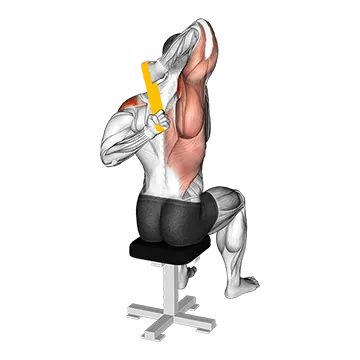 Resistance Band Shoulder Stretch Behind the BackShoulders
 Band Face PullShoulders
 Band horizontal Pallof Press with Resistance Band SquatHips, Thighs, Waist
 Band rear delt rowShoulders
 Band reverse flyShoulders