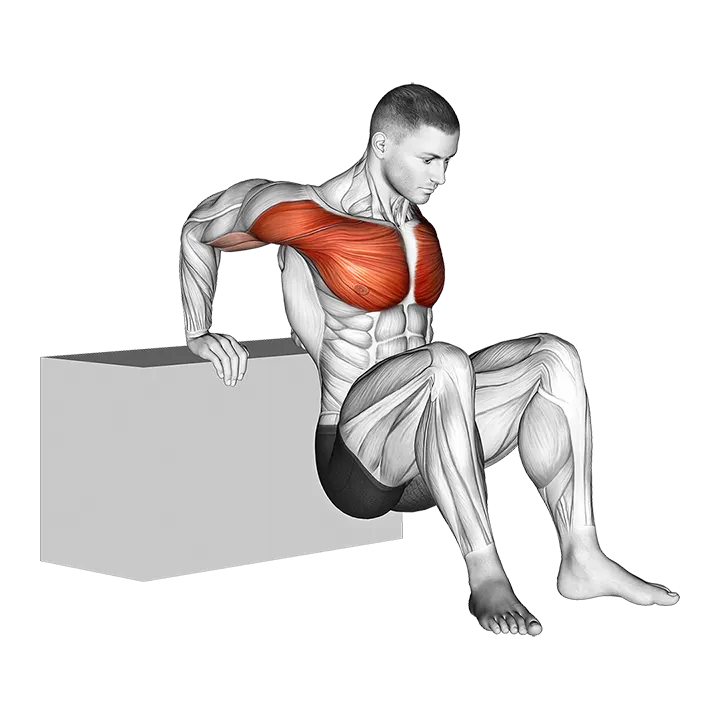
Reverse Chest Stretch
- Target muscle
- —
- Equipment
- Body weight
- Body part
- Chest
- Type
- Stretching
The Reverse Chest Stretch is a bodyweight stretching exercise that targets the pectoral muscles by clasping the hands behind the back and opening the chest wide. It counteracts the rounded-shoulder posture common from prolonged sitting or heavy pressing work, making it a practical recovery and mobility drill for anyone looking to improve chest flexibility and shoulder health.
How to do the Reverse Chest Stretch
- 1Stand tall with your feet hip-width apart and your spine in a neutral position.
- 2Reach both arms behind your back and interlace your fingers, palms facing inward toward each other.
- 3Straighten your arms fully and squeeze your shoulder blades together, drawing your hands downward and away from your body.
- 4Lift your chest upward and gently pull your shoulders back, feeling an opening sensation across the front of your chest and the fronts of your shoulders.
- 5Hold this position for 20–30 seconds, breathing slowly and deeply. Let the stretch deepen on each exhale without forcing it.
- 6Release your hands, relax your arms back to your sides, and repeat for 2–3 rounds as needed.
Form tips
- Keep your chin level and avoid jutting your head forward — a neutral neck lets the chest open more fully.
- Focus on squeezing the shoulder blades together rather than just pulling the arms back; the scapular retraction is what drives the chest stretch.
- Breathe into your chest on each inhale; you should feel the stretch ease slightly, then deepen again as you exhale and relax into it.
- If the full hand-clasp is uncomfortable, hold a towel or strap between your hands to give yourself more range.
- This stretch can also be performed kneeling on the floor, which helps keep the lower back neutral if you tend to over-arch when standing.
Common mistakes
- Arching excessively through the lower back — this compresses the lumbar spine and shifts tension away from the chest. Keep the core lightly engaged.
- Bending the elbows instead of straightening the arms fully, which reduces the stretch intensity across the pectoral muscles.
- Holding your breath, which prevents the muscles from relaxing into the stretch and limits how deeply you can open the chest.
- Rushing through the hold — a stretch under 15 seconds barely influences tissue length. Aim for at least 20–30 seconds per set.
- Forcing the arms too high behind the back, which can strain the shoulder joint. Move only as far as feels like a comfortable, deep stretch.
Frequently asked questions
What muscles does the Reverse Chest Stretch target?
It primarily targets the pectoral muscles (chest). As you retract your shoulder blades and open the chest, the front of the shoulders also receives some passive lengthening, but the main focus is the chest.
How long should I hold the Reverse Chest Stretch?
Hold each repetition for 20–30 seconds. Perform 2–3 rounds for a meaningful effect on chest flexibility. Static stretches generally need at least 20 seconds to begin influencing muscle length.
When is the best time to do the Reverse Chest Stretch?
It is best performed after a workout or as part of a cool-down routine when the muscles are already warm. Doing it in the morning or after long periods of sitting also helps counteract the effects of poor posture throughout the day.
Can I do this stretch every day?
Yes. Because it uses only body weight and gentle tension, the Reverse Chest Stretch is safe to perform daily. Regular practice is actually more effective for improving flexibility than occasional sessions.
What if I cannot clasp my hands behind my back?
Hold a resistance band, towel, or strap between your hands instead. This gives you a wider grip so you can still straighten your arms and feel the chest opening without overstressing the shoulders.







