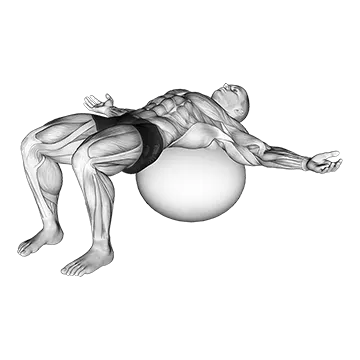
Reverse Hyper extension (on stability ball)
- Target muscle
- Erector Spinae, Gluteus Maximus
- Synergist muscles
- Hamstrings
- Equipment
- Stability ball
- Body part
- Thighs
- Type
- Strength



The reverse hyperextension on a stability ball is a posterior-chain exercise that primarily targets the erector spinae and gluteus maximus, with the hamstrings working as synergists throughout the lift. Performed face-down over a stability ball with the legs hanging free, it trains hip extension through a controlled range of motion and is an accessible, low-load way to strengthen the lower back and glutes without compressive spinal loading.
How to do the Reverse Hyper extension (on stability ball)
- 1Place a stability ball on the floor and position yourself face-down on top of it so your hips and lower abdomen rest on the centre of the ball.
- 2Walk your hands forward until the ball sits under your hips and your torso is nearly parallel to the floor, with your hands flat on the floor shoulder-width apart.
- 3Extend your arms and press firmly through your palms to anchor your upper body and prevent the ball from rolling.
- 4Allow both legs to hang down toward the floor with feet hip-width apart and toes lightly touching the ground — this is your starting position.
- 5Brace your core, squeeze your glutes, and slowly raise both legs together until they are parallel to the floor, in line with your torso.
- 6Pause for one second at the top, focusing on the contraction in your glutes and lower back without arching the lumbar spine excessively.
- 7Lower your legs back down in a slow, controlled manner until your toes lightly touch the floor again.
- 8Reset your core brace before beginning the next rep, keeping the movement smooth and deliberate throughout the set.
Form tips
- Avoid hyperextending at the top — raise your legs only to parallel with the floor so the erector spinae and glutes work without compressing the lumbar spine.
- Brace your core throughout every rep; an unbraced midsection transfers excessive stress to the lower back instead of spreading the load across the posterior chain.
- Use a slow, deliberate tempo — two seconds up, one-second hold, two to three seconds down — to maximize muscle time under tension and reduce momentum.
- Keep the ball stable by pressing firmly through your hands; if the ball rolls you lose your base of support and reduce the effectiveness of the movement.
- Start with bodyweight only until you can complete all reps with controlled form before adding ankle weights or resistance.
Common mistakes
- Raising the legs far above parallel — hyperextending the lumbar spine at the top compresses the vertebral joints and shifts stress away from the glutes and onto the passive structures of the lower back.
- Using momentum to swing the legs up — a jerky, momentum-driven rep reduces time under tension for the erector spinae and gluteus maximus and increases the risk of strain.
- Letting the hips slide forward off the ball during the lift — losing hip position on the ball changes the lever arm and reduces the load on the target muscles while destabilizing the exercise.
- Holding the breath throughout the set — failing to breathe normally increases intra-abdominal pressure unnecessarily and can cause dizziness; exhale as you lift the legs and inhale as you lower them.
- Placing the ball under the chest rather than the hips — ball position too high shortens the effective range of hip extension and reduces glute and erector activation.
Frequently asked questions
What muscles does the reverse hyperextension on a stability ball work?
It primarily works the erector spinae (lower back) and gluteus maximus, with the hamstrings acting as synergists to assist hip extension throughout the lift.
Is the reverse hyperextension on a stability ball good for lower back pain?
It can help strengthen the erector spinae and surrounding posterior-chain muscles that support the spine, but anyone with existing lower-back injuries should consult a healthcare professional before adding it to their routine.
How do I stop the stability ball from rolling during reverse hyperextensions?
Press firmly through both palms on the floor to anchor your upper body, and position the ball on a non-slip mat. Keeping your core braced also helps stabilize the ball under your hips.
Can I add weight to the stability ball reverse hyperextension?
Yes — once you can complete all reps with controlled bodyweight form, ankle weights are the most practical way to add resistance without compromising balance on the ball.
How many sets and reps should I do for reverse hyperextensions on a stability ball?
For strength and posterior-chain development, 3 sets of 10–15 controlled reps works well. Prioritize full hip extension at the top and a slow lowering phase over high rep counts.