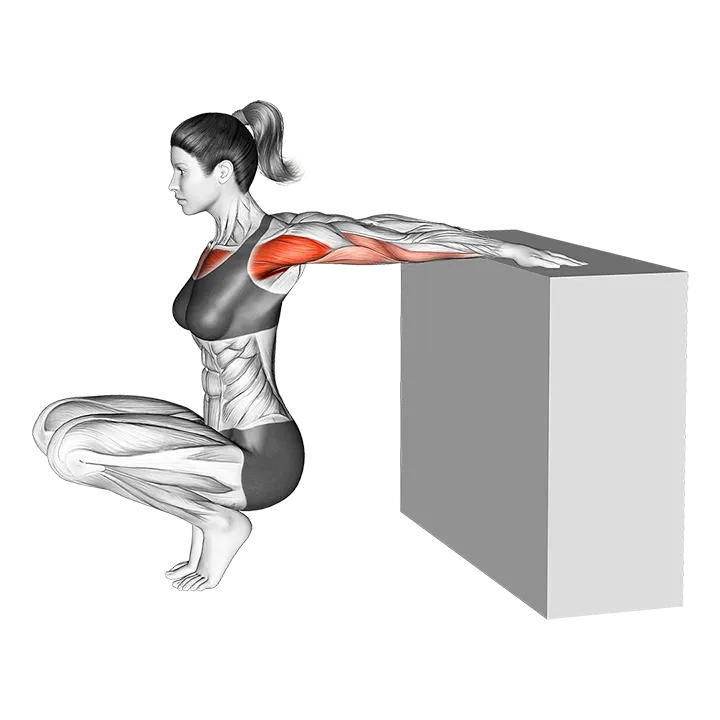
Reverse Shoulder Stretch
- Target muscle
- —
- Equipment
- Body weight
- Body part
- Shoulders
- Type
- Stretching
The reverse shoulder stretch is a bodyweight flexibility exercise that targets the anterior deltoid, chest (pectoralis major and minor), and biceps by drawing the arms behind the body. It is an effective cooldown or mobility drill for counteracting the forward shoulder posture that builds up from pressing exercises, desk work, and daily activities.
How to do the Reverse Shoulder Stretch
- 1Stand tall with your feet hip-width apart, chest lifted, and chin slightly tucked.
- 2Bring both arms behind your back and interlace your fingers, or clasp one wrist with the opposite hand if interlacing is uncomfortable.
- 3Straighten your arms as fully as possible and squeeze your shoulder blades together, opening your chest forward.
- 4Without hunching your upper back, slowly lift your clasped hands upward and away from your glutes until you feel a stretch across the front of your shoulders and chest.
- 5Keep your elbows as straight as you can and your palms pressed together or facing inward throughout the hold.
- 6Hold the end position for 20–30 seconds, breathing steadily and deepening the stretch slightly on each exhale.
- 7Lower your arms, release your hands, and gently roll your shoulders forward to decompress before repeating.
Form tips
- Focus on squeezing your shoulder blades together first before lifting your arms — the retraction is what drives the anterior deltoid stretch.
- Keep your core lightly braced and avoid arching your lower back excessively as you raise your arms; the movement should come from your shoulders, not your spine.
- Breathe slowly and let each exhale relax your chest and shoulders a little deeper into the stretch rather than forcing the range of motion.
- If your hands cannot interlace comfortably, hold a towel or resistance band between them at shoulder-width to get the same shoulder position.
- Perform this stretch at the end of a workout or after a brief warm-up — cold muscles are less pliable and more prone to discomfort.
Common mistakes
- Bending the elbows during the lift, which shortens the lever arm and reduces the stretch on the anterior deltoid and chest.
- Overextending the lower back to compensate for limited shoulder mobility — this compresses the lumbar spine without improving the shoulder stretch.
- Shrugging the shoulders toward the ears instead of retracting the blades, which engages the upper trapezius rather than opening the chest.
- Bouncing or jerking the arms upward to force a greater range of motion, which can strain the shoulder capsule and biceps tendon.
- Holding the breath, which increases tension throughout the upper body and prevents the muscles from releasing into the stretch.
Frequently asked questions
What muscles does the reverse shoulder stretch target?
It primarily stretches the anterior deltoid (front of the shoulder) and the chest muscles (pectoralis major and minor). The biceps are also gently lengthened when the elbows are kept straight and the arms are lifted behind the body.
How long should I hold the reverse shoulder stretch?
Hold each repetition for 20–30 seconds to allow the muscle fascia to relax and lengthen. Perform 2–3 holds per session, resting briefly between each one.
When is the best time to do this stretch?
It works best as part of a post-workout cooldown or a dedicated mobility session. Stretching tight, warmed-up muscles after training yields more lasting flexibility gains than stretching cold.
Can I do this stretch if I have a shoulder injury?
Use caution. If you have a rotator cuff injury, shoulder impingement, or recent surgery, consult a physiotherapist before attempting this stretch, as lifting the arms behind the body can aggravate certain conditions.
Why can't I interlace my fingers behind my back?
Limited internal rotation or tight pectorals can make the grip difficult. Use a towel or band held at shoulder-width as a substitute, and work on your chest and shoulder mobility over time to close the gap.







