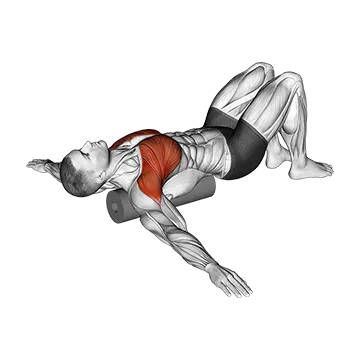
Roll Around the World Lying on Floor
- Target muscle
- —
- Equipment
- Roll
- Body part
- Back
- Type
- Stretching




Roll Around the World Lying on Floor is a foam roller mobility exercise performed on your back that targets the thoracic spine and upper back muscles, including the erectors and surrounding soft tissue. By sweeping your arms through a wide arc while balanced on the roller, you release tension along the upper back, improve thoracic extension, and support better posture.
How to do the Roll Around the World Lying on Floor
- 1Place the foam roller on the floor perpendicular to your spine. Sit in front of it, then lean back so the roller contacts your mid-back at roughly the level of your shoulder blades.
- 2Lower yourself until your upper back rests on the roller with your knees bent and feet flat on the floor, hip-width apart.
- 3Support your head lightly with your hands or let your arms rest at your sides to start. Engage your core to keep your hips low and your lower back relaxed.
- 4Slowly extend both arms out to your sides, then sweep them up overhead in a wide arc, as if making a snow angel — this is the "around the world" motion.
- 5Continue the sweep, bringing your arms around and back down to your sides, completing a full circle. Move at a slow, controlled pace and breathe steadily throughout.
- 6Pause at any point in the arc where you feel tightness in the upper back, holding for two to three seconds to allow the tissue to release.
- 7Reverse the direction of the arm sweep for the next repetition to work the muscles from both angles.
- 8After completing your reps, shift the roller slightly up or down your spine to address different segments of the thoracic region before repeating.
Form tips
- Keep your hips low and close to the floor throughout the movement — letting them rise shifts the load away from your thoracic spine and reduces the stretch.
- Move your arms slowly and deliberately. The slower the arc, the more time the muscles have to respond and release.
- Breathe out as your arms sweep overhead; exhaling helps relax the chest and upper back, deepening the stretch.
- Focus the roller on your mid and upper back (T4–T10). Avoid rolling directly onto your lower back or neck.
- If balance on the roller is difficult, widen your feet slightly for a more stable base.
Common mistakes
- Rushing the arm sweep, which turns a mobility stretch into a momentum-driven movement and reduces the benefit to the upper back.
- Raising the hips off the floor during the arc, which unloads the thoracic spine and means the roller is no longer applying useful pressure to the target area.
- Positioning the roller too low on the lumbar spine, which can compress the lower back and cause discomfort or injury.
- Holding the breath throughout the movement, which increases tension in the muscles and prevents them from releasing fully.
- Using too firm a roller before the back is warmed up — start with a softer or textured roller if the thoracic area is particularly sensitive.
Frequently asked questions
What muscles does Roll Around the World on a foam roller target?
The exercise primarily targets the thoracic spine and the muscles of the upper back, including the spinal erectors and the soft tissue surrounding the thoracic vertebrae. The sweeping arm motion also mobilizes the shoulders and stretches the chest.
When is the best time to do this exercise?
It works well as part of a warm-up to improve thoracic mobility before pressing, rowing, or overhead movements, or as part of a cool-down to release tension after a training session. It can also be done on rest days as standalone mobility work.
How many reps and how long should I hold each position?
Aim for 5–10 slow arm circles in each direction per segment of the spine. Pause for 2–3 seconds anywhere you feel notable tightness. The total session on the roller typically lasts 1–3 minutes per area.
Can I use this exercise for upper back pain or poor posture?
It can help relieve general upper back tension and stiffness associated with prolonged sitting and poor posture by encouraging thoracic extension. However, if you have an injury, a disc issue, or sharp pain, consult a healthcare professional before using a foam roller on your spine.
What kind of foam roller do I need?
A standard high-density foam roller (roughly 90 cm long, 15 cm in diameter) is ideal. Softer rollers are more comfortable for beginners or sensitive areas; firmer rollers provide deeper pressure. A shorter roller can work but is less stable when lying flat.