
Seated Chest Clam
- Equipment
- Body weight
- Body part
- Chest
- Type
- Strength
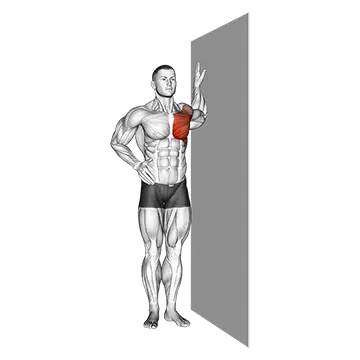



The seated chest clam is a bodyweight exercise performed while seated, in which the arms open and close at chest level to create dynamic tension across the pectoralis major (both clavicular and sternal heads) and the anterior deltoid. It requires no equipment and is well suited for building chest activation awareness and adding upper-body pressing volume without loading the spine.
How to do the Seated Chest Clam
- 1Sit upright on a chair or bench with your feet flat on the floor and your spine in a neutral position.
- 2Raise both arms to chest height and bend your elbows to roughly 90 degrees so your forearms point forward and your palms face each other.
- 3Press your forearms and the backs of your hands together at the midline, creating tension across your chest.
- 4Maintaining that tension, slowly open your arms outward like a clamshell opening, stopping when your elbows are in line with or slightly behind your shoulders.
- 5Pause briefly at the open position, feeling a stretch across the chest and front shoulders.
- 6Drive your arms back together at the midline under control, squeezing your pectorals as your forearms meet.
- 7Keep your shoulders down and away from your ears throughout the entire movement.
- 8Complete the desired number of repetitions, maintaining consistent tension and a tall seated posture throughout.
Form tips
- Initiate each closing movement from the chest rather than the shoulders — think of pulling your elbows toward each other rather than pressing your hands together.
- Keep your core lightly braced and avoid leaning forward or backward as you open and close, which would shift the load away from the target muscles.
- Control the eccentric (opening) phase over at least two counts to maximise time under tension across the pectorals and anterior deltoid.
- Keep your elbows at or just below shoulder height throughout; dropping them too low biases the sternal head while losing clavicular head engagement.
Common mistakes
- Shrugging the shoulders upward during the press, which transfers effort to the upper trapezius and reduces pectoral activation.
- Opening the arms too far behind the body, which can stress the shoulder capsule and removes the stretch from a safe, controlled range.
- Losing the 90-degree elbow bend by letting the arms straighten, which reduces mechanical tension on the chest and front deltoid.
- Moving too quickly through both phases, relying on momentum rather than muscular effort and diminishing the training stimulus.
- Allowing the torso to hunch forward as fatigue sets in, which compromises the pressing plane and reduces the effectiveness of each repetition.
Frequently asked questions
What muscles does the seated chest clam work?
It targets the pectoralis major (both the clavicular head at the upper chest and the sternal head across the mid-chest) and the anterior deltoid at the front of the shoulder.
Is this exercise suitable for beginners?
Yes. Because it uses only body weight and can be performed on any standard chair, it is accessible at all fitness levels. Beginners can focus on learning how to contract the chest intentionally before progressing to loaded pressing exercises.
How many reps and sets should I do?
A common starting point is 2–3 sets of 12–20 repetitions with a slow, controlled tempo. Because resistance is limited to body weight, higher rep ranges and deliberate pauses are the primary ways to increase difficulty.
Can I make the exercise harder without equipment?
Yes — slow down each phase, add a two-to-three second pause at the open position and a one-to-two second squeeze at the closed position, or increase total weekly volume by adding sets.