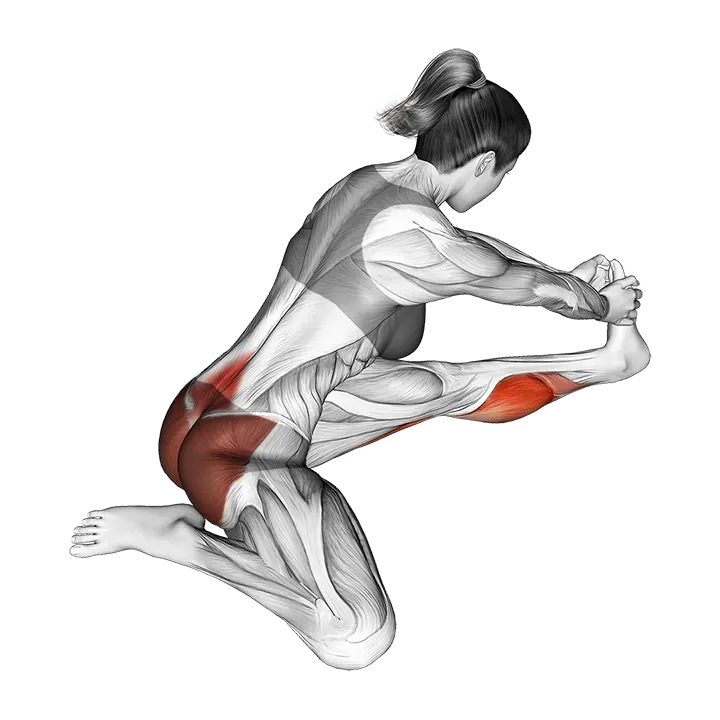
Seated Hip Stretch With Opposite Leg From Behind
- Synergist muscles
- Soleus
- Equipment
- Body weight
- Body part
- Hips
- Type
- Stretching
The seated hip stretch with opposite leg from behind is a floor-based mobility exercise that targets the gluteus maximus, gluteus medius, hamstrings, erector spinae, and gastrocnemius, with the soleus acting as a synergist. By positioning one leg behind the body and using the opposite leg to deepen the stretch, it releases tension across the hips and lower back. It is an excellent addition to warm-up and cool-down routines for improving hip mobility and posterior chain flexibility.
How to do the Seated Hip Stretch With Opposite Leg From Behind
- 1Sit on the floor with your legs in front of you and your back upright.
- 2Bend your right knee and bring your right foot toward your left hip, letting it rest on the floor to the outside of your left thigh.
- 3Swing your left leg around and place it behind your body, extending it back and slightly to the side so the inside of your left thigh rests on the floor.
- 4Place both hands on the floor in front of you for initial support and to help control your balance.
- 5Sit tall, engage your core lightly, and gently press your hips downward toward the floor to begin feeling the stretch in your right glute and hip.
- 6Walk your hands forward slowly to increase the depth of the stretch, hinging at the hips rather than rounding through your lower back.
- 7Hold the deepest comfortable position for 20–45 seconds, breathing steadily and allowing your hips to relax further with each exhale.
- 8Use your hands to push yourself upright, then switch sides — place your left foot to the outside of your right thigh and extend your right leg behind you.
Form tips
- Keep your spine long throughout the hold — imagine the top of your head reaching toward the ceiling to prevent the lower back from collapsing.
- Let gravity and slow, controlled breathing do the work; avoid forcing the stretch by pushing aggressively with your hands.
- If your hips tilt significantly to one side, place a folded towel or yoga block under the raised hip to level your pelvis and ensure an even stretch.
- Point the toes of your back foot and press the top of that foot gently into the floor to keep the back leg stable and engaged.
- Perform this stretch after your workout or at the end of a warm-up when muscles are already warm for best results and reduced injury risk.
Common mistakes
- Rounding the lower back instead of hinging at the hips, which shifts the stretch away from the glutes and onto the lumbar spine, increasing injury risk.
- Letting the hip of the bent leg lift off the floor, which reduces the glute stretch and creates uneven loading on the pelvis.
- Forcing the range of motion by pushing hard with the hands before the hips have relaxed, which can cause strain in the hip joint or lower back.
- Holding the breath during the stretch, which increases muscle tension and limits how deeply the hips can release.
- Placing the foot of the front leg too close to the groin, reducing the lever arm and significantly diminishing the stretch on the gluteus maximus and hip external rotators.
Frequently asked questions
What muscles does the seated hip stretch with opposite leg from behind target?
The primary muscles stretched are the gluteus maximus, gluteus medius, hamstrings, erector spinae, and gastrocnemius. The soleus also receives a secondary stretch. Together these muscles span the hips, glutes, and lower back.
How long should I hold this stretch?
Aim for 20–45 seconds per side. For general flexibility maintenance, one or two holds per side is sufficient. If you are working to increase hip mobility, two to three holds per side with a brief rest between each is more effective.
Is this stretch suitable for people with tight hips or limited flexibility?
Yes. If your hips are very tight, start with a smaller forward lean and place a folded blanket or yoga block under the raised hip to level your pelvis. Over time, as flexibility improves, you can deepen the stretch by walking your hands further forward.
Can I do this stretch before a workout?
It is better suited for the end of a warm-up or as part of a cool-down, when muscles are already warm. Using it as a static hold at the very start of a cold workout is less effective and carries a slightly higher risk of strain.
How is this stretch different from a standard pigeon pose?
Both stretches target the glutes and hip external rotators, but in this seated variation the opposite leg is extended behind the body rather than being bent beneath you. This changes the pelvic position slightly and also adds a stretch to the gastrocnemius and soleus of the back leg, making it a slightly broader posterior-chain stretch.







