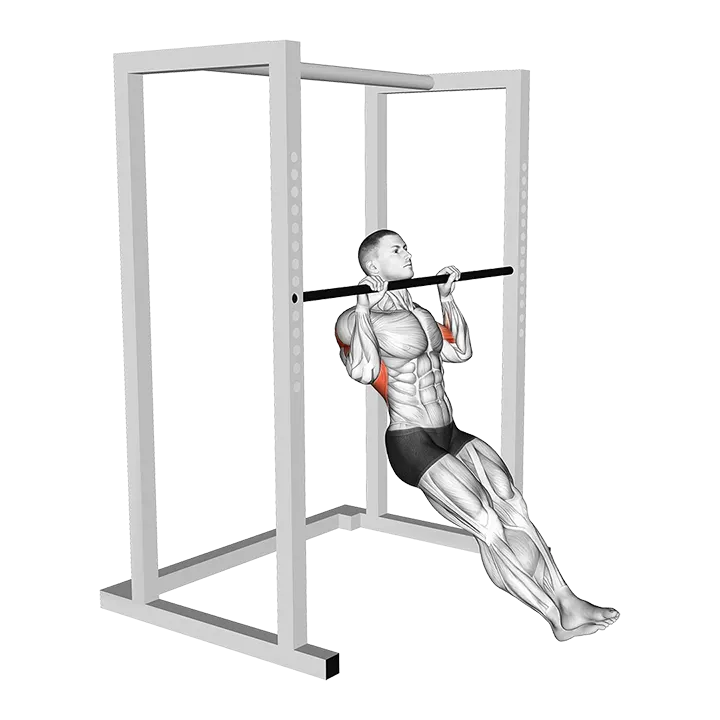
Seated Isometric Hold Pull up
- Target muscle
- —
- Equipment
- Body weight
- Body part
- Back
- Type
- Strength
The Seated Isometric Hold Pull up is a bodyweight back exercise in which you sit beneath a low bar and hold yourself in the top pull-up position — chin at or above the bar — for a sustained period. The static hold builds strength and endurance across the lats, rhomboids, and biceps, making it a practical tool for developing the upper-back tension required for full pull-ups.
How to do the Seated Isometric Hold Pull up
- 1Position yourself seated on the floor directly beneath a low horizontal bar that you can reach with arms extended overhead.
- 2Grip the bar with both hands slightly wider than shoulder-width, using an overhand (pronated) grip.
- 3Brace your core, press your feet lightly into the floor for stability, and pull your shoulder blades down and together.
- 4Drive your elbows toward your hips to engage the lats and lift your chest toward the bar until your chin clears the bar.
- 5Hold this top position with your chest close to the bar, elbows bent, and shoulder blades fully retracted.
- 6Keep your neck neutral — avoid jutting your chin forward to artificially clear the bar.
- 7Breathe in a controlled rhythm throughout the hold; do not hold your breath.
- 8When the hold is complete, lower yourself in a slow, controlled manner back to the seated starting position.
- 9Reset your grip and posture before beginning the next set.
Form tips
- Actively pull the shoulder blades down and back throughout the entire hold — letting them creep upward shifts tension from the lats to the traps and reduces the training stimulus.
- Think about driving your elbows down toward your back pockets rather than simply bending your arms; this cue recruits the lats more effectively.
- Keep your chest up and slightly forward — a rounded upper back reduces muscle engagement and places unnecessary strain on the shoulder joints.
- Exhale slowly during the hold to stay relaxed and extend how long you can sustain the position before fatigue sets in.
- Start with shorter holds (5–10 seconds) and build duration progressively before adding sets, rather than grinding through poor form on long holds.
Common mistakes
- Shrugging the shoulders up toward the ears during the hold, which shifts load to the upper traps instead of the target back muscles and limits lat engagement.
- Allowing the elbows to flare wide rather than tracking back and down, which reduces lat tension and places extra strain on the shoulder capsule.
- Jutting the chin forward to make it appear above the bar — this does not increase the training effect and can strain the neck.
- Holding the breath for the entire duration, which spikes blood pressure and accelerates fatigue; maintain a slow, controlled breathing pattern instead.
- Dropping out of the hold abruptly rather than lowering with control, which wastes the eccentric portion and increases injury risk at the shoulder and elbow.
Frequently asked questions
What muscles does the Seated Isometric Hold Pull up work?
The exercise primarily targets the muscles of the back — particularly the latissimus dorsi and rhomboids — while the biceps and rear deltoids act as supporting muscles. Because it is an isometric hold, every muscle involved must sustain continuous tension rather than cycling through a range of motion.
How long should I hold the top position?
Beginners should aim for 5–10 second holds and accumulate 3–5 sets with full rest between efforts. As strength improves, extend each hold to 20–30 seconds. Prioritize a stable, fully retracted shoulder-blade position over duration — a 10-second hold with perfect form is more productive than a 30-second hold with sagging posture.
Can the Seated Isometric Hold Pull up help me learn full pull-ups?
Yes — holding the top position builds the grip strength, lat engagement, and scapular stability that full pull-ups demand. Pairing isometric holds at the top with slow eccentric (lowering) reps is one of the most effective progressions for trainees who cannot yet complete an unassisted pull-up.
What equipment do I need for the Seated Isometric Hold Pull up?
You need a stable low horizontal bar you can reach while seated on the floor — a squat rack set at the appropriate height, gymnastic rings fixed low, or the underside of a sturdy table all work. No additional equipment is required.
Is the Seated Isometric Hold Pull up suitable for beginners?
Yes. Because you remain seated with feet on the floor, you can offload a portion of your body weight, making the top-hold position more accessible than a full hanging pull-up. As you grow stronger, gradually reduce how much you push through your feet until you are holding with full body weight suspended.







