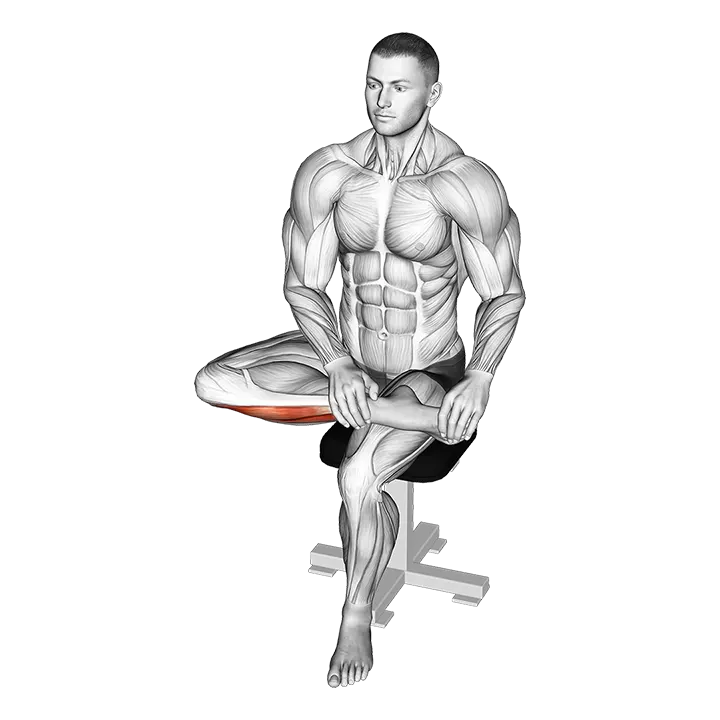
Seated Toe Extensor And Foot Inverter Stretch
- Target muscle
- —
- Equipment
- Body weight
- Body part
- Calves
- Type
- Stretching
Seated Toe Extensor And Foot Inverter Stretch is a seated bodyweight stretching exercise that targets the muscles on top of the foot responsible for lifting the toes and turning the sole inward. Performed by crossing the leg and using the hands to guide the foot, it improves flexibility in the lower leg and foot, and is useful for relieving tightness from prolonged standing, running, or wearing restrictive footwear.
How to do the Seated Toe Extensor And Foot Inverter Stretch
- 1Sit upright on a chair, bench, or the floor with your spine tall and your feet flat on the ground.
- 2Cross your right ankle over your left knee so the right foot rests comfortably on the left thigh.
- 3Place your left hand on the right shin just above the ankle to keep the leg stable.
- 4With your right hand, grasp the top of the right foot across the toe joints.
- 5Gently curl the toes downward and pull the top of the foot toward the floor, creating a stretch across the toe extensors on the top of the foot.
- 6At the same time, turn the sole of the foot inward (toward the midline of the body) to engage the foot inverter stretch.
- 7Hold the combined stretch for 20–30 seconds, breathing slowly and allowing the tissues to relax.
- 8Release gradually, return the foot to a neutral position, and repeat on the opposite side.
Form tips
- Move into the stretch slowly and with control — the top-of-foot tissues respond better to a sustained, gentle hold than to a forced pull.
- Keep your seated posture upright throughout; rounding the back transfers tension away from the foot and reduces stretch effectiveness.
- Breathe steadily during the hold — exhaling fully on each breath helps the muscles around the foot and ankle relax deeper into the stretch.
- You can fine-tune the stretch by adjusting the degree of inversion: more inward rotation increases the inverter component, while less isolates the toe extensors.
- If crossing the leg is uncomfortable, place the foot on a low stool or folded towel and use both hands to guide the foot from below.
Common mistakes
- Pulling too hard on the toes: Forcing the stretch aggressively can strain the small joints and tendons on the top of the foot — use a firm but gentle pressure and let time do the work.
- Neglecting the inversion component: Only curling the toes without also rotating the sole inward misses the foot inverter muscles (tibialis posterior, for example), reducing the stretch's full benefit.
- Holding the breath: Breath-holding increases muscular tension throughout the body, which works against the goal of releasing tightness in the foot and lower leg.
- Rushing through the hold: Holding for only a few seconds is insufficient for connective tissue and deeper muscles to release — aim for at least 20–30 seconds per side.
- Letting the ankle sag out of position: Allowing the ankle to drift reduces the inversion angle mid-stretch; use your stabilizing hand to keep the foot in the target position throughout the hold.
Frequently asked questions
What muscles does the Seated Toe Extensor And Foot Inverter Stretch target?
The stretch primarily targets the toe extensor muscles on the dorsum (top) of the foot — including extensor digitorum longus and extensor hallucis longus — which lift the toes, and the foot inverter muscles that rotate the sole inward, such as tibialis posterior. Together these muscles run along the top and inner side of the lower leg and foot.
When is the best time to do this stretch?
This stretch is most effective as part of a post-workout cool-down or during a dedicated flexibility session when muscles are already warm. It is also useful after prolonged periods of sitting, running, or wearing shoes with a narrow toe box that compress the top of the foot.
Can this stretch help with shin splints or foot pain?
Stretching the toe extensors and foot inverters can relieve tension in muscles that contribute to shin splints and foot discomfort, particularly pain along the front or inside of the lower leg. However, if you have an existing injury or persistent pain you should consult a physiotherapist before adding this stretch to your routine.
How long should I hold the Seated Toe Extensor And Foot Inverter Stretch?
Hold each side for 20–30 seconds and repeat 2–3 times per foot. For chronic tightness, extending the hold to 45–60 seconds can yield greater gains in flexibility over time.
Is this stretch suitable for people with flat feet?
Yes. Stretching the foot inverter muscles can complement strengthening work for flat feet by restoring mobility to the structures that support the arch. If you have flat feet or overpronation, pair this stretch with foot and ankle strengthening exercises for a balanced approach.







