
Seated Twist (Straight Arm)
- Target muscle
- Obliques
- Synergist muscles
- Rectus Abdominis
- Equipment
- Body weight
- Body part
- Waist
- Type
- Strength


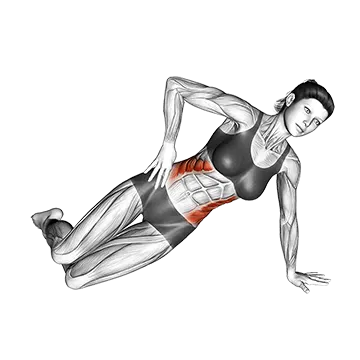

The seated twist with straight arms is a bodyweight core exercise that targets the obliques through controlled rotation of the torso. Keeping your arms extended increases the rotational challenge compared to a standard seated twist. It also engages the rectus abdominis as a stabilizer, making it a practical drill for building rotational strength and core control.
How to do the Seated Twist (Straight Arm)
- 1Sit on the floor with your knees bent and feet flat, hip-width apart. Sit tall so your spine is neutral and your torso is upright.
- 2Extend both arms straight out in front of you at shoulder height, palms facing each other or facing down. Keep your arms parallel to the floor throughout the set.
- 3Lean your torso back slightly — roughly 45° from the floor — until you feel tension in your core. Maintain this angle for the entire set.
- 4Brace your core, then rotate your torso to the right as far as you can without letting your hips shift or your arms drop.
- 5Hold the end position for one count, feeling the contraction in your right oblique.
- 6Return to center in a controlled manner, then rotate to the left side with the same deliberate pace.
- 7Continue alternating sides for the desired number of reps, keeping your arms straight and your lower body still throughout.
Form tips
- Think of the rotation coming from your ribcage, not your shoulders or arms. The arms follow the torso — they should not swing independently.
- Keep your feet light on the floor or lift them slightly if you want to increase core demand, but only do this once you can hold a stable torso at each end position.
- Breathe steadily — exhale as you rotate to each side and inhale as you return to center.
- Slow the movement down if you feel momentum taking over. A slow, deliberate rep engages the obliques far more than a fast, swinging one.
Common mistakes
- Letting the arms bend at the elbows, which reduces the rotational lever and decreases oblique engagement.
- Rotating the hips instead of the torso, which shifts the work away from the obliques and can strain the lower back.
- Sitting fully upright rather than leaning back slightly, which reduces core tension and makes the movement too easy to be effective.
- Using momentum to swing from side to side instead of controlling each rotation, which cuts short the time the obliques spend under tension.
- Dropping the arms below shoulder height mid-set, which changes the mechanics and reduces the challenge on the obliques.
Frequently asked questions
What muscles does the seated twist with straight arms work?
The primary muscle is the obliques, which drive the rotational movement. The rectus abdominis acts as a synergist, helping to stabilize your torso throughout the exercise.
What is the difference between a seated twist with straight arms and a regular seated twist?
Extending your arms straight out increases the rotational lever — the further your hands are from your center, the more your obliques have to work to control the movement. The regular (bent-arm) version is slightly easier and is a good starting point before progressing to straight arms.
Is the seated twist with straight arms good for beginners?
It can work for beginners, but the straight-arm variation is more demanding than it looks. Start with a shallow lean-back angle and a small range of rotation, then increase both gradually as your core strength improves.
How many sets and reps should I do?
Two to three sets of 10 to 15 reps per side is a practical starting range for most people. Count each side separately — one twist to the right and one to the left equals two reps total.
Should I lift my feet off the floor during this exercise?
Keeping your feet down is the standard setup and gives you a stable base to focus on the rotation. Lifting your feet adds a balance challenge and increases core demand, but only attempt it once you can perform the grounded version with full control and no hip movement.