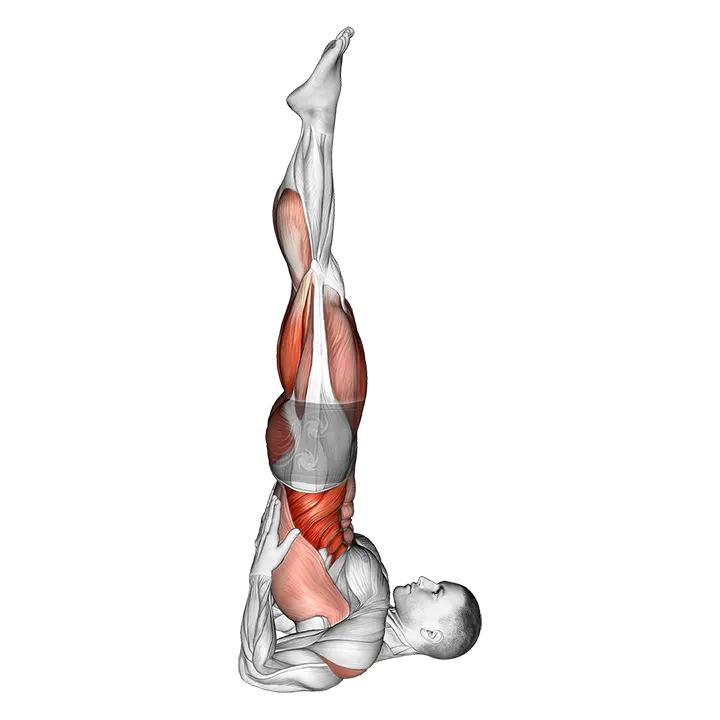
Shoulder Stand Yoga Pose
- Target muscle
- Gluteus Maximus, Hamstrings, Obliques
- Synergist muscles
- Deltoid Posterior, Gastrocnemius, Latissimus Dorsi, Quadriceps, Rectus Abdominis
- Equipment
- Body weight
- Body part
- Waist
- Type
- Stretching
The Shoulder Stand Yoga Pose (Sarvangasana) is a full-body inversion that primarily targets the gluteus maximus, hamstrings, and obliques, with support from the posterior deltoids, latissimus dorsi, quadriceps, gastrocnemius, and rectus abdominis. Performed lying on the upper back and shoulders with the legs extended vertically overhead, it builds core stability, improves circulation, and develops total-body body-weight control.
How to do the Shoulder Stand Yoga Pose
- 1Lie flat on your back on a mat with your arms alongside your body, palms facing down and legs fully extended.
- 2Press your palms and arms firmly into the mat, then engage your core and swing your legs up overhead, bringing your hips off the floor.
- 3Bend your elbows and place your hands on your lower back, fingers pointing upward, to form a supportive shelf for your spine.
- 4Walk your hands higher up your back toward the shoulder blades to straighten your torso as vertical as possible.
- 5Extend your legs straight up toward the ceiling, squeezing your thighs and pointing your toes so your body forms a single vertical line from shoulders to feet.
- 6Keep your weight distributed evenly across both shoulders and your upper back — not your neck — and gaze softly at your toes or the ceiling.
- 7Hold the position for the desired duration while breathing steadily through your nose.
- 8To exit, lower your legs slowly back overhead, release your hands to the mat, and unroll your spine back down to the floor one vertebra at a time.
Form tips
- Support your back with your hands and keep the weight on the tops of your shoulders and upper back, never on the cervical spine.
- Keep your neck long and still — do not turn your head to look sideways while in the pose, as this can strain or injure the cervical spine.
- Engage your core and glutes throughout the hold to keep your hips stacked directly over your shoulders and prevent the hips from sagging.
- Use a folded blanket under your shoulders (not your neck) to reduce compression on the cervical vertebrae and increase comfort.
- Build hold time gradually — start with 15–30 seconds and progress slowly over multiple sessions rather than forcing a long hold too soon.
Common mistakes
- Resting weight on the neck instead of the shoulders, which compresses the cervical spine and risks serious injury.
- Rotating or tilting the head while in the pose, removing the stable base and placing dangerous stress on the neck.
- Allowing the hips to drift forward so the body is not fully vertical, which reduces the effectiveness of the hold and strains the lower back.
- Collapsing the elbows wide apart rather than keeping them shoulder-width, which undermines the supportive shelf for the back.
- Coming out of the pose abruptly by dropping the legs, which can jar the spine — always lower out slowly with control.
Frequently asked questions
What muscles does the Shoulder Stand Yoga Pose work?
It primarily engages the gluteus maximus, hamstrings, and obliques to maintain the inverted position. The posterior deltoids, latissimus dorsi, quadriceps, gastrocnemius, and rectus abdominis all act as synergists to stabilize the body.
Is the Shoulder Stand safe for beginners?
It can be, with proper preparation. Beginners should place a folded blanket under the shoulders, start with shorter holds, and ideally learn the pose under the guidance of a qualified yoga instructor before practicing independently.
Who should avoid the Shoulder Stand Yoga Pose?
Anyone with neck pain, cervical spine issues, high blood pressure, glaucoma, detached retina, or who is menstruating should avoid or modify this pose. Always consult a healthcare provider if you are unsure.
How long should I hold the Shoulder Stand?
Beginners can start with 15–30 seconds and work up to 1–3 minutes over time. Focus on quality — a shorter hold with good alignment is safer and more beneficial than a long hold with poor form.
What is the difference between Shoulder Stand and Headstand?
In Shoulder Stand the body is supported on the upper back and shoulders with hands bracing the lower back, while Headstand (Sirsasana) is supported on the crown of the head and forearms. Shoulder Stand places less compression on the neck than a poorly executed Headstand.







