
Side Bridge (version 2)
- Target muscle
- Obliques
- Synergist muscles
- Adductor Brevis, Adductor Longus, Deltoid Lateral, Gluteus Medius, Gracilis, Iliopsoas, Pectineous, Serratus Anterior, Tensor Fasciae Latae
- Equipment
- Body weight
- Body part
- Waist
- Type
- Strength
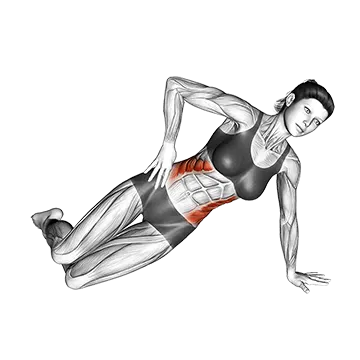
The Side Bridge (version 2) is a bodyweight lateral plank held on the hand and foot — the straight-arm variation of the forearm side bridge — that targets the obliques while recruiting the gluteus medius, tensor fasciae latae, adductors, serratus anterior, and lateral deltoid to hold a rigid line. Because the arm is fully extended, the shoulder works harder to stabilize the body. It fits as a warm-up drill, a core finisher, or movement prep.
How to do the Side Bridge (version 2)
- 1Lie on your side on a firm surface with your legs stacked and fully extended.
- 2Stack your upper foot on top of your lower foot, or place it just in front for additional stability.
- 3Place your lower hand flat on the floor directly beneath your shoulder, with fingers pointing away from your body.
- 4Extend your lower arm and press the floor away to lift your hips off the ground, forming a straight line from your head to your feet.
- 5Extend your top arm straight up toward the ceiling so your body forms a T shape, or rest it along your top hip.
- 6Brace your core hard, squeeze your glutes, and keep your hips stacked — neither sagging toward the floor nor rotating open.
- 7Hold the position for the target duration, breathing steadily without letting your hips drop.
- 8Lower your hips under control, rest briefly, then repeat on the opposite side.
Form tips
- Push the floor away actively with your supporting hand — this fires the serratus anterior and keeps the shoulder joint packed and safe.
- Imagine a rod running from your head through your heels and keep every part of your body in contact with it throughout the hold.
- If your wrist complains, set the supporting hand slightly forward of the shoulder or use a push-up handle to keep the wrist closer to neutral.
- Keep your neck neutral — your head should be a natural extension of your spine, not tilted up or dropped toward the floor.
- Progress hold time gradually (for example, three sets of 20 seconds per side) before adding hip-dip repetitions or foot elevation.
Common mistakes
- Letting the hips sag toward the floor, which shortens the obliques and shifts load onto the lumbar spine instead of the core.
- Rotating the top hip backward to create a false sense of balance, which reduces oblique engagement and places asymmetric stress on the lower back.
- Locking the elbow into hyperextension rather than keeping a very slight soft bend, which can strain the elbow joint under bodyweight load.
- Holding the breath to brace, which spikes intra-thoracic pressure and makes sustained holds unsustainable — breathe steadily throughout.
- Starting with excessively long holds before the shoulder stabilizers are ready, leading to shoulder shrug compensation and reduced core activation.
Frequently asked questions
What is the difference between the Side Bridge and the Side Bridge (version 2)?
The standard Side Bridge is held on the forearm with the elbow on the floor, while version 2 is held on a fully extended arm with the hand flat on the floor. The straight-arm version increases the lever arm at the shoulder, demanding more work from the serratus anterior and lateral deltoid.
What muscles does the Side Bridge (version 2) work?
The obliques are the primary target. Key synergists include the gluteus medius, tensor fasciae latae, adductor group, iliopsoas, serratus anterior, and lateral deltoid — all working together to resist lateral spinal flexion and keep the body in a straight line.
How long should I hold the Side Bridge?
Beginners should aim for 15–20 seconds per side and build toward 30–45 seconds. Once you can hold 45–60 seconds with perfect form, add hip-dip repetitions or elevate your feet on a bench to increase difficulty.
Is the Side Bridge (version 2) safe for lower back pain?
When performed correctly, lateral plank variations are considered spine-friendly and are often included in rehabilitation protocols because they train the core without loading the lumbar spine in flexion. However, if you experience pain during the hold, stop and consult a healthcare professional.
Can I do this exercise every day?
Isometric core exercises like the side bridge recover quickly, so daily training is generally well tolerated. Listen to your body — if the shoulder or hip fatigue noticeably between sessions, allow a rest day before repeating.