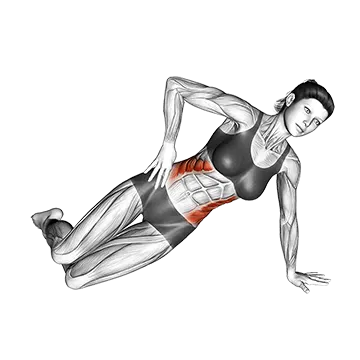
Side Hip (on parallel bars)
- Target muscle
- Obliques
- Equipment
- Body weight
- Body part
- Waist
- Type
- Strength
The side hip on parallel bars is a bodyweight strength exercise that isolates the obliques by laterally dipping and raising the hips while suspended on dip bars. Supporting your full body weight with your arms, you shift your hips to each side against gravity, making it an effective waist-focused core movement that fits well at the end of an upper-body or core session.
How to do the Side Hip (on parallel bars)
- 1Stand between a set of parallel bars and grip each bar firmly with a full, neutral grip. Press yourself up until your arms are fully extended and your body is hanging with legs together and feet off the floor.
- 2Lock your elbows and keep your arms straight throughout the set — this is a hip movement, not an arm movement.
- 3Brace your core lightly and allow your hips and legs to drop slowly to the right side by lateral-flexing at the waist, lowering as far as your oblique flexibility allows without rotating your torso.
- 4Pause briefly at the bottom of the dip, feeling a stretch in the left oblique.
- 5Drive your hips back up through the midline by contracting your obliques, returning your legs to a straight, neutral hanging position.
- 6Without pausing at the top, lower your hips to the left side in a controlled arc, reaching the same depth on that side.
- 7Drive back up to the midline to complete one full rep.
- 8Continue alternating sides for the desired number of reps, then carefully lower yourself back to the floor.
Form tips
- Exhale as you drive your hips back to the midline and inhale on the way down — the exhale helps you brace and gives the oblique contraction something to work against.
- Build depth gradually: start with a small dip to each side and add range as your obliques warm up, since the bottom of the arc is where the stretch and the load are greatest.
- Keep your legs together and ankles crossed or stacked throughout to prevent rotation and maintain a true lateral movement pattern.
- Focus on feeling the oblique on the opposite side pull you back up, rather than pushing with your arms.
- If your lower back feels pinched or your obliques cramp, shorten the range and slow down — lateral flexion is a small-range movement, and forcing depth trades oblique tension for lumbar side-bending.
Common mistakes
- Bending the elbows to absorb the hip dip, which reduces the range of motion at the waist and takes tension off the obliques.
- Rotating the torso instead of moving purely in the lateral plane, which recruits the hip flexors and reduces oblique engagement.
- Using momentum to swing the hips rather than controlling each rep, which shortens the time under tension and increases the risk of losing grip or tweaking the lower back.
- Dropping too quickly on the way down — an uncontrolled descent bypasses the eccentric loading that makes this exercise effective.
- Allowing the shoulders to shrug up toward the ears, which compresses the shoulder joint and can cause impingement over time.
Frequently asked questions
What muscles does the side hip on parallel bars work?
The exercise targets the obliques (both internal and external), which are responsible for lateral flexion of the spine. Because your legs hang free from the bars, the obliques on the stretched side both control the descent and pull your hips back to the midline on every rep.
Is this exercise suitable for beginners?
It requires a reasonable level of upper-body strength to hold your body weight on the bars, so complete beginners may struggle. If you cannot hold a straight-arm support position for at least 20–30 seconds, build that foundation with basic dip holds before adding lateral hip dips.
How many sets and reps should I do?
For strength and hypertrophy, 3–4 sets of 8–12 reps works well, counting one dip to each side as a single rep — so a set of 10 is 10 dips per side. Rest 60–90 seconds between sets.
What are good alternatives if I don't have parallel bars?
A Roman chair side bend, cable side crunch, or dumbbell side bend all train the obliques in a similar lateral-flexion pattern. If you want a hanging variation, a pull-up bar with a leg raise twisting at the top is a reasonable substitute.
How is this different from a regular hip dip on the floor?
On parallel bars you are working against your full bodyweight across the entire range of motion, making the exercise significantly more demanding than floor-based side planks or hip dips. The suspended position also removes any ground support, so your core must stabilize the movement throughout.