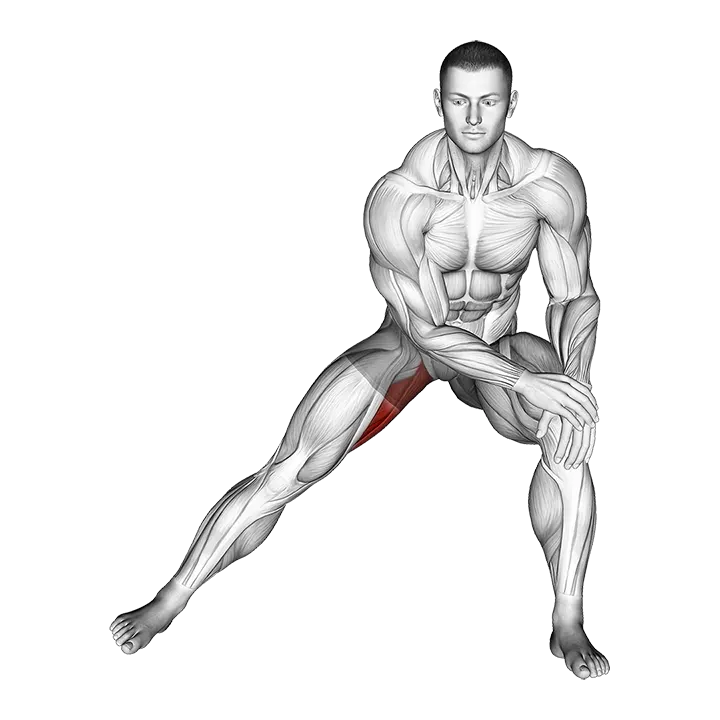
Side Lunge Adductor Stretch
- Target muscle
- —
- Equipment
- Body weight
- Body part
- Hips
- Type
- Stretching
The Side Lunge Adductor Stretch is a standing bodyweight stretch that targets the adductors (inner thigh), groin, and hip area by stepping one foot wide to the side, bending that knee into a lateral lunge, and keeping the opposite leg straight. It improves inner-thigh flexibility and hip mobility, making it a practical addition to both warm-up and cool-down routines.
How to do the Side Lunge Adductor Stretch
- 1Stand tall with your feet together, hands on your hips or extended in front for balance.
- 2Take a wide step directly to the right — aim for roughly 1.5 to 2 times shoulder width — and plant your right foot with the toes pointing forward or very slightly outward.
- 3Shift your weight to the right and bend your right knee, lowering your hips toward the floor while keeping your left leg fully straight.
- 4Keep your right foot flat on the floor and your right knee tracking in line with your right toes — do not let it cave inward.
- 5Press your hips back and down to deepen the stretch along the inner thigh of your straight left leg.
- 6Place your hands on your right thigh or the floor beside your right foot for additional balance and support if needed.
- 7Hold the position for 20–30 seconds, breathing steadily and allowing the adductors to relax into the stretch.
- 8Push through your right foot to return to the starting position, then step the left foot out to repeat on the opposite side.
- 9Perform 2–3 holds per side, gradually increasing the stance width as flexibility allows.
Form tips
- Keep your back flat and your chest lifted throughout — rounding the spine shifts tension away from the hip and can strain the lower back.
- Press your hips back and down rather than simply bending the knee; this is what creates tension along the straight-leg adductors.
- Point your feet forward or only slightly outward — excessive toe flare reduces the stretch on the inner thigh.
- Breathe slowly and continuously while holding; relaxed exhalations help release tension in the groin and allow a deeper stretch.
- Use your fingertips on the floor or your hand on your bent knee for balance rather than gripping tightly — staying relaxed improves the stretch quality.
Common mistakes
- Letting the bent knee collapse inward: this places stress on the knee joint and eliminates the hip-stability component of the movement — keep the knee tracking over the toes.
- Rounding the lower back: a flexed lumbar spine reduces the hip-hinge position needed to target the adductors and can cause discomfort in the lumbar region.
- Not stepping wide enough: a narrow stance keeps the straight leg slack and provides little to no stretch on the inner thigh — step out until you feel a clear pull along the groin.
- Bouncing at the end of the range of motion: ballistic movement in a passive stretch can activate a protective reflex that tightens the muscle rather than lengthening it.
- Holding the breath: breath-holding increases tension in the surrounding musculature, limiting how far the adductors can release; breathe steadily throughout the hold.
Frequently asked questions
What muscles does the Side Lunge Adductor Stretch target?
The primary muscles stretched are the adductors (inner thigh) and groin of the straight leg. The hip flexors and the muscles around the hip joint of both legs also receive a secondary stretch, depending on how far the hips are pushed back and how wide the stance is.
How long should I hold the Side Lunge Adductor Stretch?
Hold each side for 20–30 seconds per set and aim for 2–3 sets per side. If you are using it as a warm-up, stay at the shorter end (15–20 seconds) with a lighter depth. For a cool-down or dedicated flexibility session, hold closer to 30 seconds and allow the adductors to fully relax between sets.
Is the Side Lunge Adductor Stretch better before or after a workout?
It works well in both contexts. As part of a warm-up, use a shallower depth and shorter holds (15–20 seconds) to increase blood flow and hip mobility without over-relaxing the muscles. As a cool-down, go deeper and hold longer to improve flexibility when the muscles are already warm and pliable.
How wide should my stance be for the Side Lunge Adductor Stretch?
Start with roughly 1.5 times shoulder width and adjust based on how much of a stretch you feel in the straight-leg inner thigh. A stance that is too narrow gives little to no adductor stretch; a stance that is too wide can compromise your ability to control knee alignment on the bent leg. Find the width where you feel clear tension in the groin without your form breaking down.
I am a beginner — can I do the Side Lunge Adductor Stretch?
Yes. Begin with a moderate stance width and only lower as far as you can without your back rounding or your knee caving inward. Using a wall, chair, or the floor with your fingertips for balance makes the stretch more accessible. As hip mobility improves over several weeks, gradually widen the stance and lower the hips further.







