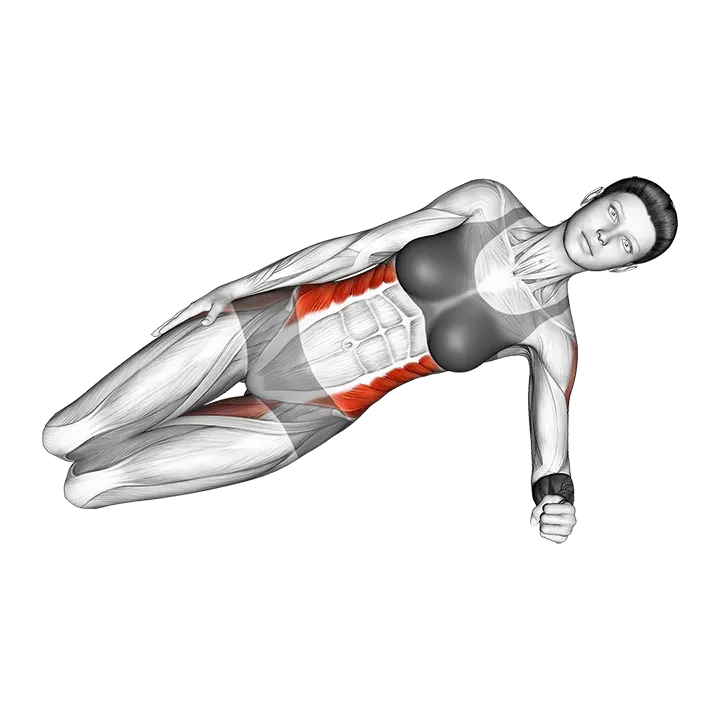
Side Plank (beginner)
- Target muscle
- Obliques
- Synergist muscles
- Adductor Brevis, Adductor Longus, Adductor Magnus, Gluteus Medius, Gracilis, Pectineous, Tensor Fasciae Latae
- Equipment
- Body weight
- Body part
- Waist
- Type
- Strength
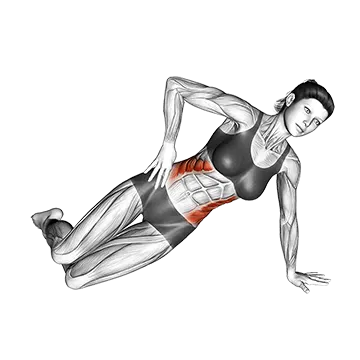
Side Plank (beginner) is a knee-supported core hold that primarily targets the obliques while recruiting synergist muscles including the gluteus medius, tensor fasciae latae, adductor brevis, adductor longus, adductor magnus, gracilis, and pectineous. By keeping the bottom knee on the ground, this beginner variation lowers the demand on the lateral core, making it ideal for building foundational hip stability and anti-lateral-flexion strength with body weight.
How to do the Side Plank (beginner)
- 1Lie on your side on a mat with your legs stacked and your bottom knee bent to approximately 90 degrees.
- 2Place your bottom forearm flat on the mat with your elbow positioned directly beneath your shoulder and your forearm pointing forward.
- 3Rest your top foot on the mat just in front of your bottom knee for additional base of support.
- 4Brace your core and lift your hips off the mat until your torso forms a straight diagonal line from your head to your bottom knee.
- 5Engage your obliques by gently drawing your bottom ribs toward your hip without rotating your torso.
- 6Place your top hand on your hip or extend your top arm toward the ceiling to open the chest.
- 7Hold the position for the target duration, breathing steadily and maintaining a neutral spine throughout.
- 8Lower your hips back to the mat in a slow, controlled manner to complete one hold.
- 9Rest briefly, then switch sides and repeat for the same duration.
Form tips
- Keep your elbow stacked directly under your shoulder for the entire hold — even slight forward or backward drift destabilizes the shoulder.
- Actively press your forearm into the mat to create tension through your shoulder and lat, which helps maintain a solid base.
- Squeeze your gluteus medius to drive your hips upward; this prevents the classic hip-sag that beginners encounter.
- Start with 10–15 second holds and add 5 seconds each week before moving toward the full straight-leg variation.
- Keep your neck in line with your spine — resist the urge to look up or let your head drop toward the mat.
Common mistakes
- Letting the hips sag toward the floor — this removes tension from the obliques and places excessive compressive load on the lumbar spine.
- Positioning the elbow too far in front of or behind the shoulder — this shifts load off the core and forces the shoulder into an unstable angle.
- Holding the breath during the isometric hold — this spikes intra-abdominal pressure and makes it much harder to maintain a stable brace through the entire set.
- Rotating the torso toward the floor or ceiling — this eliminates the lateral anti-flexion demand on the obliques, reducing the training stimulus.
- Using excessively long hold times before building a base — grinding through poor form instead of short, crisp holds prevents the obliques and hip synergists from developing strength safely.
Frequently asked questions
What muscles does the beginner side plank work?
The beginner side plank primarily targets the obliques. It also activates several synergist muscles: gluteus medius, tensor fasciae latae, adductor brevis, adductor longus, adductor magnus, gracilis, and pectineous. Together these muscles stabilize the hip, pelvis, and spine during the lateral isometric hold.
How long should a beginner hold a side plank?
A good starting point is 10–15 seconds per side with 2–3 sets, focusing on perfect alignment rather than duration. Once you can hold that comfortably with no form breakdown, add 5 seconds each session and work toward 30–45 second holds before considering the full straight-leg variation.
What is the difference between the beginner side plank and the standard side plank?
The beginner variation keeps the bottom knee on the ground, which shortens the lever arm and significantly reduces the load on the obliques and hip synergists. The standard side plank is performed with both legs straight so only the foot contacts the floor, requiring substantially greater lateral core strength and hip stability.
Why do my hips keep dropping during the beginner side plank?
Hip drop is usually a sign that the obliques or gluteus medius lack the endurance to sustain the hold. Try shortening the hold duration and consciously squeezing those muscles at the start of each rep. Rebuild with strict, short holds before increasing time, and your hips will stop sinking as lateral core strength improves.
How often should beginners do the side plank?
Three to four sessions per week works well for most beginners. This frequency gives the obliques and hip synergists enough stimulus to adapt while allowing adequate recovery. If volume is low and you feel no pain or fatigue, daily practice of short holds is generally tolerable, but consistency over several weeks matters more than daily frequency.