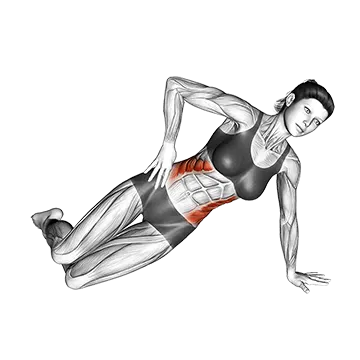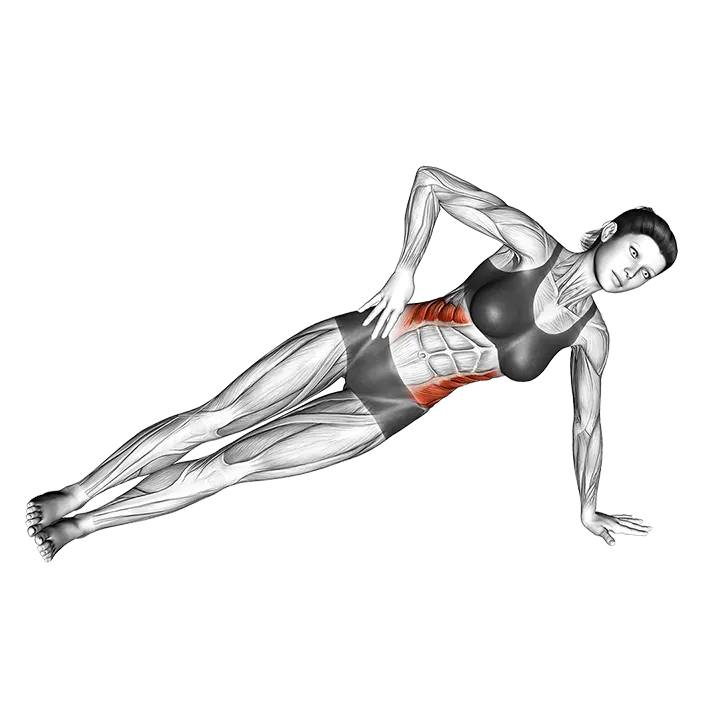
Side Plank (version 2)
- Target muscle
- Obliques
- Equipment
- Body weight
- Body part
- Waist
- Type
- Strength
The Side Plank (version 2) is a bodyweight core exercise that targets the obliques by demanding lateral stability through a fully extended supporting arm — a longer lever than the forearm version and a greater challenge for the supporting shoulder and hip. Performed on one hand with legs straight and stacked, it trains anti-lateral-flexion strength and spinal stability without any equipment. It works well as a core finisher or as a stability drill in a strength program.
How to do the Side Plank (version 2)
- 1Lie on your side on the floor with your legs straight and stacked on top of each other, feet stacked or staggered slightly for balance.
- 2Place your supporting hand flat on the floor directly below your shoulder, fingers pointing away from your body.
- 3Brace your core, then press through your palm to lift your hips off the floor until your body forms a straight line from head to feet.
- 4Keep your hips level and fully extended — do not let them sag toward the floor or pike upward.
- 5Extend your free arm toward the ceiling or rest it along your side, whichever helps you stay square and balanced.
- 6Hold the position while breathing steadily — inhale through your nose, exhale through your mouth — keeping your obliques actively contracted.
- 7Lower your hips back to the floor with control to end the set, then switch sides and repeat.
Form tips
- Keep your supporting wrist stacked directly under your shoulder; shifting it forward or backward places unnecessary stress on the joint.
- Actively press the floor away with your palm to engage the supporting shoulder and prevent it from collapsing inward.
- Squeeze your glutes and inner thighs together throughout the hold — this helps maintain a rigid, straight line through your hips and legs.
- Look straight ahead or slightly upward; dropping your chin lets your head pull the spine out of neutral alignment.
- Start with 10–15 second holds per side and build duration gradually — form degrades quickly once the obliques fatigue, and a shorter quality hold beats a long sloppy one.
Common mistakes
- Letting your hips sag toward the floor: this removes tension from the obliques and compresses the lumbar spine, defeating the purpose of the exercise.
- Piking your hips too high: shifting the hips up moves the work away from the obliques and into the shoulder, reducing lateral core stimulus.
- Allowing the supporting shoulder to shrug up toward your ear: this overloads the shoulder joint and collapses the stable base you need to hold the position.
- Holding your breath during the hold: breath-holding spikes intra-abdominal pressure and accelerates fatigue — maintain steady breathing throughout.
- Rotating your torso toward the floor instead of keeping your chest square to the wall: the twist lets your hips settle behind you and removes the anti-lateral-flexion demand the obliques are there to resist.
Frequently asked questions
What muscles does the Side Plank (version 2) work?
The primary target is the obliques (both internal and external), which resist lateral collapse of the spine and keep your hips in line for the whole hold. The supporting shoulder and hip work isometrically to hold the base steady, but the obliques do the bulk of the anti-lateral-flexion work.
What is the difference between the Side Plank and the Side Plank (version 2)?
The standard side plank is held on the forearm, which shortens the lever between your support point and your hips and makes the hold easier. Version 2 is held on a fully extended arm with the hand flat on the floor, which lengthens the lever, demands more shoulder stability, and places a higher load on the obliques.
Is the Side Plank (version 2) good for beginners?
It is more demanding than the forearm version, so true beginners are better served starting with the forearm side plank to build base oblique strength. Once you can hold the forearm version for 30 seconds per side with solid form, progress to version 2.
How long should I hold a side plank?
For most people, 3 sets of 20–45 seconds per side is a practical target. Prioritize quality over duration — if your hips sag or your shoulder shrugs before the time is up, stop and rest rather than grinding through poor form.
What are good alternatives to the Side Plank (version 2)?
The forearm side plank is the most direct regression. Other lateral core alternatives include the side plank with hip dip (adds dynamic range), the Copenhagen plank (loads the adductors as well), and the pallof press (trains anti-rotation alongside anti-lateral-flexion).