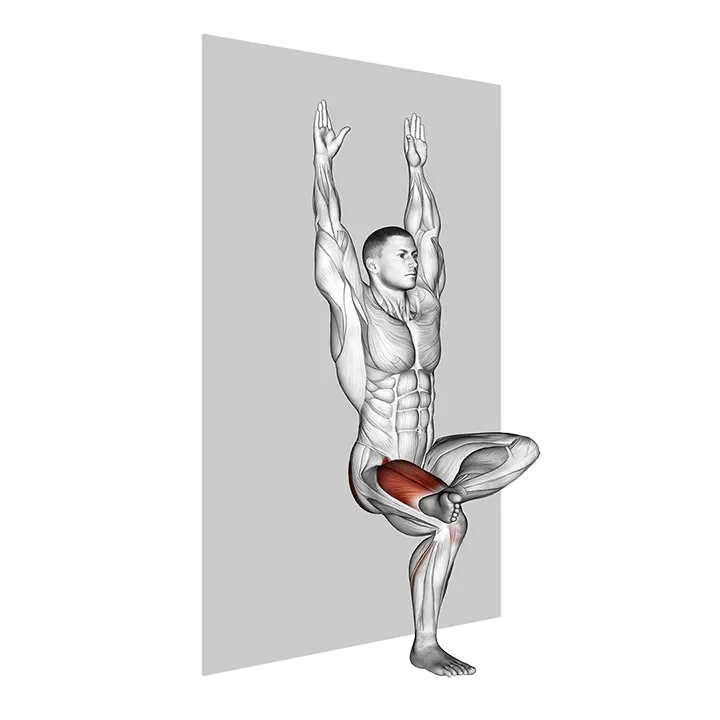
Single Leg Sit (wall)
- Target muscle
- Quadriceps
- Synergist muscles
- Gluteus Maximus, Soleus
- Equipment
- Body weight
- Body part
- Thighs
- Type
- Strength

The single leg sit (wall) is a unilateral bodyweight strength exercise that isolates the quadriceps of the working leg while the gluteus maximus and soleus assist in maintaining the position. Performed with your back flat against a wall, you lower into a single-leg squat hold at roughly 90° and keep the opposite foot off the ground. It is an effective way to build quad endurance, expose side-to-side strength imbalances, and develop stability without any equipment.
How to do the Single Leg Sit (wall)
- 1Stand with your back flat against a wall and your feet hip-width apart, roughly 18–24 inches from the base of the wall.
- 2Shift your weight onto one foot and lift the opposite foot a few inches off the floor, keeping it extended in front of you or slightly bent at the knee.
- 3Slide your back down the wall until the working knee forms approximately a 90° angle, with your thigh parallel to the floor.
- 4Check that your working knee is aligned over your second toe and not caving inward.
- 5Keep your back in full contact with the wall and your core lightly braced throughout the hold.
- 6Hold the position for the target duration while breathing steadily — do not hold your breath.
- 7Press through the heel of the working foot to slide back up the wall to the starting position, then lower the raised foot to the floor.
- 8Rest briefly, then repeat on the opposite leg.
Form tips
- Press your entire back into the wall — any gap between your lower back and the wall shifts load away from your quads and onto your spine.
- Before you slide down, step the working foot slightly toward the midline of your body so your hips stay level instead of rotating toward the raised leg.
- Start with shorter holds (10–20 seconds) and build duration gradually rather than forcing a deep position you cannot sustain with good form.
- Use the raised leg as a balance reference, not a crutch — avoid touching it to the wall or the standing leg.
Common mistakes
- Allowing the working knee to cave inward (valgus collapse), which overloads the medial knee and reduces quad activation.
- Letting the hips drop below 90° with a rounded lower back, which transfers load from the thighs to the lumbar spine.
- Raising the thigh above parallel so the knee angle is greater than 90°, which significantly reduces the demand on the quadriceps.
- Holding the breath to grind through the burn, which spikes blood pressure and shortens the sustainable hold time.
- Pushing off the floor with the raised foot to reduce the load, which defeats the purpose of the single-leg variation.
Frequently asked questions
What muscles does the single leg sit (wall) work?
The quadriceps are the primary muscle under load. The gluteus maximus assists in stabilizing the hip, and the soleus works isometrically to keep the ankle stable throughout the hold.
How long should I hold the single leg wall sit?
Beginners can start with 10–20 second holds per leg. As your quad endurance improves, work toward 30–60 seconds. Three sets per leg with equal rest is a common starting structure.
How is the single leg wall sit different from a regular wall sit?
The single leg version places all of the load on one quadriceps at a time, roughly doubling the intensity compared to the two-legged version. It also challenges hip stability and reveals strength differences between sides.
Where should my foot be positioned relative to the wall?
Your foot should be far enough from the wall that your shin is vertical and your knee does not travel past your toes when you lower to 90°. Start around 18–24 inches out and adjust until your shin angle is neutral.
Can the single leg sit (wall) help with knee rehabilitation?
Isometric quad exercises like this are often used in knee rehab protocols because they load the muscle without joint movement. Always consult a physiotherapist before using this exercise as part of a rehabilitation program.