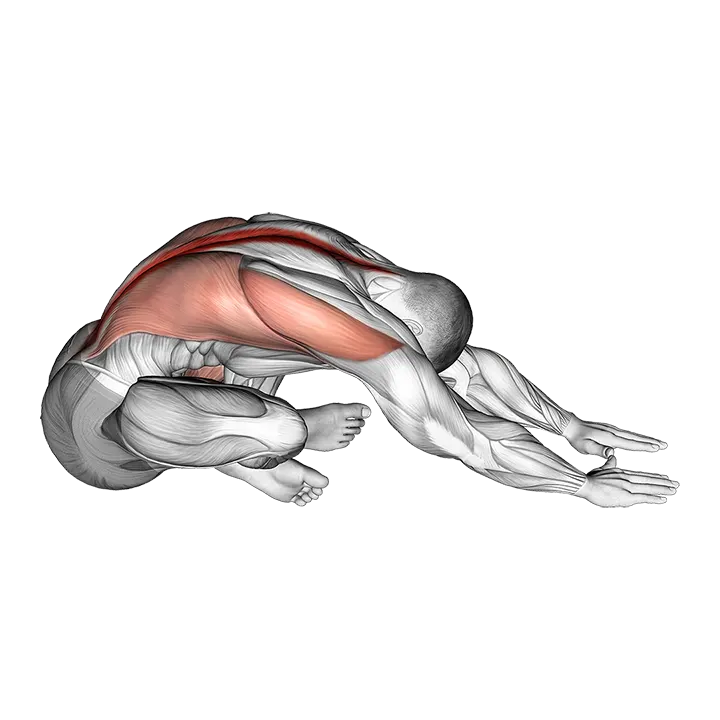
Sitting Crossed Legged Reach Forward Stretch
- Target muscle
- —
- Equipment
- Body weight
- Body part
- Back
- Type
- Stretching
The sitting crossed legged reach forward stretch is a seated flexibility exercise that lengthens the muscles of the lower back and hips by folding the torso forward over crossed legs. It is performed on the floor with no equipment and is commonly used to reduce tension in the back and improve range of motion in the hip rotators and glutes. The position of the crossed legs deepens the stretch compared to a standard seated forward fold.
How to do the Sitting Crossed Legged Reach Forward Stretch
- 1Sit on the floor with your legs crossed comfortably at the ankles or shins, spine upright and tall.
- 2Place both hands on the floor in front of you, shoulder-width apart.
- 3Inhale to lengthen your spine, drawing the crown of your head toward the ceiling.
- 4Exhale and slowly walk your hands forward along the floor, hinging from your hips rather than rounding from your shoulders.
- 5Continue reaching forward until you feel a moderate stretch through your lower back and the outer hip of the top leg.
- 6Keep your sit bones in contact with the floor throughout the movement — avoid letting your hips lift or tilt to one side.
- 7Hold the end position for 20 to 45 seconds while breathing steadily.
- 8Slowly walk your hands back to the start, sit upright, then switch which leg is crossed on top and repeat on the other side.
Form tips
- Initiate the forward lean from the hip crease, not by rounding your upper back — this keeps the stretch in the lower back and hips rather than straining the spine.
- Keep both sit bones evenly weighted on the floor; if one hip rises, reduce the depth of the reach until your pelvis stays level.
- Breathe into the stretch on each exhale and allow the muscles to release gradually rather than forcing a deeper position.
- Sit on a folded blanket or yoga block if your hips tilt backward when you cross your legs — raising the hips slightly makes it easier to hinge forward with a neutral spine.
Common mistakes
- Rounding the upper back and collapsing the chest forward instead of hinging at the hips, which shifts the stretch away from the lower back and glutes and can compress the thoracic spine.
- Allowing one sit bone to lift off the floor, which reduces the effectiveness of the stretch on the elevated side and can create uneven tension in the lower back.
- Pulling with the arms or jerking into the stretch, which activates a protective muscle reflex and prevents the tissues from releasing.
- Holding the breath or bracing throughout the hold, which increases muscle tension and limits how far the stretch can develop.
- Skipping the leg switch and only stretching one side, which reinforces any existing imbalance in hip flexibility.
Frequently asked questions
What does the sitting crossed legged reach forward stretch target?
It primarily stretches the muscles of the lower back along with the hip rotators and glutes, which are placed under tension when the legs are crossed and the torso reaches forward.
How long should I hold the sitting crossed legged reach forward stretch?
Hold each side for 20 to 45 seconds and repeat 2 to 3 times per side. Longer holds of up to 60 seconds can be used when focusing on improving flexibility over time.
Can I do this stretch if my hips are tight and I cannot sit flat on the floor with crossed legs?
Yes. Sit on a folded blanket, cushion, or yoga block to raise your hips. This reduces the demand on hip flexibility and makes it easier to maintain a neutral spine during the forward reach.
When is a good time to do the sitting crossed legged reach forward stretch?
It is most effective as part of a cool-down after exercise when the muscles are warm, or as a standalone mobility session. Avoid performing it as a cold stretch before intense activity.
How is this different from a standard seated forward fold?
Crossing the legs rotates the hip outward on the top side, which places additional emphasis on the hip rotators and outer glute compared to a forward fold with both legs extended or parallel.







