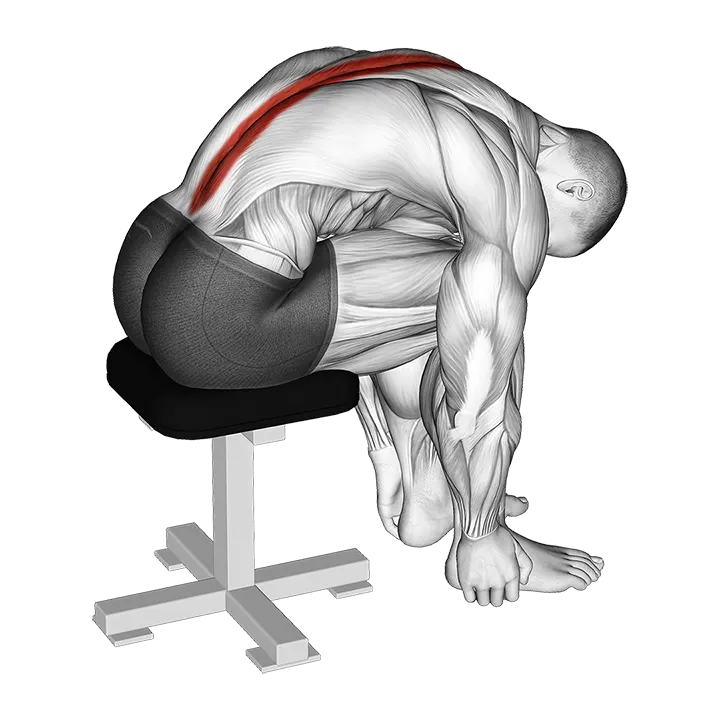
Sitting Lower Trunk Extensor Stretch
- Target muscle
- —
- Equipment
- Body weight
- Body part
- Back
- Type
- Stretching
The Sitting Lower Trunk Extensor Stretch is a gentle, body-weight stretch that targets the lower back extensors — including the erector spinae — by rounding the lumbar spine in a seated position. It relieves stiffness and tightness in the lower back, making it useful as a warm-up, cool-down, or recovery stretch for anyone who sits for extended periods.
How to do the Sitting Lower Trunk Extensor Stretch
- 1Sit upright on a chair or on the floor with your feet flat on the ground and your hands resting on your thighs.
- 2Take a slow breath in to prepare, sitting tall and lengthening through your spine.
- 3On an exhale, begin to round your lower back by tilting your pelvis backward (tucking your tailbone under).
- 4Lean your torso forward and bring both hands around your knees, gently hugging them toward your chest.
- 5Allow your upper back to follow the curve naturally, letting your lower back fully round into a C-shape.
- 6Hold the position for 20–30 seconds, breathing slowly and allowing the lower back muscles to relax with each exhale.
- 7To deepen the stretch, gently draw your knees a little closer to your chest on each exhale without forcing the movement.
- 8To release, slowly sit back upright by unrolling your spine from the bottom up, finishing tall in the starting position.
- 9Repeat 2–3 times as needed, resting briefly between holds.
Form tips
- Breathe slowly and rhythmically throughout — exhale as you round deeper into the stretch to help the lower back muscles release tension.
- Keep the movement passive and gravity-assisted; use your hands only to maintain the position, not to yank your knees harder into your chest.
- Focus the rounding on your lower back rather than your neck and upper spine — avoid jutting your chin forward or collapsing your head down aggressively.
- If sitting on the floor, cross your legs or extend them straight out; on a chair, keep feet hip-width apart and flat on the floor for stability.
- Hold each rep for at least 20 seconds — short holds do not give the erector spinae enough time to fully relax and lengthen.
Common mistakes
- Rounding aggressively through the neck and upper back instead of the lower lumbar region, which shifts the stretch away from the target area and can strain the cervical spine.
- Jerking or bouncing the knees toward the chest, which activates a stretch reflex in the muscles and prevents them from releasing — always move slowly and hold the position still.
- Holding your breath during the stretch, which increases muscular tension and reduces the depth of the stretch — breathe out deliberately to help the lower back relax.
- Over-gripping the knees and pulling too hard, which can compress the lumbar discs; use only light hand pressure and let gravity and relaxation do the work.
- Releasing the stretch too quickly by snapping back upright, which can strain the lower back — always unroll the spine slowly and with control.
Frequently asked questions
What muscles does the Sitting Lower Trunk Extensor Stretch target?
It primarily stretches the lower trunk extensor muscles — most notably the erector spinae group that runs along the lumbar spine. The surrounding deep lower-back muscles and thoracolumbar fascia also benefit from the stretch.
How long should I hold the stretch?
Aim to hold each repetition for 20–30 seconds. This gives the erector spinae and surrounding soft tissue enough time to relax and lengthen. Perform 2–3 holds per session.
Can I do this stretch if I have lower back pain?
Mild lower back stiffness often responds well to this stretch, but if you have a diagnosed disc herniation, acute injury, or sharp pain, consult a healthcare professional before attempting it. Stop immediately if you feel any radiating pain or numbness.
Is it better to do this stretch on a chair or on the floor?
Both positions work. A chair is more accessible and easier to get in and out of, making it a good option at a desk. Sitting on the floor gives slightly more freedom to adjust hip position. Choose whichever feels most comfortable and stable for you.
When is the best time to perform this stretch?
It works well as part of a cool-down after exercise, as a mid-day relief stretch after prolonged sitting, or in a morning mobility routine. Avoid performing it as the very first movement of the day when the spinal discs are still fully hydrated and more vulnerable to compression.







