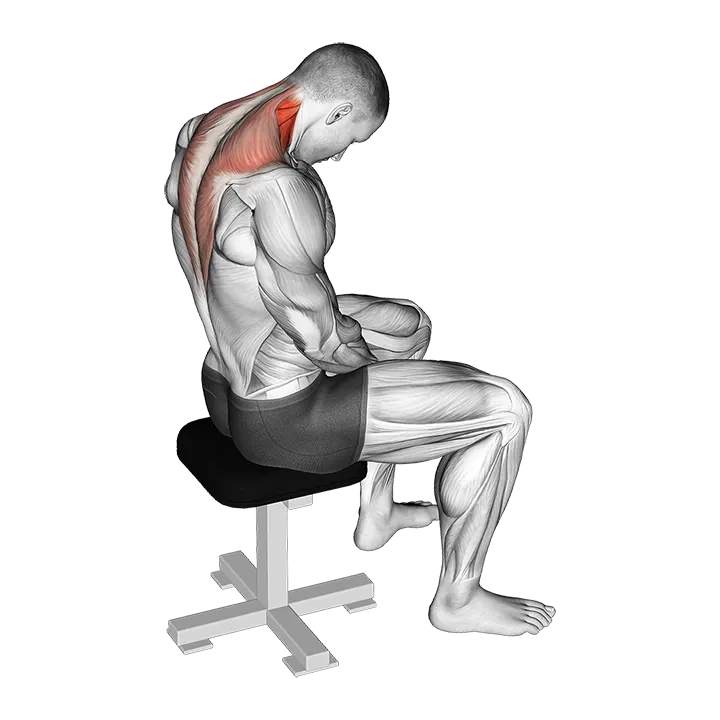
Sitting Neck Flexion Stretch
- Target muscle
- —
- Equipment
- Body weight
- Body part
- Neck
- Type
- Stretching
The sitting neck flexion stretch is a bodyweight mobility exercise that targets the muscles along the back of the neck by gently drawing the chin toward the chest. Performed seated with an upright posture, it relieves tension built up from prolonged sitting or screen time and is suitable for all fitness levels as part of a warm-up, cool-down, or daily mobility routine.
How to do the Sitting Neck Flexion Stretch
- 1Sit upright on a chair or bench with your feet flat on the floor, hips at roughly 90°, and your spine tall — avoid slumping or leaning back.
- 2Relax your shoulders down and away from your ears, and let your arms rest on your thighs.
- 3Take a slow breath in to lengthen your spine.
- 4As you exhale, gently lower your chin toward your chest, allowing the weight of your head to create a mild stretch along the back of your neck.
- 5Stop when you feel a comfortable pull in the back of your neck — do not force or bounce the movement.
- 6Hold the end position for 20–30 seconds while breathing steadily and allowing the stretch to deepen naturally.
- 7Slowly lift your head back to the neutral upright position to finish the rep.
Form tips
- Keep your shoulders down throughout — letting them round forward shifts the stretch away from the neck and onto the upper back.
- Use only gravity and the weight of your head to deepen the stretch; never press down on your head with your hand unless instructed by a healthcare professional.
- Breathe continuously during the hold — holding your breath increases neck muscle tension and reduces the stretch's effectiveness.
- Move in and out of the stretch slowly and smoothly; jerky or fast movements can irritate the cervical spine.
Common mistakes
- Rounding the upper back instead of keeping the spine tall, which reduces the stretch on the neck and can strain the thoracic spine.
- Bouncing or forcing the chin down aggressively, which can irritate the cervical vertebrae and small neck muscles.
- Elevating and tensing the shoulders, which limits the range of motion and misdirects the stretch away from the neck.
- Holding the breath during the stretch, which keeps neck muscles contracted and prevents them from releasing fully.
- Rushing through the hold without giving the muscles time to lengthen — holding for fewer than 20 seconds rarely produces a lasting mobility benefit.
Frequently asked questions
What muscles does the sitting neck flexion stretch target?
It primarily stretches the muscles along the back of the neck — including the upper trapezius and cervical extensor group — which are commonly tight from prolonged sitting or looking at a screen.
How long should I hold the sitting neck flexion stretch?
Hold each rep for 20–30 seconds to allow the neck muscles enough time to relax and lengthen. Aim for 2–3 repetitions per session.
Is the sitting neck flexion stretch safe for people with neck pain?
For general muscle tension it is typically safe, but if you have a diagnosed cervical condition, herniated disc, or experience sharp pain or tingling during the stretch, stop immediately and consult a healthcare professional before continuing.
Can I do this stretch every day?
Yes — because it uses only your body weight and gravity, it can be performed daily as part of a morning routine, between work sessions, or as a cool-down. Daily practice tends to produce the most consistent improvement in neck mobility.
What is the difference between a neck flexion stretch and a neck rotation stretch?
The neck flexion stretch moves the head straight forward and down (chin to chest), targeting the back of the neck. A neck rotation stretch turns the head side to side, targeting the muscles that run diagonally along the sides of the neck. Both complement each other in a well-rounded neck mobility routine.







