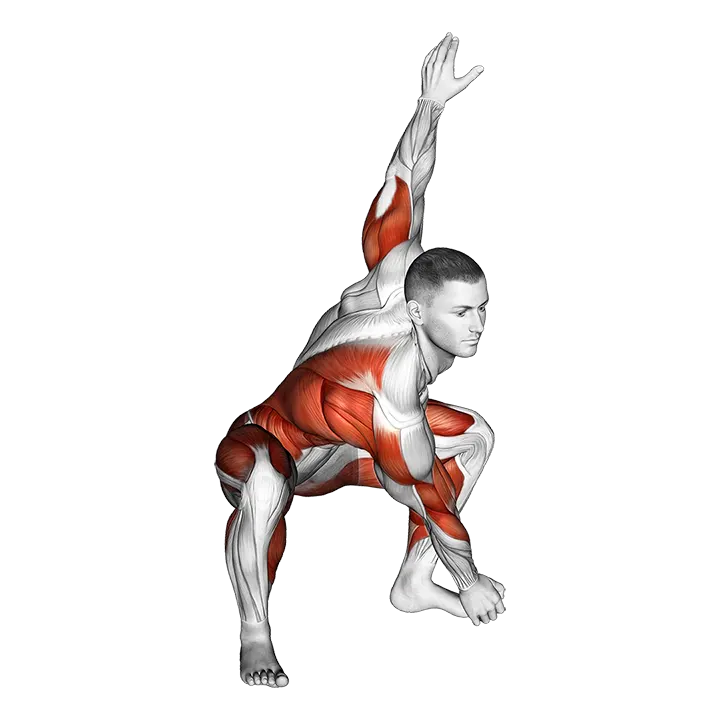
Sitting Sumo Right Twist Stretch
- Target muscle
- —
- Equipment
- Body weight
- Body part
- Back, Thighs, Waist
- Type
- Stretching
The Sitting Sumo Right Twist Stretch is a bodyweight stretching exercise that targets the back and waist while also opening the inner thighs. Performed in a wide-leg seated position with a rotational reach to the right, it improves thoracic and lumbar mobility, hip flexibility, and helps relieve tightness across the lower back and groin.
How to do the Sitting Sumo Right Twist Stretch
- 1Sit on the floor and spread your legs wide into a sumo stance, with your feet angled outward at roughly 45°. Sit tall with your spine upright and your hands resting on your thighs.
- 2Press the backs of your knees gently toward the floor to deepen the inner-thigh stretch and stabilize your base.
- 3Take a slow breath in to lengthen your spine. On the exhale, begin rotating your torso to the right, leading with your chest rather than your shoulders.
- 4Extend both arms to the right as you twist, reaching your right hand behind you and your left arm across toward your right foot or shin.
- 5Hold the rotated position for 20–30 seconds, breathing steadily and letting your spine lengthen with each exhale.
- 6To deepen the stretch, gently walk your fingertips further to the right on each exhale — do not force the range.
- 7On an inhale, slowly unwind back to center, returning your torso to the upright starting position.
- 8Repeat on the left side if performing as part of a balanced routine.
Form tips
- Initiate the rotation from your mid-back (thoracic spine), not just your shoulders — think about rotating your ribcage rather than pulling with your arms.
- Keep both sit bones firmly grounded on the floor throughout the twist; if one hip lifts, reduce your range of rotation.
- Maintain a long spine by lifting the crown of your head toward the ceiling before and during the twist — avoid rounding your lower back.
- Breathe into the stretch: inhale to lengthen, exhale to deepen. Forcing the range while holding your breath tightens rather than releases the muscles.
Common mistakes
- Rounding the lower back instead of maintaining a neutral spine, which compresses the lumbar discs and reduces the stretch's effectiveness on the waist and back.
- Twisting only at the shoulders and neck rather than rotating the thoracic spine, which limits the back mobility benefit and can strain the cervical spine.
- Letting one sit bone lift off the floor during the twist, which destabilizes the pelvis and shifts load unevenly into the hip and lower back.
- Pulling aggressively on the leg or foot to force a deeper twist, risking overstretching the lower back or inner-thigh tendons.
- Holding the breath throughout the hold, which increases muscular tension and prevents the passive release the stretch is designed to create.
Frequently asked questions
What muscles does the Sitting Sumo Right Twist Stretch work?
It primarily stretches the back (erector spinae and mid-back rotators), the waist (obliques and quadratus lumborum), and the inner thighs (adductors) that are lengthened by the wide sumo leg position.
How wide should my legs be in the sumo position?
Start with your feet roughly 1.5–2 times your hip width apart, toes angled outward about 45°. Widen gradually as your flexibility improves — forcing an overly wide stance before your hips are ready can strain the inner thighs.
How long should I hold the stretch?
Hold the twisted position for 20–30 seconds per side, breathing steadily throughout. For general mobility work, 2–3 sets per side is sufficient; for a cool-down, a single extended hold of up to 60 seconds works well.
Is the Sitting Sumo Right Twist Stretch good for lower back pain?
It can help relieve tightness in the lower back and waist by gently mobilizing the lumbar and thoracic spine. However, if you have an acute back injury or disc issues, consult a healthcare professional before attempting rotational stretches.
Can beginners do this stretch?
Yes. Beginners can start with a narrower leg stance and a shallower rotation, using their hands on the floor for support. Range of motion will improve naturally with consistent practice — there is no need to force depth on early sessions.







