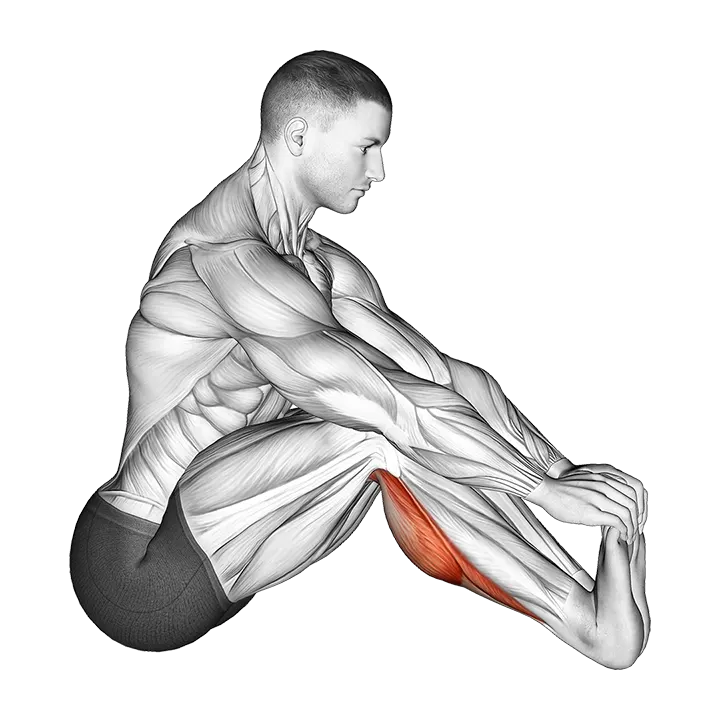
Sitting Toe Pull Achilles Stretch
- Target muscle
- —
- Equipment
- Body weight
- Body part
- Calves
- Type
- Stretching
The sitting toe pull Achilles stretch is a floor-based flexibility exercise that targets the Achilles tendon and the calf muscles (gastrocnemius and soleus) by pulling the toes back toward the shin while seated. It requires no equipment and is well suited for improving ankle dorsiflexion and relieving tightness in the lower leg after activity.
How to do the Sitting Toe Pull Achilles Stretch
- 1Sit on the floor with your legs extended straight in front of you and your spine upright.
- 2Flex your foot so your toes point toward the ceiling, then reach forward and wrap your hand around the ball of your foot or the toes.
- 3Gently pull your toes back toward your shin until you feel a stretch along the back of your lower leg and Achilles tendon.
- 4Keep your knee straight and pressed lightly toward the floor throughout the movement to target the gastrocnemius.
- 5Hold the stretched position for 20–30 seconds, breathing slowly and allowing the tension to ease gradually.
- 6Release the pull and let your foot return to a neutral position.
- 7Switch to the opposite foot and repeat the same sequence.
- 8Complete the desired number of holds on each side.
Form tips
- Pull the toes back slowly and stop at the point of mild tension — forcing the stretch further can aggravate the Achilles tendon.
- Keep your knee fully extended for the entire hold to ensure the gastrocnemius, which crosses the knee joint, is included in the stretch.
- Sit tall rather than rounding your lower back; collapsing forward reduces the effective range of motion at the ankle.
- If you cannot reach your toes comfortably, loop a towel or resistance band around the ball of your foot and pull the ends instead.
Common mistakes
- Bending the knee during the stretch, which takes the gastrocnemius off tension and limits the effectiveness of the exercise.
- Pulling too aggressively on the toes, which can place excessive stress on the Achilles tendon and increase injury risk.
- Holding the stretch for only a few seconds, which is generally not long enough for the muscle-tendon unit to relax and lengthen.
- Rounding the lower back and hunching forward, which shifts the position of the pelvis and reduces dorsiflexion range at the ankle.
- Neglecting the opposite side, which can leave asymmetrical tightness between the two calves and ankles.
Frequently asked questions
What muscles and tendons does the sitting toe pull Achilles stretch target?
The stretch primarily targets the Achilles tendon and the two calf muscles it connects to: the gastrocnemius and the soleus. Keeping the knee straight places greater emphasis on the gastrocnemius, while a slight knee bend (in variations) shifts more load to the soleus.
Should I do this stretch before or after a workout?
Static stretches held for 20–30 seconds are generally best performed after a workout or as part of a cool-down, when muscles and tendons are warm. Using them as a primary pre-workout warm-up may temporarily reduce force production, though brief holds of around 10 seconds are considered lower risk before activity.
How many sets and holds should I do?
A common recommendation is 2–3 holds per side, each lasting 20–30 seconds, with a short rest between holds. For rehabilitation or persistent Achilles tightness, a physical therapist may prescribe longer or more frequent sessions.
Is this stretch safe if I have Achilles tendon pain?
If you have an active Achilles tendon injury or tendinopathy, you should consult a physical therapist or sports medicine professional before performing this stretch. Static stretching can sometimes aggravate an irritated tendon, and a clinician can advise whether stretching or loading exercises are more appropriate for your stage of recovery.
What are good alternatives if I cannot reach my toes?
Looping a towel, yoga strap, or resistance band around the ball of the foot achieves the same dorsiflexion pull without requiring hamstring flexibility. A standing calf stretch with a straight knee against a wall is another effective alternative that targets the same muscles and tendon.







