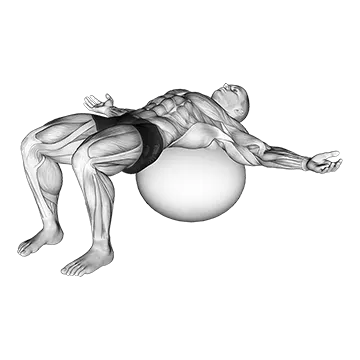
Stability Ball Single Leg Squat
- Target muscle

- Gluteus Maximus, Quadriceps
- Synergist muscles
- Adductor Magnus, Soleus
- Equipment
- Stability ball
- Body part
- Thighs
- Type
- Strength



The Stability Ball Single Leg Squat is a unilateral lower-body strength exercise in which the rear foot rests on a stability ball while the front leg performs a squat, placing the primary demand on the gluteus maximus and quadriceps of the working leg. The adductor magnus and soleus assist in stabilizing the movement. The unstable surface of the stability ball increases the balance and proprioceptive challenge compared to a fixed rear-foot elevation.
How to do the Stability Ball Single Leg Squat
- 1Place a stability ball on the floor behind you and stand about two to three feet in front of it, facing away.
- 2Reach one foot back and rest the top of that foot on the stability ball, laces down, so the rear leg trails behind you and the ball supports only the foot.
- 3Stand tall on your front foot with your foot pointing forward and your weight distributed evenly across the sole.
- 4Brace your core, keep your chest up, and allow a slight forward lean at the hips to maintain balance.
- 5Inhale and lower your body by bending the front knee and hip, descending until your front thigh is roughly parallel to the floor or your mobility allows.
- 6Keep your front knee tracking in line with your toes and avoid letting it cave inward during the descent.
- 7Exhale and drive through the heel and mid-foot of your front foot to press back up to the starting position.
- 8Complete all reps on one side, then switch legs and repeat.
Form tips
- Set the ball far enough back that your front shin can stay close to vertical at the bottom, but not so far that the rear hip is pulled into an uncomfortable stretch.
- Keep your gaze forward and your torso relatively upright to shift more demand onto the gluteus maximus rather than the lower back.
- Press the top of your rear foot lightly into the ball rather than bearing weight through it; the front leg should carry virtually all the load.
- If balance is difficult, briefly touch a wall or hold a light object for support until you build the necessary stability.
- Control the descent over two to three seconds to increase time under tension on the quadriceps and gluteus maximus.
Common mistakes
- Placing the front foot too close to the ball, which forces the front knee to travel far over the toes and increases patellar tendon stress.
- Allowing the front knee to cave inward (valgus collapse) during the squat, which reduces gluteus maximus activation and places excess strain on the knee joint.
- Bearing too much weight through the rear foot on the stability ball, which destabilizes the ball and shifts work away from the target muscles of the front leg.
- Rounding the lower back by letting the torso drop excessively forward, which transfers load from the quadriceps and gluteus maximus to the lumbar spine.
- Rushing through the descent without control, which reduces tension on the working muscles and makes it harder to maintain balance on the unstable surface.
Frequently asked questions
What muscles does the Stability Ball Single Leg Squat work?
The primary muscles worked are the gluteus maximus and quadriceps of the front working leg. The adductor magnus assists in hip extension at the bottom of the squat, and the soleus contributes to ankle stability during the movement. The core musculature works continuously to maintain balance on the unstable surface.
How is this exercise different from a regular Bulgarian split squat?
Both exercises use a rear-foot-elevated split squat pattern, but placing the rear foot on a stability ball rather than a fixed bench introduces additional balance and proprioceptive demand. The unstable surface requires more continuous stabilization from the working leg and core, which can increase neuromuscular challenge without adding external load.
Is this exercise suitable for beginners?
It is generally better suited to intermediate exercisers who already have a baseline of single-leg strength and balance. Beginners are typically advised to master the standard split squat or Bulgarian split squat on a fixed surface before progressing to the stability ball version, as the unstable rear support significantly increases the balance demand.
How far in front of the stability ball should my front foot be?
A starting position of roughly two to three feet in front of the ball works for most people, but the exact distance depends on your leg length and hip mobility. Your front shin should remain close to vertical at the bottom of the squat and your front knee should not travel dramatically past your toes. Adjust the distance in small steps until the movement feels controlled.
How many sets and reps are recommended for the Stability Ball Single Leg Squat?
For strength and hypertrophy, 3–4 sets of 8–12 reps per leg is a common starting point. Because balance fatigue accumulates quickly on the unstable surface, shorter rest intervals can make the exercise disproportionately difficult; 60–90 seconds of rest between sets on each side is a reasonable guideline.