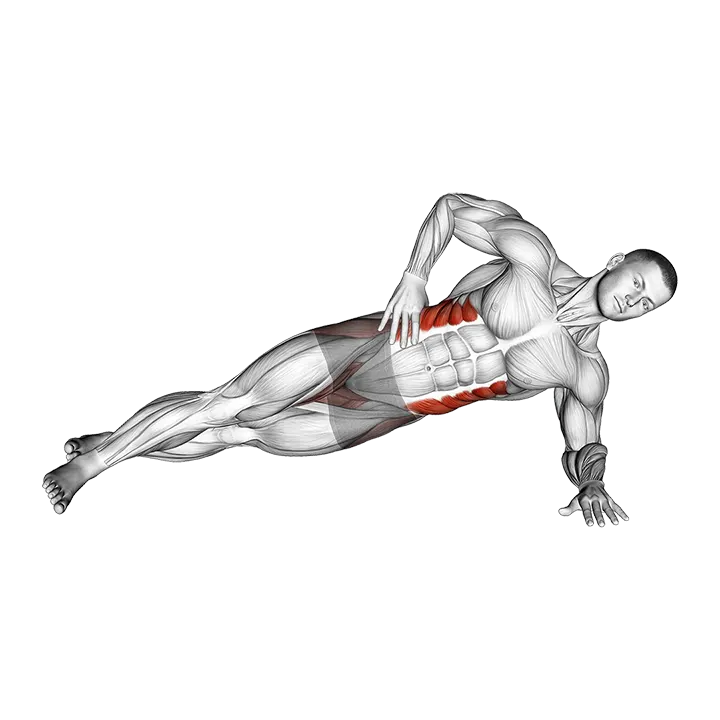
Staggered Leg Side Bridge
- Target muscle
- —
- Equipment
- Body weight
- Body part
- Waist
- Type
- Strength
The Staggered Leg Side Bridge is a bodyweight lateral core exercise that challenges the obliques, deep waist stabilizers, and lateral hip musculature through an isometric hold. By placing the top foot slightly in front of the bottom foot rather than stacking them, the exercise narrows the base of support and demands greater balance control than a standard side bridge. It is a practical tool for building lateral stability, improving hip alignment, and reinforcing the side of the torso that supports the spine.
How to do the Staggered Leg Side Bridge
- 1Lie on your side on a firm surface with your legs fully extended. Stack your hips and shoulders vertically so your body forms a straight line from head to feet.
- 2Place your bottom elbow directly beneath your shoulder with your forearm flat on the floor and pointing away from your body.
- 3Stagger your feet by sliding the top foot approximately one foot-length in front of the bottom foot so they are offset rather than stacked.
- 4Rest your top hand on your hip or extend it toward the ceiling to assist with balance.
- 5Press your bottom forearm and the outer edge of your bottom foot into the floor, then lift your hips until your body forms a straight diagonal line from head to feet.
- 6Hold the position by contracting the muscles along the side of your torso and keeping your hips level — do not let them sag toward the floor or rotate forward or backward.
- 7Breathe steadily throughout the hold, keeping your neck neutral and your gaze directed forward.
- 8Lower your hips back to the floor in a controlled manner to end the set, then switch sides.
Form tips
- Actively pack your bottom shoulder by pressing the shoulder blade down and back rather than letting it shrug toward your ear. This protects the joint and keeps the lateral core engaged as intended.
- Think of your body as a rigid plank from shoulder to ankle. Any sag at the hips or kink at the waist means the core has stopped doing its job — reset your position rather than grinding through misaligned form.
- Squeeze the glute of the top leg throughout the hold. This cues hip extension, discourages the pelvis from tipping forward, and adds lateral hip work to the set.
- The staggered foot position reduces your base of support compared to stacking your feet. If you feel your hips rotating, shorten the hold and rebuild with control before increasing duration.
Common mistakes
- Letting the hips sag toward the floor — this removes the demand from the lateral core and shifts stress onto the shoulder joint instead. Keep the hips elevated and in line with the shoulders and feet throughout the hold.
- Rotating the pelvis forward or backward — the staggered leg position can tempt you to open the hips toward the ceiling or floor. Stay squared up and stay focused on the lateral plane.
- Shrugging the bottom shoulder — allowing the shoulder to rise toward the ear compromises joint position and shortcuts the intended core work. Press the shoulder blade actively into its socket for the entire hold.
- Holding your breath — isometric exercises naturally encourage breath-holding, which spikes intra-abdominal pressure unnecessarily. Breathe slowly and steadily throughout each hold.
- Holding too long to maintain good form — if your hips begin to drop in the final seconds, the productive part of the set is already over. Use shorter holds with perfect alignment rather than grinding through with hips sagging.
Frequently asked questions
What muscles does the Staggered Leg Side Bridge work?
The exercise targets the lateral core, including the obliques and the deep stabilizing muscles along the side of the waist. The hip musculature on both sides works to maintain alignment throughout the hold, and the shoulder stabilizers of the supporting arm remain active from start to finish.
What is the difference between the Staggered Leg Side Bridge and a standard side bridge?
In a standard side bridge the feet are stacked on top of each other. In the staggered variation the top foot sits slightly in front of the bottom foot, which narrows the base of support and shifts your center of mass. This makes the hold more demanding for balance and places a somewhat different loading pattern on the lateral hip and waist stabilizers.
How long should I hold the Staggered Leg Side Bridge?
Start with holds of 10–20 seconds and work toward 30–45 seconds as your lateral core strength and balance improve. Total time under tension per side matters more than any single long hold — three 20-second holds per side with good form can be as effective as one extended hold with hips sagging.
How do I make the Staggered Leg Side Bridge easier or harder?
To make it easier, perform the hold from your bottom knee rather than your foot while keeping the staggered top leg extended. To make it harder, raise the top leg off the bottom foot during the hold, or add a small controlled hip dip — lowering and raising the hips slightly — to introduce a dynamic element.
Can beginners do the Staggered Leg Side Bridge?
The exercise requires no equipment and suits most fitness levels, but some baseline lateral core strength helps. If the full side bridge feels unstable, start with a standard side bridge from the knees before progressing to the full foot position, and then move to the staggered variation once you can hold steady for 20–30 seconds per side.







