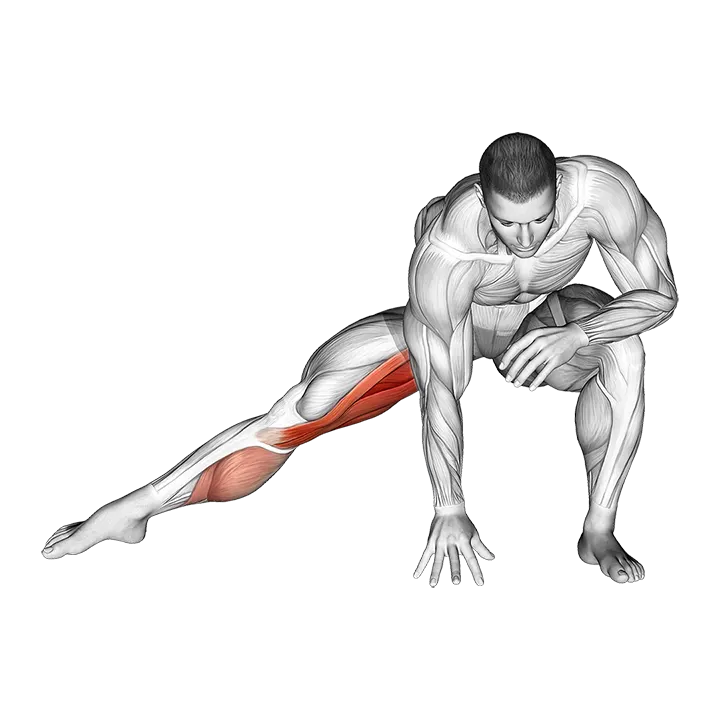
Standing Bent Knee Hip Adductor Stretch
- Target muscle
- —
- Equipment
- Body weight
- Body part
- Hips
- Type
- Stretching
The Standing Bent Knee Hip Adductor Stretch targets the hip adductors and inner thigh of the straight leg by shifting your weight into a side-lunge position with one knee bent. Keeping the working knee bent reduces hamstring tension and directs the stretch more precisely to the groin and inner hip. It is a practical bodyweight movement for improving hip mobility and groin flexibility.
How to do the Standing Bent Knee Hip Adductor Stretch
- 1Stand with your feet roughly two shoulder-widths apart, toes pointing forward or turned out slightly.
- 2Place your hands on your hips or rest them on your thighs for support.
- 3Shift your weight to the right side by bending your right knee and pushing your hips back and to the right, as you would in a side lunge.
- 4Keep your left leg straight throughout — do not allow the left knee to bend.
- 5Press your left foot flat into the floor to maintain contact and stability.
- 6Hold the stretched position for 20–30 seconds, breathing slowly and allowing the inner thigh of the straight leg to relax into the stretch.
- 7Push through your right foot to return to the starting position.
- 8Repeat on the opposite side by bending the left knee and straightening the right leg.
Form tips
- Keep your torso upright or lean only slightly forward — collapsing your chest toward the floor shifts tension away from the hip adductors and onto your lower back.
- Press the foot of your straight leg firmly into the floor. Lifting the heel or rolling to the outer edge reduces the stretch on the inner thigh.
- Breathe out as you lower into the position and continue breathing normally while you hold it — relaxing on each exhale lets you ease further into the stretch without forcing it.
- Control the depth of the stretch by how far you bend the working knee. Start with a shallow bend and increase only when you feel comfortable and stable.
Common mistakes
- Allowing the straight knee to bend — even a small bend takes tension off the adductors and reduces the effectiveness of the stretch. Keep that leg fully extended throughout.
- Rushing the hold and releasing after only a few seconds — the hip adductors are dense, strong muscles that need sustained time under a gentle load to release. Hold each side for at least 20 seconds.
- Letting the heel of the straight leg lift off the floor, which reduces inner-thigh tension and shifts load to the outer leg. Keep the full foot flat on the ground.
- Forcing the stretch by lunging too deep too soon, which can strain the groin. Move into a comfortable range first and progress gradually over multiple sessions.
- Twisting the torso toward the bent knee — this rotates the pelvis and reduces the adductor stretch on the straight side. Keep your hips square and facing forward.
Frequently asked questions
What muscles does the Standing Bent Knee Hip Adductor Stretch target?
The stretch primarily targets the hip adductors — the group of muscles along the inner thigh of the straight leg, including the adductor magnus, adductor longus, and gracilis. Keeping the knee bent on the working side reduces hamstring involvement so the stretch stays focused on the groin and inner hip.
How is this different from a regular side lunge stretch?
In a standard side lunge stretch both legs are often involved, and the hamstrings of the straight leg tend to limit range of motion. By intentionally bending the working knee and keeping the opposite leg straight, this variation isolates the adductors of the straight leg with less interference from hamstring tightness.
How long should I hold the stretch?
Hold each side for 20–30 seconds to allow the adductors time to relax and lengthen. For a full mobility session, two to three rounds per side with a brief rest between rounds is effective.
Can I do this stretch as part of a warm-up?
A brief, gentle version works as a dynamic warm-up when performed with controlled movement in and out of the position rather than a static hold. For deeper flexibility gains, save longer static holds for after your workout when muscles are already warm.
I feel the stretch in my hamstring, not my inner thigh. What am I doing wrong?
This usually means the straight-leg knee is not fully extended, the foot is rolled outward, or your stance width is too narrow. Make sure the straight leg is completely extended, the foot is flat and pointing forward, and your feet are at least two shoulder-widths apart before shifting your weight to the side.







