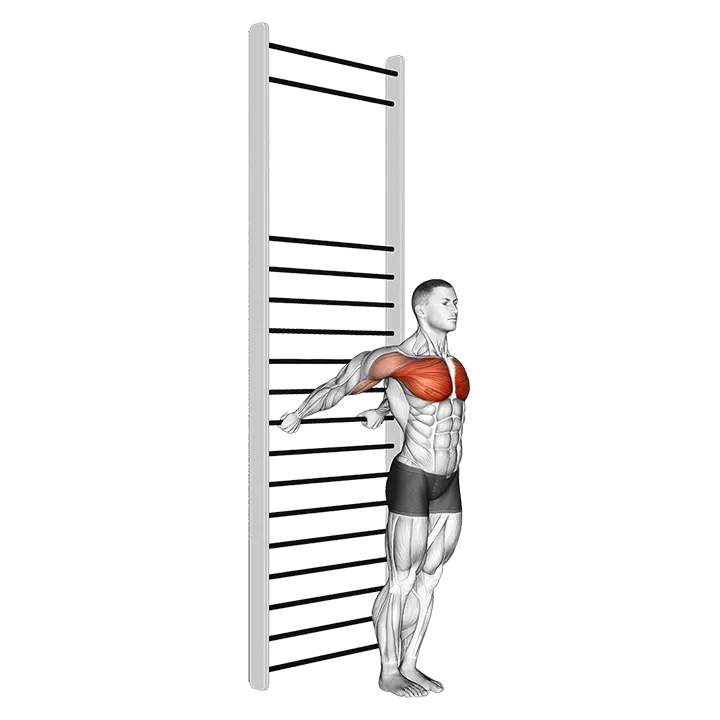
Standing Chest Stretch (with Training Wall Bars)
- Target muscle
- —
- Equipment
- Body weight
- Body part
- Chest
- Type
- Stretching
The Standing Chest Stretch with Training Wall Bars is a static stretch that opens the pectorals and the front of the shoulders by using wall-mounted gymnastics bars as a fixed anchor. You grip a bar at roughly shoulder height, step forward, and let your body weight pull the chest into extension. It is a practical cool-down or warm-up movement for anyone whose training or posture tightens the chest.
How to do the Standing Chest Stretch (with Training Wall Bars)
- 1Stand with your back to the wall bars, feet about hip-width apart, close enough to reach the rungs comfortably.
- 2Extend one or both arms behind you and grip a rung at shoulder height or slightly above — a higher rung increases the stretch intensity.
- 3Step forward with both feet until your arm or arms are fully extended and you feel tension across the front of your chest.
- 4Stand tall: keep your head neutral, your chin level, and avoid leaning your torso forward at the hips.
- 5Breathe in to prepare, then exhale slowly and allow your chest to open further as your shoulder(s) draw back gently.
- 6Hold the stretched position for 20–30 seconds, continuing to breathe slowly and steadily throughout.
- 7To increase the stretch, step one small step further forward; to decrease it, step back slightly — find the level where you feel a firm but pain-free pull.
- 8To finish, step back toward the wall bars to release the tension before letting go of the rung.
- 9Repeat on the opposite arm if performing the stretch unilaterally, or rest 30–60 seconds before a second hold if working bilaterally.
Form tips
- Hold each rep for 20–30 seconds — shorter holds do not give connective tissue enough time to respond to the stretch.
- Keep your shoulders pulled down and away from your ears throughout the hold; shrugging reduces the stretch on the pectorals.
- Use exhales to deepen the stretch progressively — breathe out and let the chest sink open a little further with each breath cycle.
- Experiment with grip height: a rung above shoulder height emphasizes the lower pectorals and the front of the shoulder, while a rung at shoulder height targets the mid-chest more directly.
- For a unilateral stretch, rotate your torso gently away from the gripping arm to isolate one side of the chest at a time.
Common mistakes
- Gripping far below shoulder height: a very low rung biases the stretch toward the upper (clavicular) fibers and the front of the shoulder, so the mid and lower chest you were trying to open barely gets stretched.
- Leaning the torso forward: bending at the hips to reach further reduces the stretch across the chest and places unnecessary strain on the lower back.
- Holding the breath: breath-holding increases muscular tension and prevents the pectorals from relaxing into the stretch, making the hold less effective.
- Releasing abruptly: letting go of the bar or stepping back quickly can cause a sudden jerk to the shoulder joint — always release the stretch slowly and with control.
- Overstretching through pain: stepping too far forward so the stretch becomes sharp or painful moves past the productive range and risks straining the pectoral muscle or the shoulder capsule.
Frequently asked questions
How is the wall bars version different from a doorway chest stretch?
The wall bars give you multiple rung heights to choose from, so you can fine-tune the angle of the stretch without repositioning your entire body. A doorway stretch is fixed to one height and width, while the bars let you shift up or down by a single rung to hit different portions of the pectoral. The bars also allow a clean unilateral hold, which is harder to achieve in a doorway.
When in a workout should I do this stretch?
Use it as part of a cool-down after any pressing session (bench press, push-ups, dips) to help restore chest length after the muscles have been working in a shortened position. It can also appear in a warm-up at low intensity to increase blood flow and range of motion before upper-body training. Avoid heavy static stretching immediately before maximum-effort sets, as it can temporarily reduce force output.
How long and how often should I hold the stretch?
Aim for 2–3 holds of 20–30 seconds per side per session. For general maintenance, 3–4 sessions per week is sufficient. If you are actively working to correct rounded-shoulder posture, daily stretching with progressive grip height increases tends to produce faster results.
Can I do this stretch if I have a shoulder injury?
Check with a physiotherapist before loading an injured shoulder into end-range extension. If you have been cleared for gentle movement, start with a rung at or slightly below shoulder height and step forward only a short distance. Sharp pain or any sensation of catching or instability in the joint is a sign to stop and seek guidance.
Is one arm at a time better than stretching both arms together?
Both approaches are valid. Stretching one arm at a time lets you rotate the torso slightly away from the gripping side, which isolates the pectoral more precisely and reveals side-to-side differences in flexibility. Bilateral holds are more time-efficient and produce a symmetric stretch. Begin unilaterally if one side feels noticeably tighter than the other.







