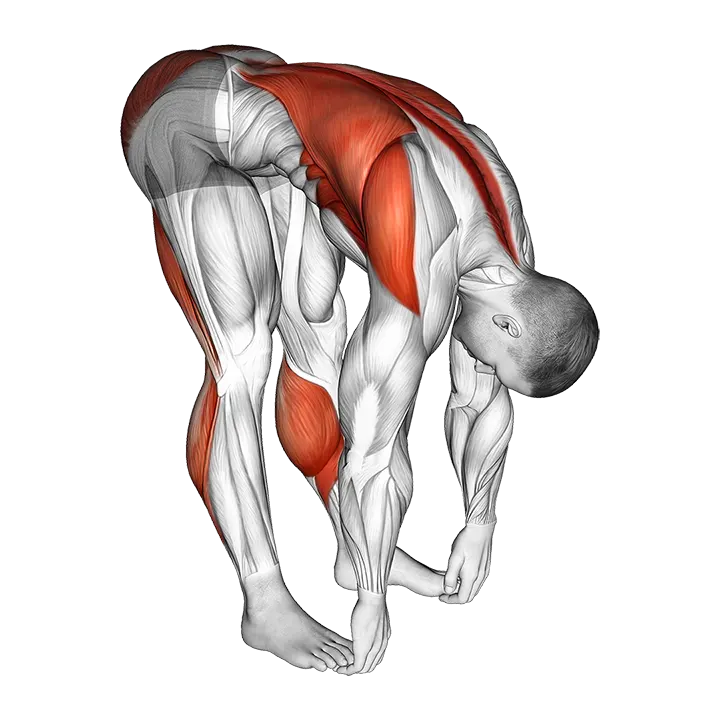
Standing Hamstrings and Back Stretch
- Target muscle
- —
- Equipment
- Body weight
- Body part
- Back, Thighs
- Type
- Stretching
The standing hamstrings and back stretch is a bodyweight flexibility exercise that simultaneously lengthens the hamstrings along the back of the thighs and the muscles of the lower and mid back. Performed upright with a forward bend, it requires no equipment and is commonly used as part of a cool-down or mobility routine to reduce tension built up from sitting, lifting, or running.
How to do the Standing Hamstrings and Back Stretch
- 1Stand with your feet hip-width apart and your knees soft but not deeply bent.
- 2Inhale to lengthen your spine, then exhale and hinge forward at the hips, leading with your chest rather than rounding from the shoulders.
- 3Lower your torso toward your thighs, letting your arms hang down toward the floor or resting your hands on your shins.
- 4Allow your head and neck to relax fully so they hang heavy with gravity.
- 5Straighten your knees as far as your flexibility allows without locking them out forcefully — stop where you feel a firm but comfortable pull along the back of your legs and into your lower back.
- 6Hold the position for 20–40 seconds, breathing slowly and allowing the stretch to deepen on each exhale.
- 7To finish, bend your knees slightly, engage your core, and roll back up to standing one vertebra at a time.
Form tips
- Hinge from the hips rather than curling your spine first — this ensures the hamstrings are loaded from the start of the movement.
- Keep a slight bend in your knees if your hamstrings are tight; forcing straight legs can shift excessive stress onto the lower back.
- Let gravity do the work — relax your shoulders, neck, and jaw so your upper body hangs freely rather than reaching or pulling.
- Breathe steadily and use each exhale to release a little more tension; avoid holding your breath, which keeps muscles guarded.
Common mistakes
- Rounding the upper back immediately instead of hinging at the hips, which reduces the stretch on the hamstrings and places all tension on the spine.
- Bouncing or pulsing at the bottom of the stretch, which triggers the stretch reflex and increases the risk of a muscle strain.
- Locking the knees into full hyperextension, which puts undue stress on the knee joint rather than allowing a progressive hamstring stretch.
- Holding your breath throughout the hold, which keeps muscles tense and prevents the stretch from deepening.
Frequently asked questions
What muscles does the standing hamstrings and back stretch target?
The primary muscles being stretched are the hamstrings (biceps femoris, semitendinosus, semimembranosus) at the back of the thighs and the erector spinae and other soft tissues along the lower and mid back.
How long should I hold this stretch?
Hold for 20–40 seconds per set for a static stretch. This duration is generally sufficient to allow the hamstrings and back muscles to relax into the position. You can repeat 2–3 times if needed.
Should my legs be completely straight?
Not necessarily. Keep a soft bend in your knees if your hamstrings are tight. As flexibility improves over time, you can gradually work toward straighter legs. Forcing straight knees too soon can strain the lower back.
When is the best time to do this stretch?
This stretch is best performed after a workout or activity when your muscles are warm. Stretching cold, tight hamstrings aggressively can increase injury risk, so avoid forcing the range of motion at the start of a session.
Can this stretch help with lower back pain?
Tight hamstrings can contribute to lower back discomfort by pulling on the pelvis, so regularly stretching them may help reduce that tension. However, if you have an existing back injury, check with a healthcare professional before adding forward-bend stretches to your routine.







