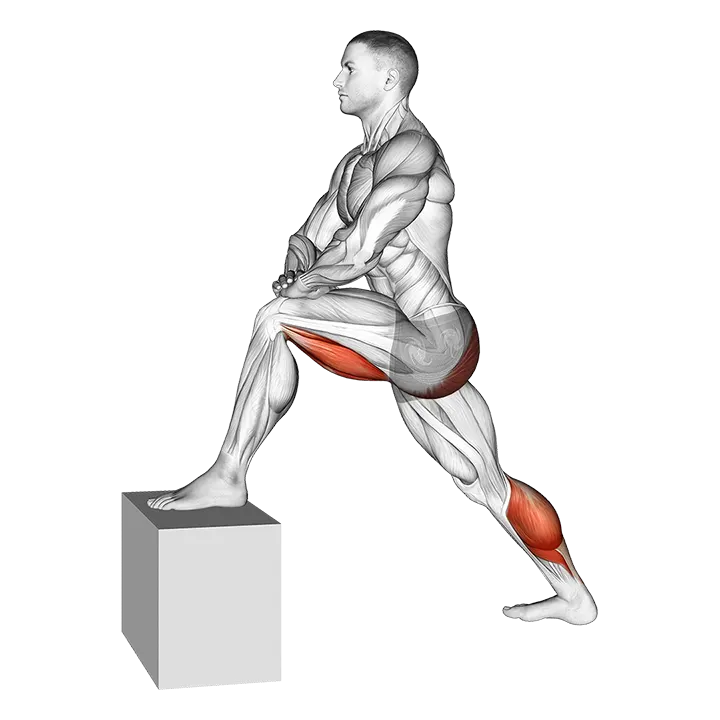
Standing Hip Flexor Stretch
- Target muscle
- —
- Equipment
- Body weight
- Body part
- Thighs
- Type
- Stretching
The Standing Hip Flexor Stretch is a bodyweight flexibility exercise that targets the hip flexor muscles at the front of the thigh and pelvis, particularly the iliopsoas and rectus femoris. Performed in a staggered stance with one knee lowered toward the floor, it lengthens the hip flexors by placing the rear hip into extension. It is a foundational mobility drill for people who sit for extended periods or experience tightness through the front of the hips.
How to do the Standing Hip Flexor Stretch
- 1Stand tall with your feet together and find a stable surface nearby if you need balance support.
- 2Step your right foot forward roughly two to three feet, forming a staggered stance.
- 3Lower your left knee toward the floor in a controlled manner, allowing the left foot to remain on its toes behind you.
- 4Keep your torso upright and your front knee stacked directly over your front ankle — do not let it drift forward past your toes.
- 5Shift your hips gently forward and downward until you feel a stretch along the front of the left hip and thigh.
- 6Squeeze the glute of the rear leg lightly to increase the stretch and encourage a posterior pelvic tilt.
- 7Hold the position for 20–30 seconds, breathing steadily and allowing the hip flexors to relax with each exhale.
- 8Press through the front foot to return to standing, then repeat on the opposite side.
- 9Complete 2–3 rounds per side.
Form tips
- Actively squeeze the glute of the rear leg throughout the hold — this tilts the pelvis posteriorly and creates a more effective stretch on the iliopsoas, which is often missed when the pelvis tips forward.
- Keep your torso upright rather than leaning forward. Leaning forward shifts tension away from the hip flexors and reduces the effectiveness of the stretch.
- Do not allow the front knee to cave inward or drift past the toes — both positions reduce stability and shift stress onto the knee joint rather than the hip.
- If your rear knee feels uncomfortable on a hard floor, place a folded mat or towel underneath it to cushion the contact point.
- Breathe deeply into the stretch rather than holding your breath. Relaxing on each exhale allows the nervous system to release tension and lets the hip flexors lengthen more readily.
Common mistakes
- Allowing the front knee to track past the toes — this places excessive shear force on the knee joint and is usually a sign the stance is too short. Step the front foot further forward so the shin stays roughly vertical at the bottom of the stretch.
- Letting the pelvis tilt anteriorly (arching the low back) — an anterior pelvic tilt actually shortens the hip flexors and negates the stretch. Squeeze the rear glute and gently tuck the pelvis to maintain a neutral spine and maximize the stretch.
- Leaning the torso forward over the front leg — bending at the waist reduces hip extension on the rear side and moves tension away from the hip flexors. Maintain an upright chest throughout the hold.
- Cutting the hold short — a stretch held for fewer than 15 seconds is typically not long enough for the muscle to relax and begin lengthening. Aim for at least 20 seconds per side to see meaningful improvement in flexibility.
- Skipping the rear glute contraction — without actively engaging the glute of the rear leg, many people fail to achieve true hip extension and miss the deepest part of the hip flexor stretch. The contraction is not optional; it is what makes the stretch work.
Frequently asked questions
What muscles does the Standing Hip Flexor Stretch target?
The stretch primarily targets the hip flexor muscle group at the front of the hip and thigh, with particular emphasis on the iliopsoas (iliacus and psoas major) and the rectus femoris, which is the front head of the quadriceps. Both muscles cross the hip joint and become shortened with prolonged sitting.
How long should I hold a hip flexor stretch?
Most research and practical guidance supports holding each side for 20–30 seconds as a minimum effective dose. Repeating for 2–3 rounds per side produces better cumulative results than a single long hold. If your hip flexors are particularly tight, gradually working toward 45-second holds over several weeks is a reasonable progression.
Can tight hip flexors cause lower back pain?
Yes, chronically tight hip flexors are a common contributor to lower back pain. When the iliopsoas is shortened, it pulls the lumbar spine into an anterior tilt, increasing compression on the lumbar vertebrae. Regularly stretching the hip flexors can reduce this pull and help relieve associated lower back discomfort, though persistent pain should be evaluated by a healthcare professional.
How is the Standing Hip Flexor Stretch different from a kneeling lunge stretch?
The two stretches work the same muscles and the mechanics are nearly identical. The kneeling version rests the rear knee on the floor throughout, which tends to provide more stability and allows a deeper pelvic tuck. The standing version keeps the rear foot on its toes, which requires slightly more balance but is more accessible when a mat or soft surface is not available.
How often should I stretch my hip flexors?
Daily stretching is safe and beneficial for the hip flexors, especially for people who sit for long hours. Two to three rounds per side held for 20–30 seconds each is a practical starting point. Consistency over time matters more than any single session — small daily doses of stretching produce greater lasting flexibility than infrequent long sessions.







