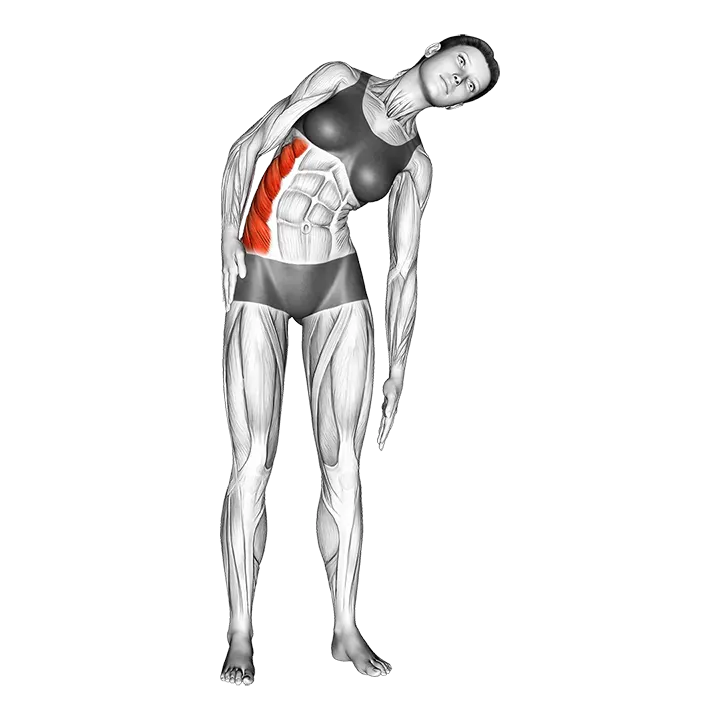
Standing Lateral Side Stretch
- Target muscle
- —
- Equipment
- Body weight
- Body part
- Waist
- Type
- Stretching
The standing lateral side stretch lengthens the muscles along the side of your torso — including the obliques, intercostals, and the connective tissue around the waist — by reaching one arm overhead and bending to the opposite side. It is a body-weight-only movement that requires no equipment and fits naturally into warm-up routines, cool-downs, or any session that involves heavy torso rotation or overhead pressing work.
How to do the Standing Lateral Side Stretch
- 1Stand with your feet hip-width apart, knees soft rather than locked, and your weight distributed evenly across both feet.
- 2Let your arms hang at your sides and take one slow breath to lengthen your spine before you begin.
- 3Raise your right arm straight overhead, keeping your bicep close to your ear and your palm facing inward.
- 4On an exhale, slowly lean your upper body to the left, allowing the right side of your torso to open and stretch. Your left hand can rest lightly on your left thigh for support.
- 5Stop leaning when you feel a clear stretch along your right side — do not force the range; the stretch should be firm but never sharp.
- 6Keep your hips level and facing forward. Avoid letting your pelvis shift sideways or your torso rotate — the movement is a pure lateral bend.
- 7Hold the position for 20 to 30 seconds, taking slow, deliberate breaths. With each exhale, allow the side body to release a little further into the stretch.
- 8Inhale and use your core to return to the upright starting position in a controlled manner.
- 9Lower your right arm, then repeat the sequence on the opposite side, raising the left arm and bending to the right.
Form tips
- Breathe into the stretched side — directing your breath toward the ribs that are fanning open helps deepen the release and makes the stretch feel more productive.
- Think about reaching your raised hand toward the ceiling before you bend to the side; creating that upward length first means you stretch the lateral line rather than simply collapsing the spine.
- Keep both feet firmly planted and press evenly through the outer edge of the foot on the side you are bending toward — this grounds the base and prevents the hips from drifting.
- Your gaze can follow the raised arm overhead or stay forward, but avoid twisting your neck in either direction, as that introduces unintended rotation.
- Progress the stretch gradually over the hold rather than forcing depth immediately; the side body releases more with sustained, relaxed effort than with aggressive pulling.
Common mistakes
- Letting the hips shift sideways: when the pelvis drifts in the direction of the bend, the stretch transfers away from the lateral torso and into the hip, reducing effectiveness and straining the lumbar spine.
- Rotating the torso instead of bending purely sideways: twisting the chest toward the floor turns the movement into a combined stretch that loses the direct lateral pull on the obliques and intercostals.
- Holding the breath: bracing or breath-holding tenses the muscles you are trying to lengthen; continuous, relaxed breathing is essential for the tissue to release.
- Bending the overhead elbow: a bent arm shortens the lever and reduces the stretch felt along the side body — keep the elbow straight and the arm fully extended throughout the hold.
- Rushing the hold: lateral side tissue responds best to sustained duration; bouncing or switching sides after only a few seconds does not allow enough time for a meaningful stretch response.
Frequently asked questions
What does the standing lateral side stretch stretch?
The movement primarily lengthens the lateral chain of the torso, which includes the external and internal obliques, the intercostal muscles between the ribs, and the connective tissue (fascia) running along the side of the waist. The latissimus dorsi, which attaches from the upper arm down to the lower back, also gets a mild stretch when the arm is raised overhead.
How long should I hold the standing lateral side stretch?
Hold each side for 20 to 30 seconds as a minimum. If you are using it as part of a cool-down or dedicated flexibility session, extending the hold to 45 to 60 seconds and performing two rounds per side will produce a more lasting effect. For a quick warm-up, a single 20-second hold per side is sufficient to increase tissue pliability.
When should I do this stretch — before or after a workout?
As a static stretch held for 20 or more seconds, it is best placed after training rather than before, since prolonged static stretching before heavy lifting can temporarily reduce force production. A brief, dynamic version — reaching overhead and coming back upright in a rhythmic pattern — works well as a warm-up. After workouts that involve rotational movements, overhead pressing, or heavy compound lifts, the full static hold is an effective way to decompress the lateral torso.
Can I do this stretch every day?
Yes. The lateral torso tends to accumulate tightness from prolonged sitting, one-sided activities, and most forms of resistance training, so daily stretching is both safe and beneficial for most people. Because this is a low-load body-weight movement with no equipment required, recovery is not a limiting factor — consistency over time is what produces lasting improvements in side-body mobility.
Why do I feel the stretch more on one side than the other?
Lateral asymmetry is common and usually reflects habitual posture, dominant-side patterns, or prior injury. People who spend long hours seated, carry bags on one shoulder, or play sports with pronounced rotational demands often develop tighter tissue on one side. Stretching both sides equally in each session, rather than spending extra time only on the tighter side, is a reasonable starting approach; if the asymmetry is significant or accompanied by pain, a physiotherapist can assess whether structural factors are involved.







