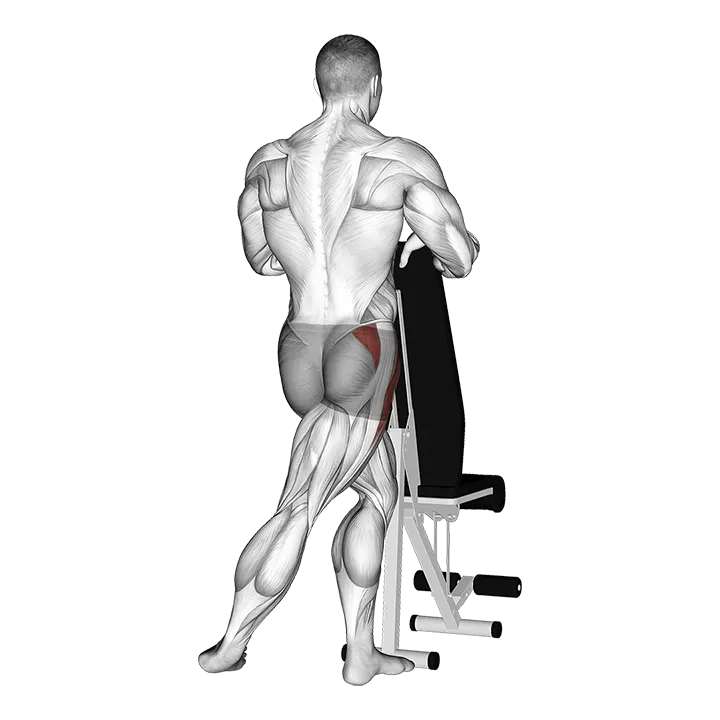
Standing Leg Under Abductor Stretch
- Target muscle
- —
- Equipment
- Body weight
- Body part
- Hips
- Type
- Stretching
The standing leg under abductor stretch is a bodyweight hip mobility exercise that targets the hip abductors — primarily the gluteus medius and the tensor fasciae latae (TFL) along the IT band — by crossing one leg behind and under the other in a curtsy-like position. It is especially useful for relieving tightness in the outer hip and lateral thigh, and pairs well with warm-ups or cool-downs for lower-body training.
How to do the Standing Leg Under Abductor Stretch
- 1Stand tall next to a wall or sturdy surface you can use for balance if needed, feet hip-width apart.
- 2Shift your weight onto your right foot, keeping a soft bend in that knee.
- 3Cross your left leg behind and under your body, stepping it to the right of your right foot as if performing a curtsy.
- 4Lower your hips slightly by bending both knees, keeping your torso upright and your chest lifted.
- 5Press your hips gently to the left to increase the stretch along the outer left hip and glute area of the crossed-under leg.
- 6Hold the stretch for 20–30 seconds, breathing steadily and relaxing deeper into the position on each exhale.
- 7Return to the starting position, switch sides, and repeat with the opposite leg.
Form tips
- Keep your torso upright throughout — avoid leaning your upper body heavily to one side, which reduces the stretch on the hip abductors.
- Move your hips in the direction opposite to the crossing leg to actively deepen the stretch on the outer hip.
- Use a wall or chair for light support if your balance is challenged; the extra stability lets you focus on releasing the hip.
- Breathe steadily and avoid holding your breath — exhale to progressively relax into a deeper range.
- Keep the weight-bearing knee tracking over your toes and avoid letting it cave inward.
Common mistakes
- Crossing the leg too far behind without hip shift, which turns the move into a balance exercise rather than a hip abductor stretch.
- Leaning the torso sharply to the side instead of keeping it upright, which reduces tension on the target muscles.
- Locking the standing knee completely straight, which limits hip mobility and can stress the joint.
- Rushing through the hold — abductor tissue releases slowly, so cutting the hold short gives little benefit.
- Letting the standing foot roll inward, which destabilizes the ankle and reduces the quality of the stretch.
Frequently asked questions
What muscles does the standing leg under abductor stretch target?
It primarily stretches the hip abductors of the crossed-under leg (the one you step behind and under), especially the gluteus medius and tensor fasciae latae (TFL), including the connective tissue along the IT band on the outer thigh.
When should I do this stretch — before or after training?
It works well in both contexts. Before lower-body training, use short holds of 10–15 seconds to improve hip mobility without reducing muscle activation. After training, hold for 20–30 seconds per side for deeper tissue release.
How long should I hold the stretch?
Aim for 20–30 seconds per side for a general flexibility benefit. If you are specifically targeting IT band tightness or chronic hip tightness, you can build up to 45–60 second holds over time.
Can this stretch help with IT band syndrome?
It can relieve some of the outer-hip tightness that contributes to IT band syndrome by targeting the TFL and gluteus medius. However, IT band syndrome often has multiple causes, so combine this stretch with strengthening and load management rather than using it as the sole treatment.
I lose my balance during this stretch — what should I do?
Hold a wall, door frame, or chair back with one hand. Balance improves as your hip mobility and proprioception develop, but there is no benefit to struggling through an unstable position when support is available.







