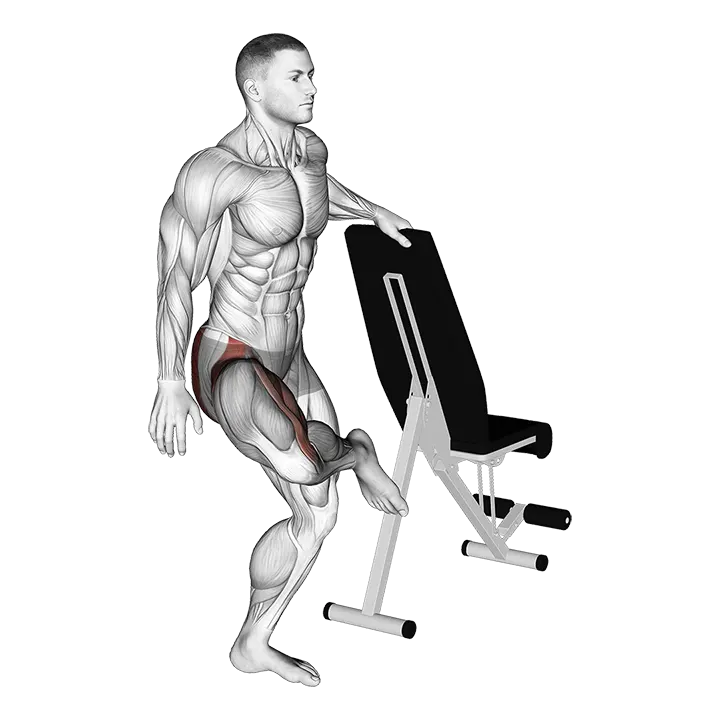
Standing Outer Hip Stretch
- Target muscle
- —
- Equipment
- Body weight
- Body part
- Hips
- Type
- Stretching
The Standing Outer Hip Stretch is a bodyweight flexibility exercise that targets the outer hip area, including the glutes, piriformis, and IT band region. Performed standing with one ankle crossed over the opposite knee in a figure-4 position, it releases tightness through the lateral hip and buttock without requiring you to get on the floor. It is an effective mobility drill for post-workout cool-downs, desk break routines, and anyone who experiences hip stiffness from prolonged sitting.
How to do the Standing Outer Hip Stretch
- 1Stand next to a wall, chair back, or other stable surface you can use for balance, and place one hand on it lightly.
- 2Shift your weight onto your right foot, keeping a soft bend in the right knee so it is not locked out.
- 3Lift your left foot off the floor and cross your left ankle over your right thigh, just above the knee, so your shin is roughly parallel to the floor.
- 4Flex your left foot gently to protect the knee joint and keep the ankle stable.
- 5Hinge at the hips and sit back and down as if lowering into a chair, allowing your torso to lean slightly forward while your spine stays long and neutral.
- 6Continue lowering until you feel a distinct stretch deep in the outer left hip and buttock — typically this occurs within the first few inches of descent.
- 7Hold the position for 20–30 seconds, breathing steadily and letting the outer hip relax with each exhale.
- 8Press through the standing heel to rise back to upright, uncross your leg, and repeat on the opposite side.
Form tips
- Keep your standing knee tracking over the middle toe throughout the hold — allowing it to cave inward reduces stability and shifts tension away from the outer hip.
- Hinge from the hips rather than rounding your lower back. A tall, neutral spine directs the stretch into the outer hip rather than stressing the lumbar area.
- Flex the foot of the crossed leg throughout the stretch. A relaxed, drooping foot can place unwanted torque on the knee of the raised leg.
- Use a wall or chair for balance so you can focus on deepening the stretch rather than fighting for stability. As hip flexibility improves, you can reduce support.
- Breathe slowly and allow the stretch to deepen gradually with each exhale rather than forcing a deeper squat — passive relaxation produces more lasting flexibility gains than aggressive loading.
Common mistakes
- Letting the standing knee lock out straight — a fully extended standing knee is unstable and makes it harder to hinge into the stretch. Keep a slight bend throughout.
- Rounding the lower back to lean forward — this shifts tension away from the outer hip and compresses the lumbar spine. Hinge at the hips and maintain a neutral back position.
- Placing the ankle too high on the thigh, directly over the knee — crossing the ankle on or above the knee can strain the knee joint. Position the ankle just above the knee on the lower thigh.
- Skipping the foot flex on the raised leg — a relaxed, plantar-flexed foot allows the ankle to roll and can put rotational stress on the knee. Keep the foot actively flexed.
- Cutting the hold short — holds under 15 seconds do not give the outer hip muscles enough time to release. Aim for at least 20 seconds per side to allow meaningful relaxation and lengthening.
Frequently asked questions
What muscles does the Standing Outer Hip Stretch target?
It stretches the outer hip area, primarily the gluteus medius, gluteus minimus, piriformis, and the surrounding soft tissue along the lateral hip and IT band region. Because it loads the hip in a figure-4 position, it reaches deeper into the outer buttock than most standing hip exercises.
Is the Standing Outer Hip Stretch the same as a pigeon pose?
They target similar areas, but the standing version is performed upright and requires no floor contact, making it more accessible for people who find pigeon pose uncomfortable or who want a quick stretch between activities. Pigeon pose generally allows a deeper stretch because gravity assists the hip into a greater range of motion, but the standing version is a practical alternative when a mat is not available.
Can I do this stretch without holding onto anything?
Yes, once you are comfortable with the movement and your balance is solid. However, using a wall or chair initially lets you focus entirely on the hip position and depth of the stretch rather than balance. Removing support is a useful progression once the movement feels stable and controlled.
How often should I do the Standing Outer Hip Stretch?
Daily stretching is safe and beneficial for the outer hips, particularly for people who sit for extended periods. Two to three rounds per side held for 20–30 seconds each is a practical starting point. You can perform it as part of a post-workout cool-down, during a desk break, or as a standalone mobility session.
I feel the stretch in my knee rather than my hip — what should I do?
Knee discomfort usually means the ankle is positioned too close to or directly over the knee joint. Move the ankle further down the thigh — closer to the mid-thigh — and make sure the foot is actively flexed. If discomfort persists in the knee, stop and try a seated figure-4 stretch instead, which places less load on the knee.







