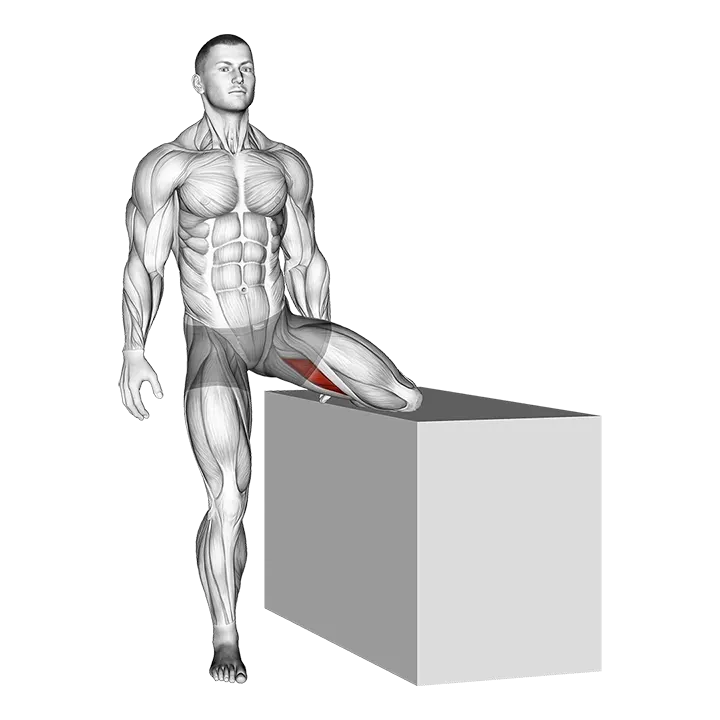
Standing Rotational Hip Stretch
- Target muscle
- —
- Equipment
- Body weight
- Body part
- Hips
- Type
- Stretching
The Standing Rotational Hip Stretch is a bodyweight mobility exercise that targets the hip external rotators, piriformis, and hip flexors by lifting one knee and rotating the thigh outward while standing upright. The rotational component places a direct lengthening demand on the deep hip rotators that are rarely addressed by forward-plane stretches alone. It is an effective drill for reducing hip tightness, improving hip mobility, and loosening the hips before activity or as part of a daily flexibility routine.
How to do the Standing Rotational Hip Stretch
- 1Stand tall with feet hip-width apart and, if needed, lightly hold a wall, chair back, or doorframe with one hand for balance.
- 2Shift your weight onto one foot, pressing that foot firmly into the floor and keeping a soft bend in the standing knee.
- 3Lift the opposite knee up in front of you to roughly hip height, keeping the thigh parallel to the floor if your flexibility allows.
- 4From that lifted position, slowly rotate the hip outward by moving the knee away from your midline — as if trying to bring the inner thigh to face the ceiling.
- 5As the knee opens outward, you should feel a stretch through the outer hip, glute, and deep hip rotators of the lifted leg.
- 6Hold the end-range position for 20–30 seconds, breathing steadily and allowing the hip to relax deeper into the rotation with each exhale.
- 7Bring the knee back to center and lower the foot to the floor with control.
- 8Repeat on the opposite side, completing 2–3 rounds per hip.
Form tips
- Keep your standing leg stable and your hips level throughout the hold — letting the pelvis tilt or hike on the standing side shifts tension away from the hip rotators and reduces the quality of the stretch.
- Initiate the rotation from the hip joint itself rather than twisting at the knee. The knee travels as a result of hip movement; forcing the knee outward independently can create undue stress on the knee joint.
- Maintain an upright torso and avoid leaning to the side to compensate for limited hip mobility. If you cannot hold the thigh horizontal, a lower knee position with good posture is more effective than a higher position with a collapsed spine.
- Breathe into the stretch rather than holding your breath. A slow exhale on each breath cycle allows the hip rotators to relax progressively, yielding better range-of-motion gains over time than static forcing.
- Use a wall or sturdy support for balance, especially when beginning this stretch — being able to focus on the hip rather than balance allows you to relax into the rotation more effectively.
Common mistakes
- Tilting the pelvis or hiking the hip on the standing side — when the standing hip hikes upward to accommodate limited mobility, tension is redirected away from the target muscles and lumbar compensation increases. Keep both hip bones level throughout the stretch.
- Forcing the rotation at the knee instead of the hip joint — pushing the knee outward using the hand or gravity without driving the movement from hip external rotation puts shear stress on the knee rather than stretch on the hip. Lead with the hip, and let the knee follow.
- Leaning the torso to the opposite side — side-bending the spine to bring the thigh higher is a common compensation for tight hip rotators. It reduces the mechanical stretch on the hip and can strain the lower back. Lower the knee and keep the trunk vertical instead.
- Cutting the hold short — briefly pausing in the stretched position does not give the nervous system enough time to relax the hip rotators and allow lengthening. Holding each side for at least 20 seconds is necessary for meaningful mobility improvement.
- Locking the standing knee — keeping the supporting leg completely straight reduces proprioceptive feedback and shifts unnecessary strain onto the knee joint. Maintain a slight, stable bend in the standing knee throughout the stretch.
Frequently asked questions
What muscles does the Standing Rotational Hip Stretch target?
The stretch primarily targets the hip external rotators — including the piriformis, obturator internus, and gemelli — along with the gluteus medius and the hip flexors of the lifted leg. Because the thigh is held in a flexed and externally rotated position, all of these structures are placed under a simultaneous lengthening load.
Is the Standing Rotational Hip Stretch good for lower back pain?
Tight hip rotators and hip flexors are a common contributor to lower back discomfort, and regularly stretching them can help reduce that tension. However, the stretch should be performed gently without forcing rotation beyond comfortable range, and anyone with an existing lower back condition should consult a healthcare professional before adding it to their routine.
How often should I do the Standing Rotational Hip Stretch?
Performing this stretch daily or on most days of the week is safe and beneficial for most people, particularly those who sit for extended periods. Two to three rounds per side held for 20–30 seconds is a practical starting routine. Consistency over several weeks produces more meaningful mobility improvements than occasional long sessions.
Can I do this stretch without anything for balance?
Yes, but using a wall or stable support is recommended when starting out. Being able to fully relax the hip into the rotation — rather than engaging stabilizing muscles just to stay upright — significantly improves the effectiveness of the stretch. Once hip mobility improves and balance becomes confident, the support can be removed.
What is the difference between the Standing Rotational Hip Stretch and a figure-four stretch?
Both stretches target the hip external rotators and piriformis, but the figure-four (also called the supine piriformis stretch) is performed lying on your back with the ankle crossed over the opposite knee. The Standing Rotational Hip Stretch is done upright, requires balance, and has the added benefit of engaging the standing leg's stabilizers, making it more functional and easier to incorporate into a warm-up routine.







