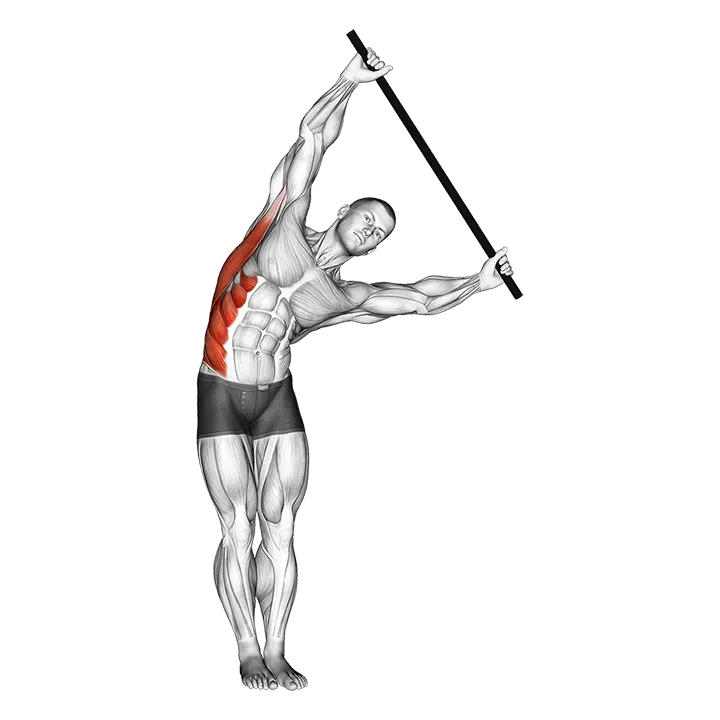
Standing Side Stretch With Stick
- Target muscle
- —
- Equipment
- Body weight
- Body part
- Back, Waist
- Type
- Stretching
The Standing Side Stretch With Stick is a bodyweight flexibility exercise that lengthens the lateral back, waist, and side body by bending the torso laterally while holding a stick or dowel rod for support and balance. The stick allows you to control the lean more precisely and reach a greater range of motion than you can achieve unsupported, making it useful for improving side-body mobility. It fits well as a warm-up movement, a cool-down stretch, or a standalone mobility drill on rest days.
How to do the Standing Side Stretch With Stick
- 1Stand tall with your feet hip-width apart and hold a stick or dowel rod vertically in one hand, planting the base firmly on the floor just outside that foot.
- 2Reach your free arm straight up overhead with your palm facing inward, keeping your elbow close to your ear.
- 3Press gently through the stick for stability and begin to bend your torso laterally toward the side holding the stick, sliding your raised arm overhead in the same direction.
- 4Keep both feet flat on the floor with equal weight through each foot — do not let the hip on the stretching side pop outward.
- 5Continue bending until you feel a firm stretch along the opposite side of your waist and lower back, pausing before any pain or sharp discomfort.
- 6Hold the position for 20–30 seconds, breathing steadily. With each exhale, allow the side body to relax and the stretch to deepen slightly.
- 7Slowly return to an upright standing position by contracting the stretched side rather than pushing off the stick.
- 8Transfer the stick to the other hand, raise the opposite arm overhead, and repeat the lateral bend to the new side.
- 9Complete 2–3 rounds per side, holding each repetition for 20–30 seconds.
Form tips
- Keep your hips level and squared forward throughout the stretch — if you rotate or let one hip drift back, the movement becomes a twist rather than a true lateral bend, reducing the stretch on the waist and side back.
- Use the stick only for light support and balance, not as a lever to pull yourself further into range. The depth of the stretch should come from a controlled lean and gravity, not from gripping the stick tightly and forcing the position.
- Let your overhead arm remain fully extended and trace a long arc in the direction of the lean rather than allowing it to collapse toward your ear — a long arm creates more traction through the side body.
- Breathe into the stretched side during the hold. Visualising the ribcage on the stretched side expanding upward with each inhale helps deepen the sensation and encourages the muscles to relax progressively.
- If your balance is secure, you can deepen the stretch slightly by crossing the foot on the stretched side over the other — this anchors the hip and increases the lateral pull through the waist.
Common mistakes
- Allowing the hips to shift sideways instead of staying stacked: when the hips drift toward the stick rather than staying centered, the stretch is reduced because the lateral distance between hip and shoulder decreases. Keep the hips level and let the upper body do the bending.
- Gripping and pulling on the stick: using the stick as a handle to haul yourself into a deeper position compresses the shoulder and can strain the elbow and wrist. The stick is a balance aid, not a pulling tool.
- Rotating the torso as the body bends: twisting during the lateral bend takes the stretch off the lateral back and waist and instead loads the spinal rotators unevenly. Focus on keeping the chest and navel facing straight ahead.
- Holding the breath: breath-holding increases muscle tension and prevents the side body from relaxing into the stretch. Maintain a slow, steady breathing rhythm and use exhalations to progress the range of motion gently.
- Cutting the hold short: a hold of fewer than 15 seconds does not give the nervous system enough time to reduce protective tension in the stretched tissues. Aim for at least 20 seconds per side before releasing.
Frequently asked questions
What does the Standing Side Stretch With Stick target?
This stretch primarily works the lateral back and waist — the soft tissue along the side of the torso between the hip and the ribcage. It also lengthens the side body broadly, including the muscles that run along the spine and the intercostal area between the ribs. Because no specific muscle is isolated, the sensation varies by individual, but most people feel the deepest stretch along the waist and lower-lateral back on the side opposite the lean.
Why use a stick instead of doing a regular standing side stretch?
The stick gives you a fixed anchor point for balance, which lets you commit more fully to the lateral lean without wobbling or bracing against a fall. That security allows you to reach a deeper, more controlled stretch than most people can hold unsupported. The stick also acts as a light guide, encouraging a straight lateral bend rather than a forward or rotational drift.
Can I use a broomstick or any household object instead of a purpose-built dowel?
Yes. Any rigid stick-like object that reaches roughly shoulder height and can bear a small amount of body weight works well — a broomstick, a mop handle, a wooden dowel, or even a sturdy umbrella. The key requirement is that the base sits firmly on the floor without sliding. If you are on a slippery surface, place a non-slip mat underneath the tip of the stick.
How long should I hold the Standing Side Stretch With Stick?
Hold each side for 20–30 seconds to give the muscles time to relax and begin lengthening. Two to three rounds per side, with a brief rest between rounds, is a practical protocol for most people. If you are particularly tight through the waist and lateral back, working toward 45-second holds over several weeks can meaningfully improve range of motion.
When is the best time to do this stretch?
Static holds like this one are most effective after exercise, when the tissues are warm and more pliable. You can also perform it on rest days after a brief warm-up walk or light movement. Doing it cold before intense activity may temporarily reduce the output of the surrounding muscles, so save longer holds for the end of your session. Daily practice — even a single two-minute routine — is safe and produces meaningful flexibility improvements over time.







