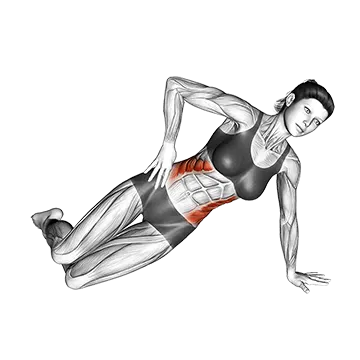
Standing Two Side Bend
- Target muscle
- Obliques
- Synergist muscles
- Iliopsoas
- Equipment
- Body weight
- Body part
- Waist
- Type
- Stretching
The standing two side bend is a bodyweight stretching exercise that targets the obliques while engaging the iliopsoas to stabilize the torso through each bend. Performed upright, you alternate lateral bends to both sides, making it an effective drill for improving lateral flexibility and waist mobility. It works well as a warm-up, cool-down, or standalone stretch between more demanding sets.
How to do the Standing Two Side Bend
- 1Stand with your feet shoulder-width apart, toes pointing forward, and arms relaxed at your sides.
- 2Engage your core lightly and press your feet evenly into the floor to create a stable base before you begin.
- 3Slide your right hand down the outside of your right thigh as you bend your torso directly to the right, keeping your hips level and facing forward.
- 4Bend only as far as you can without rotating your torso or letting your opposite hip shift outward — your left side should feel a gentle stretch.
- 5Pause briefly at the bottom of the bend, then return to the upright starting position under control.
- 6Slide your left hand down the outside of your left thigh as you bend your torso directly to the left in the same controlled manner.
- 7Pause at the bottom of the left bend, then return to upright to complete one full repetition.
- 8Continue alternating sides for the desired number of repetitions or time.
Form tips
- Keep both feet flat on the floor throughout — letting a heel lift means you are reaching past your available range of motion.
- Move in a single plane: think of your torso sliding between two panes of glass so there is no forward lean or rotation.
- Breathe out as you bend to the side and breathe in as you return to center — controlled breathing helps maintain tension in the core.
- Move slowly and deliberately rather than using momentum; the stretch is more effective and safer when the obliques control the descent.
- Keep your neck neutral and your gaze straight ahead rather than looking at the hand sliding down your leg.
Common mistakes
- Rotating the torso instead of bending purely to the side — rotation shifts the work away from the obliques and reduces the effectiveness of the stretch.
- Letting the hip on the bending side jut outward — this is a compensation pattern that limits true lateral range of motion at the waist.
- Using momentum to swing from side to side — swinging bypasses muscular control and reduces the stretch stimulus on the obliques.
- Bending forward at the waist rather than staying upright — this recruits the lower back instead of the obliques and can cause strain.
- Holding your breath through the bend — breath-holding increases spinal pressure and reduces the relaxation needed to deepen the stretch.
Frequently asked questions
What muscles does the standing two side bend stretch?
The primary muscle stretched and worked is the obliques (the muscles along the sides of your waist). The iliopsoas assists in stabilizing the pelvis and trunk throughout the movement.
How many reps and sets should I do for the standing two side bend?
For a warm-up or cool-down, 10–15 alternating reps (5–8 per side) for 1–2 sets is usually sufficient. If you are using it as a dedicated mobility drill, 2–3 sets of 10–20 reps at a slow, controlled tempo works well.
Is the standing two side bend good for reducing waist size?
No. Stretching exercises do not reduce fat in a specific area. The standing two side bend improves lateral flexibility and oblique mobility, but fat loss comes from overall calorie balance, not targeted movements.
Can I do this exercise if I have lower back pain?
Gentle lateral bending is generally low-risk, but if you have an existing lower back condition you should check with a healthcare provider first. Focus on keeping the movement controlled and stopping if you feel sharp or radiating pain.
What is the difference between the standing two side bend and a single side bend?
A single side bend typically focuses on one direction at a time, often held as a static stretch. The two side bend alternates left and right continuously, making it more suitable as a dynamic warm-up or active mobility drill rather than a static hold.