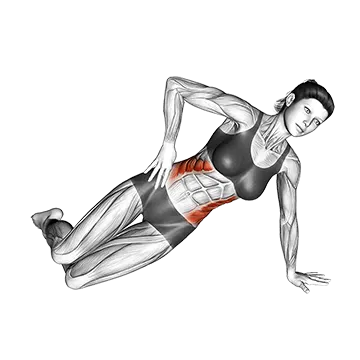
Standing Two Side Bend (bent arm)
- Target muscle
- Obliques
- Synergist muscles
- Iliopsoas
- Equipment
- Body weight
- Body part
- Waist
- Type
- Stretching
The standing two side bend (bent arm) is a bodyweight stretching exercise that targets the obliques while the iliopsoas assists in stabilizing the trunk through each lateral lean. Performed with hands clasped behind the head or arms bent at the sides, you alternate bending left and right to lengthen both sides of the waist evenly, making it an effective cool-down or mobility drill for improving lateral flexibility.
How to do the Standing Two Side Bend (bent arm)
- 1Stand tall with your feet shoulder-width apart, toes pointing forward, and your core lightly braced.
- 2Bring both hands behind your head, interlacing your fingers loosely, or bend your elbows and rest your fingertips on your temples — keep your elbows wide and your chest open.
- 3Inhale to prepare, then exhale as you slowly bend directly to the right, sliding your torso laterally without rotating or pitching forward.
- 4Lower only as far as you can while keeping both feet flat on the floor and your hips level — you should feel a gentle stretch along the left side of your waist.
- 5Hold the end position for one to two seconds, consciously relaxing into the stretch.
- 6Inhale and use your obliques to draw your torso back to the upright starting position.
- 7Exhale and repeat the movement to the left side, matching the range of motion you used on the right.
- 8Continue alternating sides in a controlled, rhythmic manner for the prescribed number of repetitions on each side.
- 9When finished, lower your arms and shake out your torso gently before moving on.
Form tips
- Keep your elbows pulled back and your chest open throughout — collapsing the elbows forward turns a lateral stretch into a forward-flexion movement.
- Move directly sideways in a single plane: imagine sliding your ribcage toward your hip rather than leaning forward or backward.
- Avoid hiking the opposite hip; press both feet evenly into the floor so the pelvis stays level and the stretch stays in the waist.
- Breathe rhythmically — exhale as you bend into the stretch and inhale as you return upright — to help the muscles release with each repetition.
- Control the return as deliberately as the descent; letting gravity snap you back reduces the muscular benefit and can strain the spine.
Common mistakes
- Rotating the torso instead of bending laterally — this shifts the work away from the obliques and reduces the effectiveness of the stretch.
- Pulling down on the head with interlaced hands, which compresses the cervical spine and strains the neck rather than the waist.
- Letting the opposite hip flare out or rise, which shortens the range of motion and prevents a true oblique stretch.
- Bending too fast and using momentum — bouncing through the stretch bypasses the slow muscle lengthening that makes it effective.
- Holding the breath, which increases core tension and limits how deeply the obliques and iliopsoas can release.
Frequently asked questions
What muscles does the standing two side bend (bent arm) stretch?
The primary target is the obliques — both internal and external — on the side being lengthened. The iliopsoas assists in stabilizing the pelvis and lower trunk during the lateral lean.
Why perform the bent-arm variation instead of reaching one arm overhead?
Keeping the arms bent and hands behind the head removes the shoulder and lat contribution, isolating the lateral stretch more purely in the waist. It also keeps the movement accessible for people with limited shoulder mobility.
How many reps and sets are recommended?
As a stretching exercise, 8–12 slow, controlled repetitions per side for 1–3 sets works well. For a cool-down, one set of 10 alternating bends is often sufficient.
Can I hold each side for longer to deepen the stretch?
Yes. Pausing at the end range for 2–5 seconds per rep transitions the movement toward a static stretch, which can increase flexibility gains. Just keep the hold passive and relaxed rather than pulling yourself deeper.
Is this exercise suitable as a warm-up?
It can serve as a light dynamic warm-up at a moderate pace, gently mobilizing the waist before more demanding activity. For a pre-workout warm-up, keep repetitions smooth and avoid forcing the end range on cold muscles.