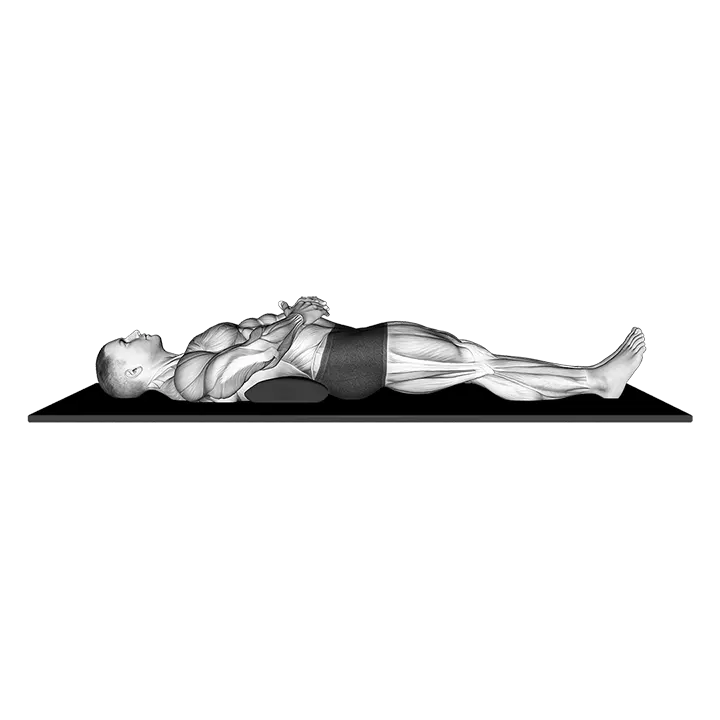
Static Position Lying Back with Pad
- Target muscle
- —
- Equipment
- Body weight
- Type
- Stretching
The Static Position Lying Back with Pad is a passive body-weight stretch that uses a pad or foam roller placed under your mid-back to encourage thoracic spine extension and general spinal decompression. By simply resting in this supported position, you allow gravity to open up the upper and mid-back over time, making it a useful cooldown or recovery drill.
How to do the Static Position Lying Back with Pad
- 1Place a foam roller, folded towel, or firm pad on the floor perpendicular to your body.
- 2Sit on the floor in front of the pad with your knees bent and feet flat.
- 3Carefully lean back so the pad sits beneath your mid-back, roughly level with your shoulder blades.
- 4Lower your upper back and head toward the floor, letting your spine gently drape over the pad.
- 5Extend your arms out to the sides or rest them on your abdomen, whichever feels more relaxed.
- 6Breathe slowly and steadily, allowing gravity to gradually increase the extension of your thoracic spine with each exhale.
- 7Hold the position for 30 to 60 seconds, or as long as comfortable without pain.
- 8To exit, engage your core, roll to one side, and use your arms to press yourself back up to seated.
Form tips
- Position the pad at the mid-back rather than the lower back — the thoracic spine is designed for extension, while forcing extension of the lumbar spine can cause discomfort.
- Let your muscles stay passive during the hold; do not actively push into the pad, since the goal is to relax and let gravity do the work.
- Control your breathing: a long, slow exhale with each breath helps your muscles release tension and deepens the stretch gradually.
- If your neck feels strained, support your head with your hands clasped behind it until you can comfortably lower it to the floor.
- Adjust the firmness of the pad to your tolerance — a softer surface is gentler for beginners, while a firmer roller provides a deeper stretch.
Common mistakes
- Placing the pad under the lower back instead of the mid-back, which can compress the lumbar spine and cause pain rather than relief.
- Tensing the back muscles during the hold, which prevents the spine from releasing into extension and defeats the purpose of the stretch.
- Holding your breath or breathing shallowly, which keeps the muscles engaged and limits how far the stretch can progress.
- Sitting up too abruptly at the end, which can strain the neck or lower back — always roll to one side first and use your arms to return to seated.
- Staying in the position too long past the point of discomfort, which can overstretch soft tissue; stop if you feel sharp or shooting pain.
Frequently asked questions
What area does this stretch target?
It primarily addresses the thoracic (mid and upper) spine. Resting over a pad encourages passive extension through a region that tends to become stiff from prolonged sitting or forward-bent postures.
How long should I hold this position?
A hold of 30 to 60 seconds is generally sufficient to allow the muscles to relax and the spine to settle into extension. You can repeat it two or three times if needed.
What kind of pad should I use?
A foam roller is the most common choice and provides a firm, defined fulcrum. A tightly rolled towel or a folded yoga mat also works. Beginners may prefer a softer surface until they adapt to the sensation.
Is this stretch safe for people with back pain?
Mild thoracic stiffness is a common use case, but if you have a diagnosed spinal condition, disc issue, or acute back pain, consult a healthcare professional before attempting this or any spinal extension stretch.
When is the best time to do this stretch?
It works well as part of a cooldown after a workout or as a standalone mobility drill during a rest day. Avoid it immediately before heavy lifting since passive stretching can temporarily reduce muscle readiness.







