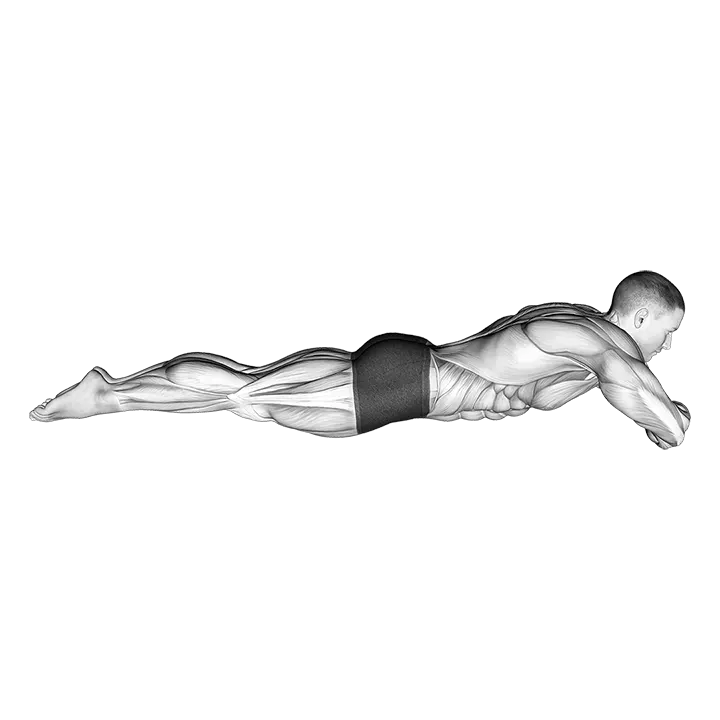
Static Position Lying Front
- Target muscle
- —
- Equipment
- Body weight
- Type
- Stretching
The Static Position Lying Front is a prone static stretch that targets the entire anterior chain — opening the hip flexors, abdominals, and chest by holding a passive face-down extension. Performed using only body weight, it is an accessible resting stretch suited for cooldowns, flexibility routines, or recovery sessions.
How to do the Static Position Lying Front
- 1Lie face-down on a flat, comfortable surface with your legs extended straight behind you and the tops of your feet resting on the floor.
- 2Place your palms flat on the floor beside your chest, fingers pointing forward, elbows bent and close to your sides.
- 3Gently press through your palms and forearms to lift your chest slightly off the floor, keeping your hips and pelvis grounded.
- 4Find a comfortable degree of extension — a low sphinx position or a slightly higher prop — where you feel a mild stretch across your abdomen and hip flexors without pain.
- 5Relax your glutes and lower back rather than actively squeezing them, allowing gravity and your body weight to deepen the stretch naturally.
- 6Breathe slowly and evenly, letting your torso sink a little further into the stretch with each exhale.
- 7Hold the position for 20–60 seconds, then gently lower your chest back to the floor to release.
Form tips
- Keep your hips pressed into the floor throughout the hold — if they lift, reduce the height of your prop or lower your chest closer to the ground.
- Avoid tensing your neck; keep your gaze downward or slightly forward and your shoulders away from your ears.
- Breathe into your belly rather than your chest to help relax the muscles being stretched.
- If you feel sharp compression in your lower back, lower your torso until the sensation disappears — the stretch should be felt in the front of the body, not the back.
Common mistakes
- Lifting the hips off the floor, which shifts the stretch away from the hip flexors and reduces effectiveness.
- Squeezing the glutes and lower back muscles, which actively compresses the lumbar spine instead of allowing a passive, relaxed stretch.
- Pushing too far into extension too quickly, which can cause lower back discomfort rather than an anterior chain stretch.
- Holding the breath, which keeps the core muscles tense and prevents the stretch from deepening naturally.
Frequently asked questions
What does the Static Position Lying Front stretch?
It stretches the anterior chain — primarily the hip flexors (iliopsoas, rectus femoris), abdominals, and chest — by placing the body in a passive prone extension while keeping the hips grounded.
How long should I hold this stretch?
Hold for 20–60 seconds per set. For general flexibility, 2–3 sets is sufficient. Longer holds of up to 90 seconds may be used in dedicated mobility or recovery sessions.
Is this stretch safe for people with lower back pain?
For many people it is, but the degree of extension must be managed carefully. Keep the lift very low (forearms on the floor, sphinx position) and stop immediately if you feel pain or compression in the lumbar spine. Consult a healthcare professional if you have an existing back condition.
When is the best time to perform this stretch?
It works well as part of a post-workout cooldown, a morning mobility routine, or an active recovery session. Avoid performing deep static stretches on completely cold muscles — a light warm-up beforehand is recommended.
What is the difference between a sphinx position and a full prone extension?
In the sphinx position your forearms remain on the floor, producing a gentler anterior stretch. A full prone extension has the arms extended and palms pressing the chest higher, increasing the range of motion. Choose whichever level produces a comfortable stretch without lower back discomfort.







