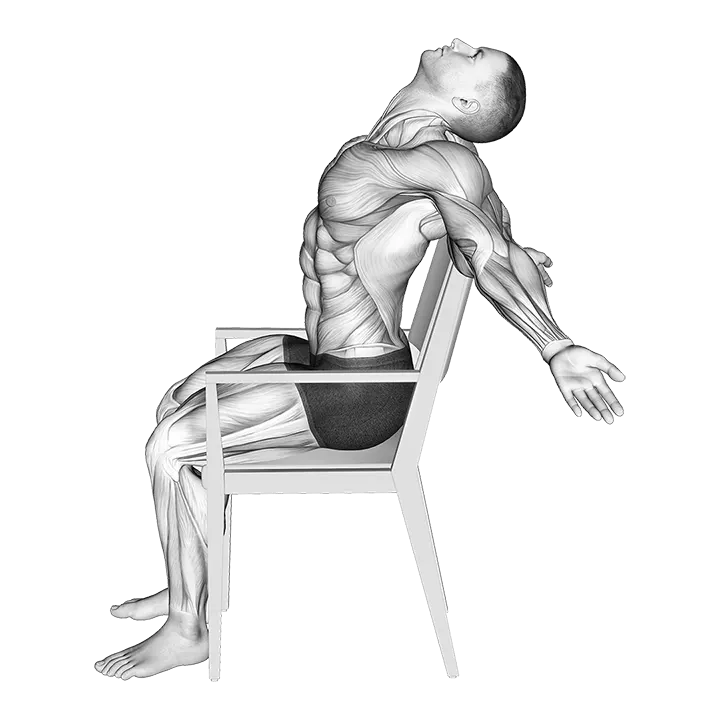
Static Position Seated Back
- Target muscle
- —
- Equipment
- Body weight
- Type
- Stretching
The static position seated back is a bodyweight stretching exercise performed by holding a controlled seated posture to release tension along the entire length of the spine and surrounding back musculature. By sitting upright or gently rounding forward and holding the position, it encourages spinal decompression, reduces stiffness from prolonged sitting, and builds awareness of neutral spinal alignment. It requires no equipment and is suitable for all fitness levels.
How to do the Static Position Seated Back
- 1Sit on the floor with your legs extended straight in front of you, or cross them comfortably — whichever position feels stable and allows your pelvis to sit level.
- 2Place your hands on your thighs or let them rest gently on the floor beside your hips for light support.
- 3Inhale and lengthen your spine upward, imagining the crown of your head pressing toward the ceiling to create space between each vertebra.
- 4Exhale and decide which variation to hold: for a decompression stretch, stay tall and maintain this elongated posture; for a release stretch, gently round your lower and mid back, letting your chin drop slightly toward your chest.
- 5Hold the chosen position without forcing or bouncing — the stretch should feel like a sustained, comfortable tension in the back, not a sharp or pinching sensation.
- 6Breathe slowly and steadily throughout the hold, using each exhale to relax deeper into the stretch without collapsing your posture entirely.
- 7After the target hold time — typically 20–60 seconds — slowly return to a neutral seated position by re-stacking your spine vertebra by vertebra from the base upward.
- 8Pause for a breath, then repeat for the desired number of sets.
Form tips
- Root your sitting bones evenly into the floor at the start of each hold — an uneven base causes the spine to twist rather than decompress symmetrically.
- Let your breathing drive the stretch: each inhale creates length; each exhale allows a gentle release of tension rather than forcing a deeper range.
- Avoid tucking the chin sharply into the chest — a gentle, natural drop of the head is sufficient and keeps the cervical spine in a comfortable line with the rest of the back.
- If your hamstrings are tight and prevent a level pelvis when legs are extended, sit on a folded blanket or small pad to tilt the pelvis slightly forward and make the back position easier to achieve.
- Keep the shoulders relaxed and away from the ears throughout the hold — shrugging adds tension to the upper back and neck rather than allowing them to release.
Common mistakes
- Rounding only at the lower back while keeping the thoracic spine stiff, which concentrates all the stretch in one area instead of distributing it along the full spine.
- Holding the breath during the stretch, which increases muscular tension throughout the back and prevents the connective tissue from releasing — maintain slow, rhythmic breathing for the duration of the hold.
- Leaning too far forward or backward from the hips rather than working through the spine itself, which shifts the exercise from a back stretch into a hip flexor or hamstring stretch.
- Holding for too short a duration — a quick five-second hold does not give the spinal muscles and surrounding fascia enough time to respond; aim for at least 20 seconds per set.
- Allowing the torso to collapse sideways during the hold, which introduces a lateral lean and reduces the symmetry of the stretch — periodically check that your weight is distributed evenly left to right.
Frequently asked questions
What does the static position seated back stretch target?
The exercise targets the muscles and connective tissue running along the length of the spine — including the erector spinae group and the surrounding thoracic and lumbar fascia — by holding a sustained position that encourages decompression and elongation of the back.
How long should I hold the static position seated back stretch?
Most practitioners hold each position for 20–60 seconds per set, performing 2–4 sets. Shorter holds of 10–20 seconds can serve as an active warm-up cue, while longer holds of 45–60 seconds are more effective for releasing deep muscular tension during a cool-down or recovery session.
Can I do the static position seated back stretch if I have lower back pain?
Gentle seated back stretches are often recommended for mild lower back stiffness, but you should stay within a pain-free range and avoid forcing a deeper position if any sharp or radiating discomfort occurs. If you have a diagnosed spinal condition or acute injury, consult a healthcare professional before performing this exercise.
When is the best time to perform the static position seated back stretch?
It is most effective as part of a cool-down after a workout, or as a mid-day reset after prolonged sitting. Because it is a static hold, it is generally better placed after activity rather than before, when dynamic movements are preferable for priming the spine.
Can I do this stretch in a chair instead of on the floor?
Yes. Sitting toward the front edge of a chair with feet flat on the floor and then performing the same elongation or gentle rounding of the spine produces a very similar effect. The chair variation is useful at a desk or in settings where getting to the floor is not practical.







