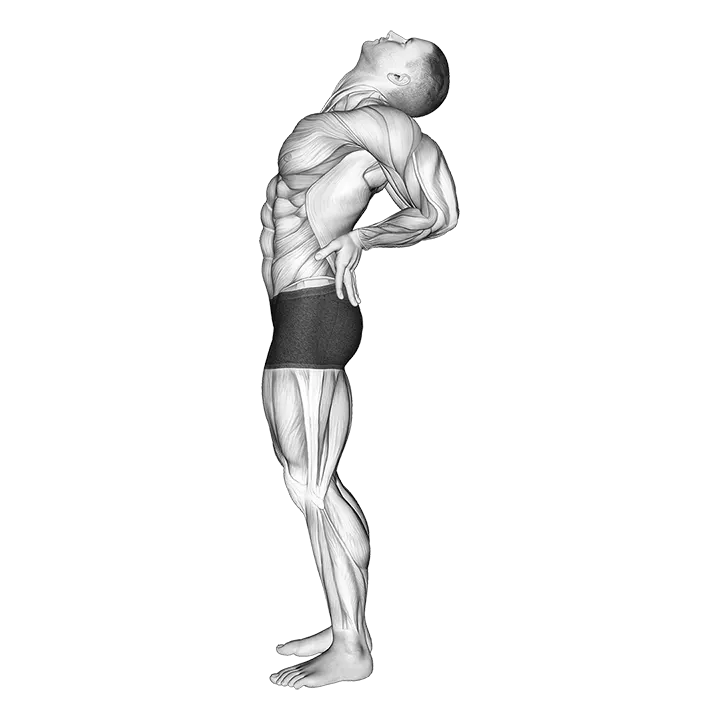
Static Position Standing
- Target muscle
- —
- Equipment
- Body weight
- Type
- Stretching
Static Position Standing is a bodyweight stretching and postural exercise in which you hold a tall, upright stance for a set duration, training the core, lower back stabilizers, glutes, and leg muscles to maintain alignment under sustained demand. Because it requires no equipment and imposes minimal joint stress, it serves as a foundational posture drill, an active recovery tool, and a starting point for progressing to more demanding balance and stability work.
How to do the Static Position Standing
- 1Stand on a firm, flat surface with your feet hip-width apart and your toes pointing forward or very slightly outward.
- 2Distribute your weight evenly across both feet — press firmly through the heel, the ball of the foot beneath the big toe, and the ball beneath the little toe.
- 3Straighten your legs without locking your knees; keep a very slight, soft bend so the joints are not hyperextended.
- 4Engage your core by gently drawing your lower abdomen inward, and squeeze your glutes lightly to support a neutral pelvis.
- 5Lengthen your spine upward — imagine the crown of your head being pulled toward the ceiling — and allow your lower back to hold its natural curve without exaggerating it.
- 6Roll your shoulders back and down away from your ears, letting your arms hang relaxed at your sides with palms facing your thighs.
- 7Level your gaze so your chin is parallel to the floor and your neck is in line with the rest of your spine.
- 8Breathe slowly and steadily through your nose, allowing your ribcage to expand in all directions without letting your chest flare or your lower back arch.
- 9Hold the position for the target duration — typically 30 seconds to 2 minutes — then relax and repeat as needed.
Form tips
- Check your weight distribution every 15–20 seconds; most people unconsciously shift onto one hip during longer holds, which defeats the postural purpose of the exercise.
- Keep your jaw and hands relaxed — tension in the face and fists is a sign that you are gripping through the upper body rather than stabilizing through the core and legs.
- Use a wall or mirror behind you to self-assess: your ears, shoulders, hips, knees, and ankles should stack in a single vertical line when viewed from the side.
- Breathe into the lower belly rather than the chest so your rib position stays neutral and your thoracic spine can stay long.
- If balance is initially challenging, stand with your heels lightly touching a wall until your neuromuscular control improves.
Common mistakes
- Locking the knees straight, which compresses the joint and shifts weight backward onto the heels — keep a micro-bend at all times.
- Allowing the lower back to hyperextend (anterior pelvic tilt), which compresses the lumbar discs and prevents true core engagement; tuck the pelvis lightly to find neutral.
- Elevating the shoulders toward the ears, which creates neck and upper-trapezius tension and masks the alignment work you are trying to practice.
- Holding the breath or breathing shallowly, which increases internal pressure and makes it harder to maintain a stable, neutral spine throughout the hold.
- Letting the head drift forward so the chin juts out — this places load on the cervical extensors and breaks the vertical line of the spine that the exercise is designed to reinforce.
Frequently asked questions
What muscles does static position standing work?
Because it is an isometric hold in an upright position, the exercise recruits the core (transverse abdominis, obliques, erector spinae), glutes, quadriceps, and the smaller stabilizing muscles of the ankles and feet. The demand on any single muscle is low, but sustained co-activation across all of them is what trains postural endurance.
How long should I hold the static standing position?
Beginners typically start with 30–60 second holds and build toward 2–3 minutes as endurance improves. For postural training, two to three holds per session is sufficient; for active recovery or mindfulness work, longer continuous durations are also appropriate.
What is the difference between static position standing and a balance exercise?
Static standing on two feet with eyes open is a foundational postural drill rather than a true balance challenge. Balance progressions — such as single-leg standing or eyes-closed variations — increase the proprioceptive demand significantly and are built on the baseline this exercise establishes.
Can static position standing help with lower back pain?
Practicing proper upright alignment can reduce the chronic postural stress that contributes to lower back discomfort, but it is not a substitute for medical evaluation. If you have an existing back condition, consult a healthcare professional before using postural drills as part of a management strategy.
Where does static position standing fit in a workout?
It works well as a warm-up posture reset before a strength or mobility session, as a cooldown between sets, or on its own as an active recovery day drill. It requires no loading or equipment, so it can be slotted in anywhere without affecting recovery.







