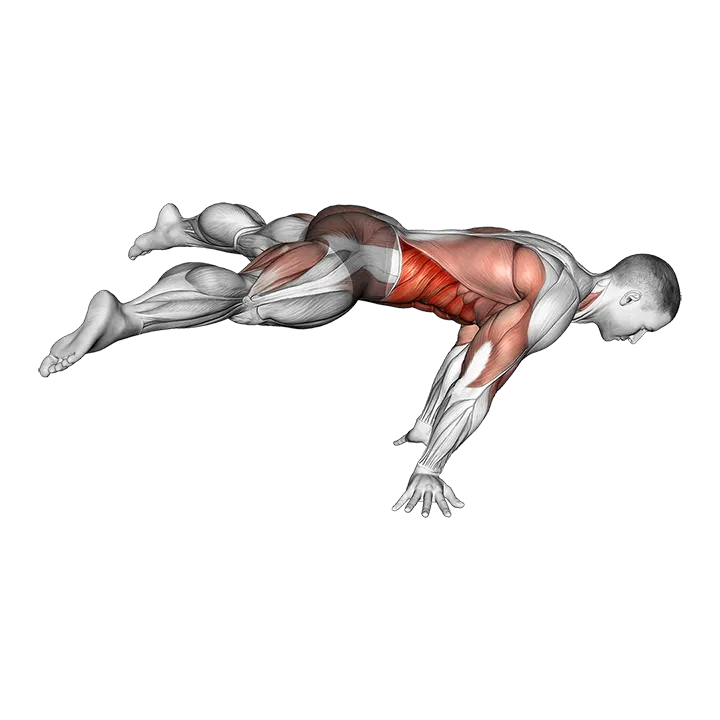
Straddle planche
- Target muscle
- —
- Equipment
- Body weight
- Body part
- Waist
- Type
- Stretching
The straddle planche is an elite bodyweight gymnastics skill in which you support your entire body weight on straight arms with your torso and legs held horizontal to the ground and your legs spread wide in a straddle position. It demands extraordinary shoulder, core, and wrist strength, making it one of the most challenging static holds in calisthenics. It develops full-body tension, scapular control, and pushing strength simultaneously.
How to do the Straddle planche
- 1Begin in a push-up position with your hands flat on the floor, fingers spread wide and pointing slightly outward, wrists stacked directly under your shoulders.
- 2Spread your legs wide into a straddle, toes pointed, and shift your weight forward over your hands by leaning your shoulders past your wrists.
- 3Protract and depress your scapulae — push the floor away and pull your shoulder blades apart and down to create a stable, rounded upper back.
- 4Engage your entire core, squeeze your glutes, and activate your quadriceps to keep your body rigid from shoulders to pointed toes.
- 5Continue leaning forward until your hips rise off the ground, transferring all bodyweight onto your palms.
- 6Hold the position with your body fully horizontal — hips level with shoulders, arms fully locked out, legs wide and parallel to the floor.
- 7Maintain maximum full-body tension and controlled breathing throughout the hold.
- 8Lower yourself back to the floor in a controlled manner by shifting your weight backward over your wrists.
Form tips
- Protract and depress your scapulae aggressively throughout the hold — a passive shoulder position collapses the press and drops your hips.
- Point your toes and actively squeeze your inner thighs outward to keep your legs stiff; slack legs add unnecessary load to your shoulders.
- Build up to the full straddle planche by first mastering the tuck planche, then the advanced tuck, and finally the straddle — each progression trains the same shoulder lean and body tension.
- Perform wrist warm-ups and finger-extension stretches before every session, as the extended wrist angle places high stress on the joint.
- Use chalk or push-up handles if grip fatigue or wrist pain limits your hold time, so you can focus on shoulder and core strength.
Common mistakes
- Bending the elbows during the hold, which transfers load away from the correct straight-arm pressing muscles and indicates insufficient shoulder strength for the skill.
- Allowing the hips to drop below horizontal, which creates a banana-body position that makes the skill easier by cheating leverage rather than building true planche strength.
- Insufficient scapular protraction, leaving the shoulders in a passive position that overloads the rotator cuff and limits how long the hold can be sustained.
- Rushing the forward lean without building the required shoulder strength first, which increases the risk of acute shoulder or wrist injury.
- Holding the breath during the skill, which spikes internal pressure and reduces hold time — practice slow, controlled exhales to maintain tension without breath-holding.
Frequently asked questions
What muscles does the straddle planche work?
The straddle planche demands intense work from the anterior deltoids and serratus anterior (scapular protraction), with heavy involvement from the entire core, glutes, quadriceps, and wrist flexors. The triceps and pectoralis major also play a stabilizing role in maintaining locked-out arms.
How long does it take to learn the straddle planche?
Most athletes need one to three years of consistent planche progression training to achieve a clean straddle planche, depending on their starting strength level. The tuck planche and advanced tuck planche are necessary prerequisites, and each progression can take several months to solidify.
What is the difference between a straddle planche and a full planche?
In the straddle planche the legs are spread wide, which shortens the effective lever arm and makes the hold significantly easier than the full planche. In the full planche the legs are held together and straight, creating the longest possible lever and the highest shoulder and core demand.
How should I train for the straddle planche?
Train through the standard planche progressions — planche lean, tuck planche, advanced tuck planche, and straddle planche — using timed holds of 3–5 seconds at your current level, for 5–8 sets per session. Supplement with pseudo planche push-ups and straight-arm strength work to build the specific shoulder strength required.
Is the straddle planche safe for the wrists?
The straddle planche places the wrists in significant extension under full bodyweight load, so dedicated wrist conditioning is essential. Warm up thoroughly with wrist circles and extension stretches before training, progress load gradually, and consider push-up handles to reduce wrist angle if pain develops.







