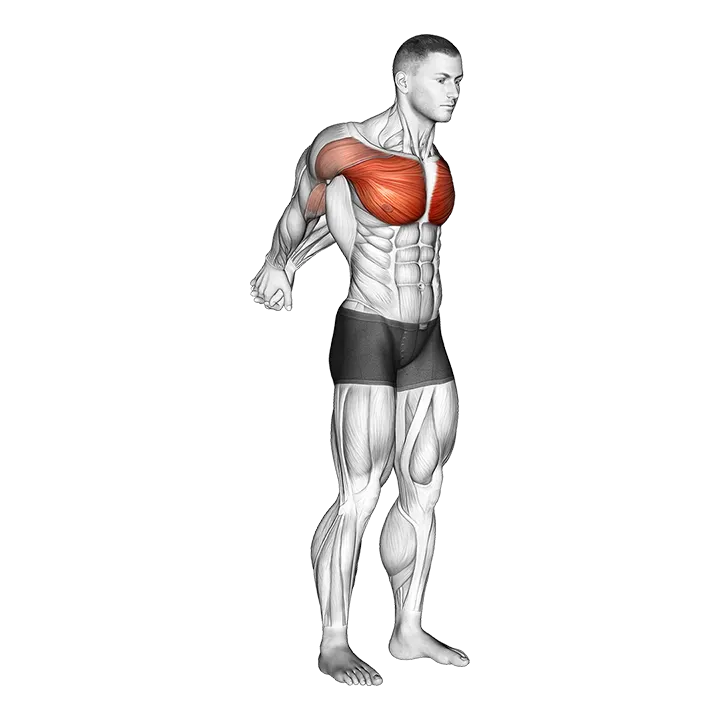
Straight Arms Backward Chest Stretch
- Target muscle
- —
- Equipment
- Body weight
- Body part
- Chest
- Type
- Stretching
The straight arms backward chest stretch is a bodyweight stretching exercise that opens the chest by extending both arms straight behind the body and drawing them back and upward. It targets the chest and anterior shoulder area, helping to counteract the effects of prolonged forward posture such as sitting at a desk or hunching over a phone. No equipment is needed, and it can be performed standing or seated.
How to do the Straight Arms Backward Chest Stretch
- 1Stand tall with your feet hip-width apart, your spine neutral, and your chin level.
- 2Let both arms hang at your sides, then extend them straight back behind your body, keeping your elbows fully locked.
- 3Interlace your fingers or clasp your hands together behind your back at hip height, if your range of motion allows — otherwise hold a folded towel between your hands at shoulder width.
- 4Rotate your palms downward so they face the floor and confirm your elbows are still straight.
- 5Squeeze your shoulder blades toward each other and gently lift your arms away from your lower back, feeling the stretch spread across your chest.
- 6Keep your chest lifted and your upper back from rounding — the movement should come from your shoulders, not your spine.
- 7Breathe steadily and hold the stretched position for 20–30 seconds.
- 8Release by lowering your arms slowly and relaxing your shoulder blades before repeating.
Form tips
- Keep both elbows fully extended throughout the hold — even a slight bend reduces the lever arm and lessens the stretch across the chest.
- Drive the chest opening by squeezing the shoulder blades toward each other first, then lift the arms; retraction does more work than arm elevation alone.
- If you cannot clasp your hands, use a resistance band, towel, or strap held at shoulder width to maintain straight arms and still achieve the full stretch.
- Exhale slowly on each breath during the hold — releasing tension through the breath allows you to ease a little deeper into the stretch without forcing it.
Common mistakes
- Bending the elbows during the hold — this shortens the effective arm length and significantly reduces the tension applied across the chest, making the stretch far less productive.
- Rounding the upper back while lifting the arms — hunching shifts the stretch away from the chest and onto the upper spine, which can cause discomfort rather than productive mobility work.
- Holding the breath throughout the hold — sustained breath-holding increases muscular tension throughout the body and prevents you from sinking deeper into the stretch as the muscle relaxes.
- Forcing the arms higher than your current range allows — aggressive lifting strains the shoulder joint at end range and can cause a sharp pinch rather than the broad, even chest opening the stretch is designed to produce.
- Pitching the torso forward to compensate for limited shoulder mobility — leaning forward releases the tension in the chest before it has been fully stretched, defeating the purpose of the movement.
Frequently asked questions
What does the straight arms backward chest stretch target?
The stretch primarily targets the chest and the front of the shoulder. Extending the arms straight behind the body with the palms rotated down places the chest under a lengthening load, while the shoulder blade retraction reinforces the opening.
How long should I hold this stretch?
Hold for 20–30 seconds per repetition and perform 2–3 repetitions. Holding shorter than 20 seconds gives the muscle insufficient time to relax and lengthen, while going beyond 60 seconds on a single hold offers diminishing returns for most people.
Can I do this stretch while seated?
Yes. Sit upright on a chair or bench with your feet flat on the floor, clasp your hands behind your back, and follow the same cues for elbow extension and shoulder blade retraction. The stretch mechanics are identical to the standing version.
How often should I perform this stretch?
Daily stretching is appropriate for a flexibility-focused routine. At a minimum, performing it after every upper-body training session or after prolonged periods of sitting helps maintain chest and shoulder mobility over time.
Why do I feel this stretch more in my shoulders than my chest?
This usually means the shoulder blades are not being actively squeezed together before the arms are lifted. Focus on retraction first — drawing the shoulder blades toward each other — then lift the arms gently. That sequence redirects the tension into the chest rather than concentrating it at the shoulder joint.







