
Straight Hip Single Leg Curl on Stability Ball
- Target muscle
- —
- Equipment
- Stability ball
- Body part
- Thighs
- Type
- Strength
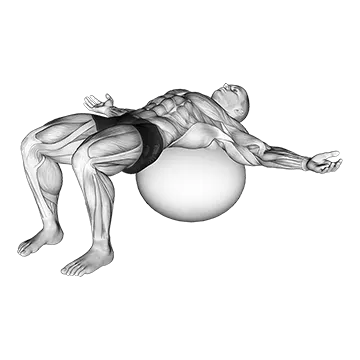

The straight hip single leg curl on a stability ball is a hamstring isolation exercise performed lying on your back with one heel on the ball and the other leg raised. By keeping the hips level rather than bridged high, it places continuous tension on the working hamstring while demanding core and glute stability to control the ball through the curl.
How to do the Straight Hip Single Leg Curl on Stability Ball
- 1Lie on your back on the floor with your arms extended to your sides, palms flat for support.
- 2Place your right heel on top of the stability ball, with your right leg nearly straight.
- 3Raise your left leg off the ground, keeping it in line with or slightly above your right leg.
- 4Press your right heel into the ball and engage your core to lift your hips just enough to keep them level — do not bridge high, maintain a neutral hip position close to the floor.
- 5Curl the ball toward your glutes by bending your right knee, pulling the ball with your heel in a controlled arc.
- 6Stop when your right knee reaches roughly a 90-degree angle and you feel a strong contraction in the back of your thigh.
- 7Slowly extend your right leg to roll the ball back to the starting position, maintaining hip level throughout.
- 8Complete all reps on the right leg, then switch legs and repeat.
Form tips
- Keep your hips level from start to finish — any tilting or rotating shifts load away from the hamstring and onto the lower back.
- Press the heel into the ball on both the curling and extending phases so the hamstring stays under tension through the full range of motion.
- Brace your core before lifting your hips and hold that brace throughout each set, as a soft core allows the pelvis to drop and destabilizes the movement.
- Move slowly on the extension phase — lowering the ball with control is where much of the hamstring work occurs.
- If balance is difficult, keep the raised leg bent slightly at the knee rather than fully extended to reduce the stability demand while you build coordination.
Common mistakes
- Letting the hips sag toward the floor at the bottom of each rep, which removes tension from the hamstring and loads the lower back instead.
- Bridging the hips too high, which turns the movement into a glute bridge curl and reduces the isolated demand on the hamstring.
- Rushing the extension phase by letting the ball roll out quickly, which eliminates the eccentric load that is a key part of hamstring development.
- Allowing the planted heel to roll to the side of the ball, which destabilizes the movement and can cause the ankle to roll or the ball to slip.
- Failing to stabilize the raised leg, causing it to swing or drop during the curl, which creates unwanted momentum and reduces core engagement.
Frequently asked questions
What muscles does the straight hip single leg curl on a stability ball work?
The primary muscles are the hamstrings (back of the thigh) of the working leg. The glutes and core muscles engage as secondary stabilizers to keep the hips level, and the quadriceps of the raised leg work isometrically to hold it in position.
Why keep the hips straight rather than bridged high?
Keeping the hips at a lower, neutral position concentrates the load on the hamstring rather than allowing the glutes to take over. The bridged version shifts emphasis toward the glutes and reduces how hard the hamstring has to work through the curl.
How is the single leg version different from the two-leg stability ball curl?
Using one leg at a time roughly doubles the hamstring load compared to the two-leg version, and it also reveals and corrects strength imbalances between legs. The single leg variation also demands more core and hip stability to control the ball without the assistance of a second leg.
Is this exercise suitable for beginners?
It is more appropriate for those with some base hamstring and core strength. Beginners should first build confidence with the two-leg stability ball curl before progressing to the single leg version, as the balance and stability demands are significantly higher.
How many sets and reps should I do?
For strength and muscle development, 3 sets of 8–12 reps per leg is a practical starting point. Rest 60–90 seconds between sets. As the movement becomes easier, increase reps or slow the tempo — particularly on the extension phase — before adding more sets.