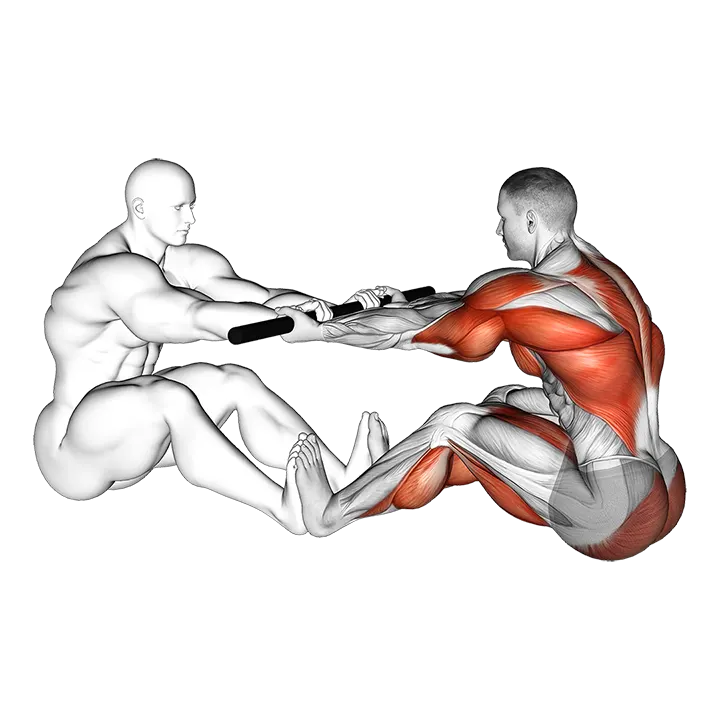
StrongMan MAS Wrestling
- Target muscle
- —
- Equipment
- Body weight
- Body part
- Weightlifting
- Type
- Strength
StrongMan MAS Wrestling is a traditional Yakut pulling sport in which two athletes sit facing each other across a wooden board and compete to pull a stick from the opponent's grip or force them off the board. The event demands full-body strength and grip endurance, engaging the back, hips, legs, and arms in a combined isometric and explosive pulling effort. It trains the same qualities used in strongman competition — raw grip strength, seated stability, and the ability to sustain and redirect force under resistance.
How to do the StrongMan MAS Wrestling
- 1Sit on the board facing your opponent with your feet firmly planted against the footboards, knees bent and positioned outside your arms.
- 2Grip the wooden stick with both hands using a full overhand grip, hands approximately shoulder-width apart, placed between your opponent's grip points.
- 3Brace your core, set your back into a rigid, slightly forward-leaning position, and press your feet hard into the footboards before the pull begins.
- 4At the start signal, drive through your legs into the footboards and pull the stick toward your hips, engaging your back, arms, and entire posterior chain simultaneously.
- 5Keep your elbows close to your torso and use your bodyweight as leverage by leaning back into the pull while maintaining a flat, braced spine.
- 6If your opponent surges, resist by reinforcing your grip, pushing harder through your feet, and maintaining your position on the board without lifting your hips.
- 7Continue pulling and countering your opponent's force until you extract the stick from their hands or pull them off the board, then release in a controlled manner.
- 8When training solo, sit on the floor with your feet braced against a wall or anchor point, grip a resistance band or rope at the same height, and practice both explosive burst pulls and sustained isometric holds.
- 9Rest fully between sets to allow grip and full-body recovery before repeating.
Form tips
- Squeeze the stick with your full hand — palm, fingers, and thumbs — rather than just your fingertips; a full-hand grip dramatically increases holding strength under sustained pulling.
- Press your feet hard into the footboards throughout the entire effort; losing foot contact removes leg drive, which is your primary power source.
- Keep your torso upright to slightly reclined but never rounded — a neutral or extended spine transfers pulling force far more efficiently than a flexed one.
- Train grip endurance separately with dead hangs, towel pull-ups, or plate pinches, since grip failure is the most common reason competitors lose the stick before their legs or back give out.
- Practice both explosive burst pulls and sustained isometric holds in training, as real matches require you to shift between the two depending on your opponent's response.
Common mistakes
- Releasing foot pressure from the footboards: lifting or relaxing your feet removes the leg drive that powers the pull, cutting force output and destabilizing your seated base so the opponent can move you more easily.
- Pulling with the arms alone: relying solely on arm strength without recruiting the back and legs creates a mechanically weak position, fatigues the arms rapidly, and leaves you unable to sustain force when the opponent counters.
- Rounding the lower back: a flexed spine under load reduces force transfer from the hips and legs to the stick and increases the risk of lower back strain during explosive or prolonged pulling efforts.
- Gripping with only the fingers: a fingertip grip instead of a full palm-and-thumb grip dramatically reduces holding strength and makes it easy for the opponent to strip or rotate the stick from your hands.
- Failing to brace before the start signal: entering the pull without pre-bracing the core and setting the back means the initial burst catches you in a weak position, causing positional collapse and an immediate leverage disadvantage.
Frequently asked questions
What muscles does StrongMan MAS Wrestling work?
MAS Wrestling has no single target muscle — it is a full-body pulling event. The primary contributors are the muscles of the back (lats, traps, erectors), hips and legs (glutes, hamstrings), and arms and hands (biceps, forearms, grip). Core bracing muscles work continuously to transfer force between the lower and upper body.
Is MAS Wrestling good for beginners?
It is accessible for beginners as a bodyweight activity, but grip strength and seated pulling coordination take time to develop. Start with solo resistance-band drills to build the pulling pattern before competing against a partner, and keep early sessions short to avoid grip and lower back fatigue.
How can I train for MAS Wrestling without a partner?
Sit on the floor with your feet braced against a wall or fixed anchor, grip a heavy resistance band or rope attached at foot level, and perform both explosive pulls and timed isometric holds. Supplement with dead hangs, towel pull-ups, and seated cable rows to build the grip endurance and back strength the sport demands.
How many sets and reps should I do for MAS Wrestling training?
Match-simulation sets of 10–20 seconds of maximal sustained pulling work well, with 3–5 sets per session. Rest at least 2–3 minutes between sets because grip and full-body recovery take longer than in conventional lifting. As strength improves, add short explosive bursts (2–3 seconds of all-out effort) to replicate the start-of-match surge.
What is the difference between MAS Wrestling and tug of war?
In tug of war both teams stand and pull a rope together. In MAS Wrestling two individual athletes sit facing each other on a board, feet against footboards, and each grips the same wooden stick — the goal is to pull the stick free from the opponent's hands or force the opponent off the board. The seated position and shared object make it far more of an individual grip-and-leverage contest than a team pulling event.







