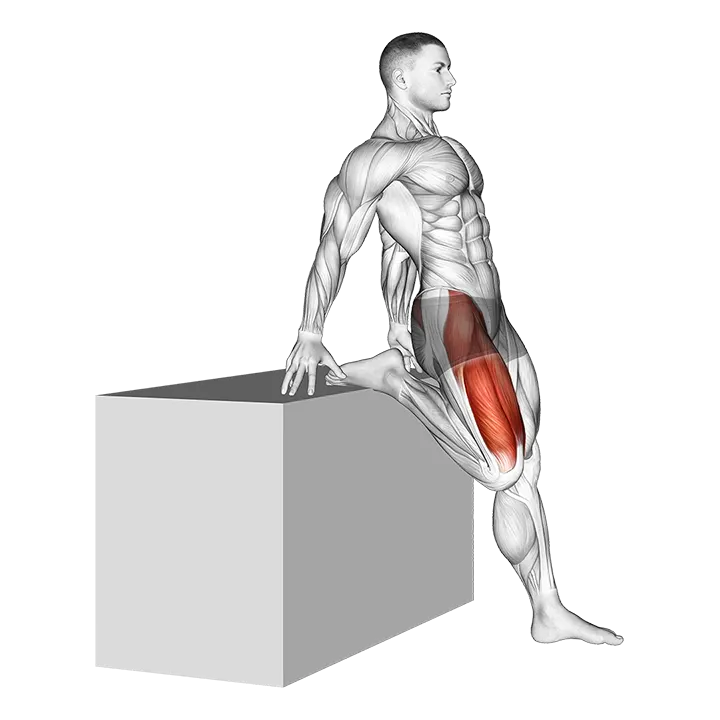
Supported One Leg Standing Hip Flexor And Knee Extensor Stretch
- Target muscle
- —
- Equipment
- Body weight
- Body part
- Thighs
- Type
- Stretching
The supported one leg standing hip flexor and knee extensor stretch is a standing bodyweight stretch that simultaneously lengthens the hip flexors and quadriceps of the rear leg while balance support from a wall or stable surface keeps the movement safe and accessible. It is particularly effective for relieving tightness in the front of the thigh after prolonged sitting or lower-body training sessions.
How to do the Supported One Leg Standing Hip Flexor And Knee Extensor Stretch
- 1Stand facing a wall or sturdy support and place one hand lightly on it for balance.
- 2Shift your weight onto your left foot, keeping the knee soft rather than locked.
- 3Bend your right knee and reach back with your right hand to grasp the top of your right foot or ankle.
- 4Draw your right heel toward your right glute until you feel a stretch along the front of the thigh and hip.
- 5Tuck your pelvis slightly under — posterior pelvic tilt — to deepen the hip flexor portion of the stretch without arching the lower back.
- 6Stand tall with your chest up, shoulders relaxed, and your supporting knee tracking over your toes.
- 7Hold the stretch for 20–40 seconds, breathing steadily throughout.
- 8Slowly release your foot back to the floor, then repeat on the opposite side.
Form tips
- Use the wall only for balance, not to lean your body weight into it — keeping your torso upright maximises the stretch through the hip flexors.
- Actively squeeze the glute of the stretching leg as you hold the position; this increases reciprocal inhibition and allows the hip flexors and quadriceps to relax more fully.
- Keep your knees together or close — letting the stretching knee drift outward to the side reduces tension on the rectus femoris and turns this into a less effective quad stretch.
- Breathe into the stretch and try to deepen it slightly on each exhale rather than forcing a static hold.
Common mistakes
- Arching the lower back to pull the heel closer — this compresses the lumbar spine and shifts the stretch away from the hip flexors, defeating half the purpose of the exercise.
- Leaning heavily into the support surface — forward lean tilts the pelvis anteriorly and reduces the hip flexor component, leaving only a partial quad stretch.
- Allowing the standing knee to lock out straight — a hyperextended support knee adds unnecessary joint stress and makes it harder to maintain balance throughout the hold.
- Gripping the toes instead of the ankle or foot — pulling from the toes forces the ankle into extreme dorsiflexion and can cause foot or ankle discomfort rather than stretching the intended muscles.
- Holding the breath — tension in the torso and hip from breath-holding prevents the hip flexors and quadriceps from fully releasing during the stretch.
Frequently asked questions
What muscles does the supported one leg standing hip flexor and knee extensor stretch target?
This stretch primarily targets the hip flexors — including the iliopsoas and rectus femoris — and the quadriceps of the rear leg. Because the rectus femoris crosses both the hip and knee joints, flexing the knee while extending the hip stretches it along its full length.
How long should I hold this stretch?
Hold each side for 20–40 seconds per repetition. Two to three repetitions per side in a single session is sufficient for most people. For chronic hip flexor tightness, working toward the higher end of that range and repeating the stretch daily will produce the most noticeable improvement over time.
Can I do this stretch if I have knee pain?
Proceed with caution if you have current knee pain. The stretch places the knee joint in deep flexion, which some knee conditions — such as patellar tendinopathy or patellofemoral pain — may not tolerate well. Reduce the range of motion by not pulling the heel fully to the glute, and stop if you feel any pain inside the joint rather than a muscle pull.
When is the best time to do this stretch — before or after a workout?
This stretch is best performed after a workout or as part of a dedicated flexibility session when the muscles are already warm. Using it as static stretching before strength or speed training may temporarily reduce force production. A brief dynamic hip flexor warm-up is more appropriate before lifting or sprinting.
What if I cannot reach my foot while balancing on one leg?
Loop a resistance band, towel, or belt around your ankle and hold the ends with your hand — this extends your reach so you can achieve the same hip and knee position without compromising your balance or rounding your back to compensate.







